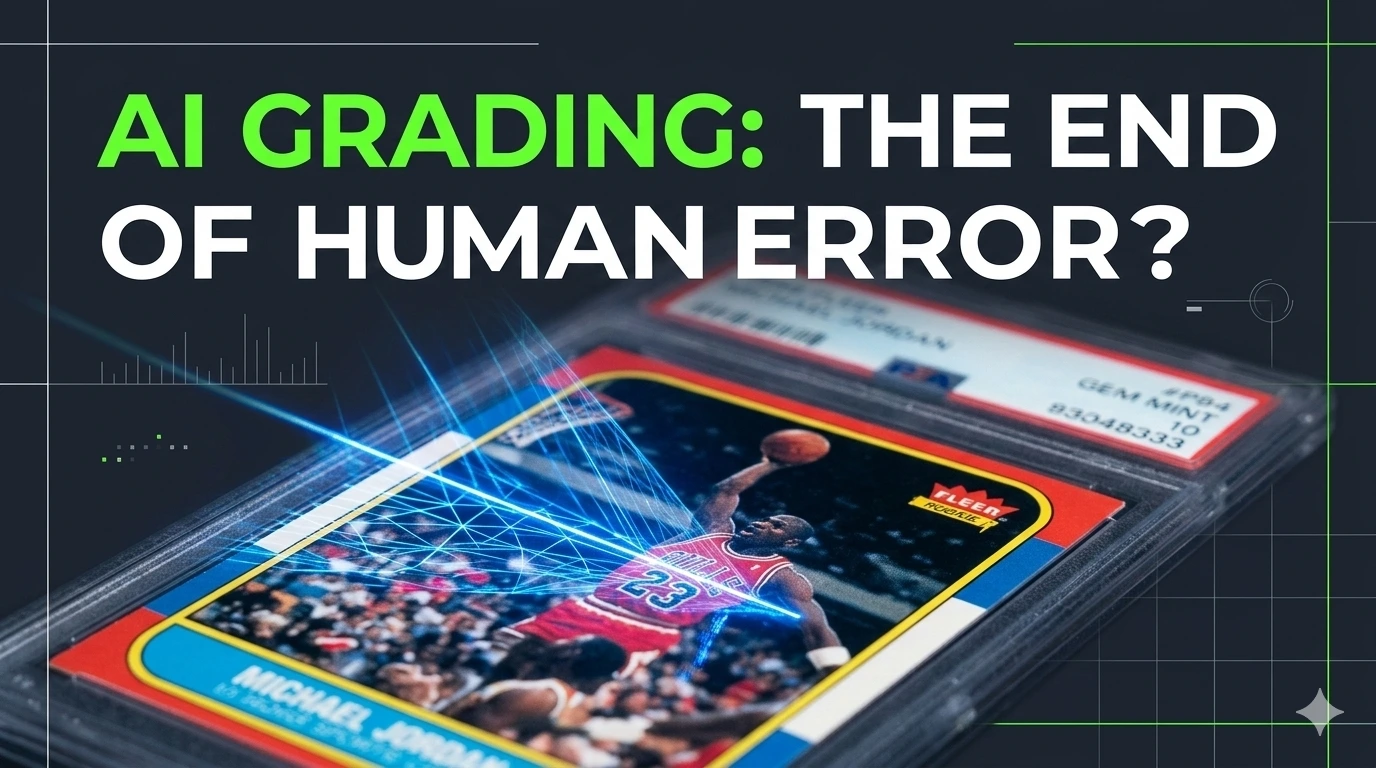
Sports Card Market Trends: What Collectors Should Watch
From grading and AI tools to parallels, Fanatics, and fractional ownership: a clear guide to sports card market trends and how to collect with confidence.
Sports Card Market Trends: What Collectors Should Watch
Think back to the shoebox you kept under your bed or the stack of boxes you kept in the back of your closet. Most of us had stacks of cardboard boxes that we would use to trade for the cardboard player cut-outs we would collect on the playground, and they would give us so much joy. If you haven't engaged in this hobby since you were a kid and used to chew on gum and put the cards in your mouth, you might be surprised to learn that the playground has now been transformed into an ecosystem that functions like Wall Street.
The last several years have seen the level of risk and reward change. When a single 1952 Mickey Mantle card sells for 12 million dollars, which is the price of a luxury mansion, it indicates that sports cards have become a viable financial instrument. This economic sector is now being called "alternative asset classes," which means that sports cards are being put in the same category as stocks, real estate and fine art.
Certain cards maintaining value relates to highly calculated scarcity and value reporting, unlike the Junk Wax era of the 80s and 90s, in which cards flooded the market and subsequently drove value to zero. In the modern era of cards, value is determined using data analytics. In the case of third-party grading, it is the professional appraisal of a card (possibly bringing it from common to rare status) that allows data analytics to come into play.
As long as value is determined in this way, success will come from high-level prediction and analysis of market data, and not simply from knowing that a certain card from a certain Super Bowl-winning team is valuable. Whether it is a specific modern-day rookie card or the market as a whole, cards will only present their true value after market data is analyzed.
TL;DR
- The market is data-driven: Value comes from scarcity, condition, and sold comps—not nostalgia. Use comps and the figoca extension to avoid overpaying.
- Grading turns raw into liquid: Professional slabs from PSA and BGS lock in condition; AI pre-grading helps you decide what to submit.
- Modern rookies = volatile; vintage = stable: Chase upside in active players or store value in established legends; avoid Junk Wax traps.
- Parallels and refractors control scarcity: Numbered cards (/99, /25, /5) and 1-of-1s are the modern answer to overproduction.
- Fanatics is reshaping licensing: MLB, NBA, and NFL are consolidating under one rights-holder; unlicensed cards often depreciate.
- Start with a plan: Set a fun budget, pick a niche, research comps, prefer graded for big buys, and protect your cards. See the 5-step checklist at the end.
How Professional Grading Transformed Cardboard into a "Blue Chip" Asset
Imagine trying to sell a vintage Corvette. A pristine, garage-kept model commands a fortune, while one with a scratched bumper sells for a fraction of the price. Sports cards operate on the same principle, but the difference is determined by third-party experts rather than a mechanic. This process turns a fragile piece of paper into a liquid asset by encasing it in a tamper-proof, hard plastic holder known as a slab.
Once a card is "slabbed," the benefits of professional sports card authentication become clear: the card is protected forever, and its condition is guaranteed. Giants in the industry, such as PSA and Beckett, review the card under magnification and assign it a number that dictates its financial destiny:
- Gem Mint (10): Virtually perfect condition; often worth 10x to 100x the price of a raw card.
- Mint (9): Superb condition with only one very minor flaw.
- Near-Mint (8): An attractive card that shows slight wear upon close inspection.
For a full breakdown of what each grade means, see PSA grades explained.
Beyond the grade itself, value is driven by scarcity. Every graded card is tracked in a public census known as a "Population Report." Savvy collectors spend hours comparing PSA and Beckett grading pop reports to see exactly how many Gem Mint copies exist. If a Michael Jordan card has 5,000 copies in a PSA 10, it is less exclusive, and potentially less valuable, than a LeBron James card with only 50 perfect copies in existence.
Determining how card grading affects market value comes down to certainty. A raw card in a shoebox is a gamble, but a graded card is a verified commodity with a known supply. However, as human graders occasionally make mistakes, technology is stepping in to offer mathematical precision.
Why AI Grading is the New Referee in the Card Market
Waiting months for a human to judge your collectibles is becoming a thing of the past. Just as instant replay changed sports officiating, AI card grading online is introducing mathematical certainty to the hobby. Instead of relying on a subjective opinion that might vary from day to day, these systems use rigid algorithms to enforce a standard that never wavers. This shift addresses the biggest frustration in the market: the fear that a grader's fatigue or mood could mistakenly devalue a pristine asset.
The technology works similarly to advanced medical imaging, but for cardboard. By using a custom card grading scanner, or even a high-res smartphone camera, computer vision analyzes surface integrity, corner sharpness, and centering ratios on a pixel level. This AI card grading technology spots minute imperfections that are unseen by the naked eye. It ensures a "perfect" score is in fact, perfect, and creates a digital fingerprint of the card. It becomes virtually impossible to counterfeit or modify the card without leaving a trace.
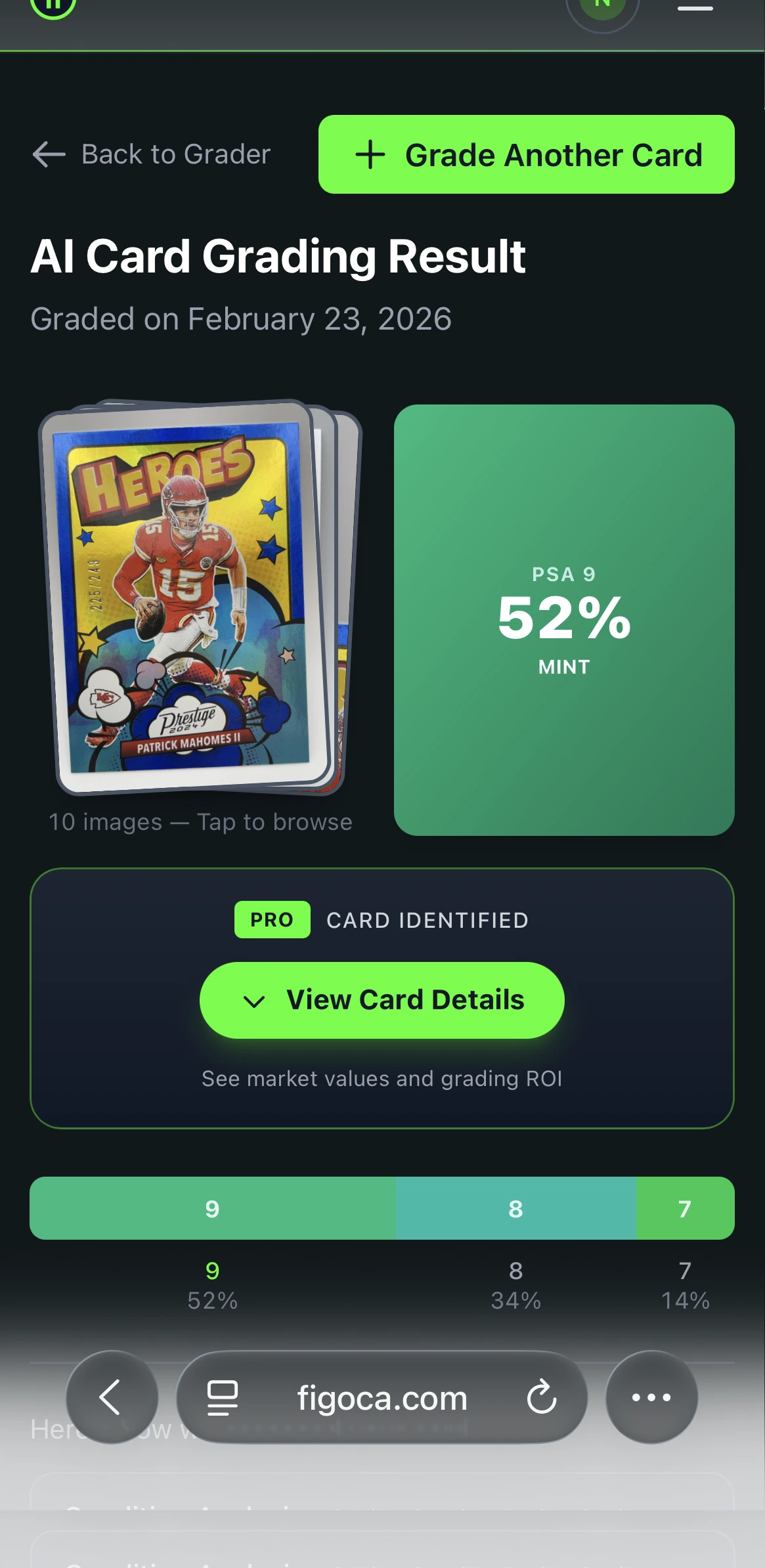
Casual fans can now access this technology from their living rooms before spending a dime on official submission fees. Many collectors use a free AI card grading tool on their mobile devices to "pre-grade" their collection, filtering out damaged items that aren't worth the cost of professional authentication. With the condition of your cards now verifiable in seconds, the only remaining question is which players are actually worth collecting.
AI Card Grader
Know your card's grade before you submit
Snap a photo with your phone and get an instant AI-powered grade estimate. Check centering, corners, edges, and surface — just like the pros.
- Instant grade estimate
- Sub-grades for all 4 pillars
- Built-in ROI calculator
- Free to use
Modern Rookie Cards vs. Vintage Icons: Where the Smart Money is Moving
Investing in sports cards essentially splits into two distinct paths: chasing high-growth potential or securing historical stability. Think of modern rookies like volatile tech stocks that can skyrocket or crash based on a single playoff performance. Conversely, comparing vintage sports cards versus modern wax boxes (unopened packs) reveals a different strategy, akin to buying "blue-chip" stocks or real estate where value appreciates slowly but reliably over time.
Speculating on active players requires nerves of steel because their prices are tied directly to the daily news cycle. When a young superstar like Patrick Mahomes wins a Super Bowl, the investment potential of modern rookie cards surges, often driven by the fear of missing out. However, this creates a "hype tax" where prices inflate aggressively during the season and drop when the spotlight fades, meaning timing the market is just as important as picking the right athlete.
Established legends offer shelter from this weekly turbulence because their careers are already written in stone. A 1952 Mickey Mantle or a 1986 Michael Jordan doesn't need to win another game to prove their worth; they function as a "store of value" because supply is fixed and history cannot change. While they may not double in value overnight, they rarely suffer the catastrophic drops seen when a modern prospect gets injured.
One critical trap for returning collectors is the Junk Wax Era roughly between 1987 and 1994, where companies printed millions of copies of every card. Managing market volatility requires understanding that even a Hall of Fame player's card from this period might be worth pennies simply because too many exist. To fix this oversupply issue, modern manufacturers invented a system to manufacture rarity, turning standard pictures into limited-edition treasures.
Decoding the Rarity: How "Parallels" and "Refractors" Control Demand
The solution card manufacturers came up with to tackle overproduction problems of the Junk Wax era was to not print fewer cards, but instead establish a system of multiple perceived scarcities. Using an analogy of the car market, base-model "mundane" cars are produced at a mass scale, but it is the collector's edition "trims" with special paint jobs and other exclusives that are valued the most. In the same way, there is a base version of each card set, and then there are special "Parallels" that are produced in far fewer numbers to represent the more exclusive versions. Determining whether you have a more exclusive card is usually an exercise in examining the card border for differences in color or texture. If you have an aberration, you may have a more valuable card than first glance suggests.
Refractors are the most well-known type of parallel card. Topps first coined the name "Refractor" in the 1990s to describe cards with a special coating that reflected light. Standard cards of superstar players like Shohei Ohtani usually only sell for a few dollars, but the same card that has been produced in extremely low quantities as a refractor can sell for hundreds.
To determine how rare a card is, see if there is a stamped serial number on it, usually on the back, or on one of the corners of the front. If a card has a stamp saying "10/99," there are only 99 copies of that particular card in existence. Knowing how many copies of each card exist is helpful to determine if there is a bubble in the sports cards market. Unlike the print runs of the 90s that were unknown and opaque, numbered cards provide certainty in regard to the supply.
- Silver/Refractors: beginner level shiny parallels, distinct from the base card, and rare, but achievable.
- Numbered (/99, /25, /5): ultra rare iterations with lower numbers corresponding to exponentially greater value.
- 1-of-1 "Masterpieces": the only one in existence, a "Holy Grail" card for that particular card.
For more on chase cards and odds, read what is a case hit in sports cards.
The Fanatics Takeover: How Exclusive Licensing is Reshaping the Hobby
The recent evolution of parallel cards drew a shift in wide-scale appreciation of rarity pertaining to cards aimed at addressing the issue concerning the origin of cards. Juggling of card brands was imitated due to the fragmentation of the card industry across Topps, Panini, and a host of new entrants. Fanatics, a new player in the industry, has addressed fragmentation in the card industry the same way a new streaming service monopolizes all content owned by a major distributor in a specific industry. Fanatics has entered the card industry after purchasing license rights for the MLB, NBA, and NFL and all other cards are now treated as unofficial in the industry.
In terms of visual and financial impacts, the Fanatics brand is taking the card hobby to a new level altogether. Losing licensing rights due to sponsorship agreements means that the former license holder's cards show players without official team logos. Less serious collectors may appreciate the consolidation, as cards without current licensing often depreciate. As a result, the new rights-holder has simplified a once overwhelming number of brands for novices in the marketplace.
Considering the future, this consolidation hints at a more controlled approach to the hobby. Some purists see a monopoly as a threat, but the prognosis for high-end sports card assets shows consolidation in the buying, selling, and grading of cards, all on one platform. Of course, even with a controlled supply chain and streamlined process, prices will still be highly variable, based on the actual performance of the players.
Navigating the Rollercoaster: Managing Volatility with Data Tools
While corporate giants reshape the industry landscape, the daily price of a specific card still depends entirely on what a buyer is willing to pay at the moment. In the past, collectors relied on monthly price guide magazines, but today's market moves with the speed of the stock exchange. To avoid overpaying, successful buyers look for comps—comparable past sales records—rather than the seller's asking price. Evaluating sports card sales history is the only way to distinguish a fair market deal from an overpriced gamble.
Modern technology has made this research significantly easier for the average fan. Instead of manually searching auction results, you can now use specialized apps that function like stock tickers for athletes, aggregating scattered sales data into clear charts. The figoca extension shows comps and deal signals directly on eBay as you browse. Download the figoca extension to see recent sales and price confidence without leaving the page. Tracking sports card price trends with data tools reveals whether a player's value is spiking due to temporary hype or growing steadily over time. Just as you would review a company's performance before buying shares, checking a card's six-month trend line prevents buying at the peak.
Aside from price trends, every collector should realize that compared to cash or stocks, cards are not as liquid. In the case of the sports card market, liquidity is described as the ease of converting an asset into cash within a short time frame and without a high risk of losing a significant portion of its value. A card graded a perfect 10 of a player like Patrick Mahomes could sell literally in seconds after being listed. In contrast, a card of a player who sells for a dollar might never sell. These cards turn into money very slowly and, as a result, money is tied up in cardboard and collectibles which can be difficult to access in a liquidity crisis.
To mitigate the high entry costs of the market and minimize risk, the market has evolved to provide new options. With the introduction of new technologies, the need for bulky, heavy physical albums is eliminated. Fans can now purchase fractional ownership of high value "grail" cards.
figoca extension
Get card comps on eBay in seconds
See comps directly on eBay listings and search results. Save time, avoid overpaying, and learn faster while you browse.
- Comps inline on item and search pages
- Automatic card detection and parsing
- Fast, privacy-first, and free
- Built for newcomers and hobbyists
For step-by-step workflows on buying and flipping, see how to buy sports cards on eBay and how to flip sports cards.
Owning a Piece of a Legend: The Rise of Fractional Ownership and Digital Hybrids
New technology in fractional co-ownership allows everyday fans to purchase shares in million-dollar collectibles like a 1952 Mickey Mantle card. These honorary cards are considered "Holy Grail" cards and fans can purchase a co-ownership stake for as little as $20. This technology opens up new opportunities for fans, as what was once a hobby dominated by a small number of investors has now become a more level playing field. Fans can now invest in and digitally store "museum" collectibles that were previously kept in shoeboxes.
The actual Mickey Mantle card will not go to the card co-ownership stake owners. Their ownership will be kept in a vault managed by the company to mitigate the risk of fire, theft and damage at home. So the actual Mickey Mantle card will be safe and will not reside with the co-ownership stake card owners. Because of the vault attitude, the storage situation has been a prime proponent in the rapid development of new technologies in the world of cards. With the rise of digital cards and card ownership represented by digital tokens, cards will be able to be stored in a vault and represented via a digital token. These digital tokens can be bought and sold on apps and will be able to be traded like stocks. They will eliminate the need to insure the card and will eliminate mailing cards through the post.
While these high-tech options are alluring, they also add new complications that will require some discipline. Whether you plan to scour a garage sale looking for physical treasures, or purchase digital shares of a legend, success will involve a process.
Your 5-Step Checklist for Starting a Modern Card Portfolio
You can now understand the essence of the hobby and recognize the fascination of the intersection of sports history and contemporary economics. Instead of just viewing the cards as sentimental memorabilia, you can now understand them as living, breathing, changing, and responding to the forces of scarcity, condition, and demand. Ultimately, this is significant as it empowers you to traverse card stores and online auctions with a judgmental perspective as opposed to a hopeful one.
To convert this new understanding into a safe and enjoyable collection, begin with this systematic approach:
- Set a "Fun" Budget: Treat this capital like entertainment money—never spend more than you can afford to keep "parked" in cardboard.
- Choose a Niche: Focus on a specific player or team to build expertise rather than buying randomly.
- Research Comps: Look up "sold" listings on auction sites to confirm you are paying fair market value. Use figoca comps or the figoca extension on eBay to check recent sales quickly.
- Verify Authenticity: For your first serious purchases, stick to graded cards to ensure condition and legitimacy. Learn how to spot fake PSA slabs and use the EV grading calculator to decide if your card is worth grading.
- Secure Storage: Protect your investment immediately with proper cases and a climate-controlled environment. Start with which cards should I sleeve.
Ultimately, the best strategy for managing market volatility is maintaining a genuine connection to the sport. When you prioritize "buying what you love" over chasing quick profits, a market dip never feels like a total loss because you still own a piece of history you cherish. The shoebox under the bed has evolved, and now you have the tools to fill it wisely.
Avoid common pitfalls with 5 mistakes sports card collectors should avoid and 10 secrets every card collector needs to know. When you are ready to grade, see how to submit to PSA and PSA vs CGC vs BGS vs SGC.
figoca extension
Get card comps on eBay in seconds
See comps directly on eBay listings and search results. Save time, avoid overpaying, and learn faster while you browse.
- Comps inline on item and search pages
- Automatic card detection and parsing
- Fast, privacy-first, and free
- Built for newcomers and hobbyists

Card enthusiast, figoca founder, and independent software developer
Nico is a card enthusiast who built figoca after running into the same problems many collectors face: uncertain pre-grading decisions, too much tab switching for comps, and no fast way to price cards on the go. He is also a big Kansas City Chiefs fan (❤️💛), follows the Kansas City Royals (💙), and enjoys Formula 1 and Golf.
- Sports Card enthusiast
- Founder of figoca
- Independent software developer with a TypeScript and AWS background