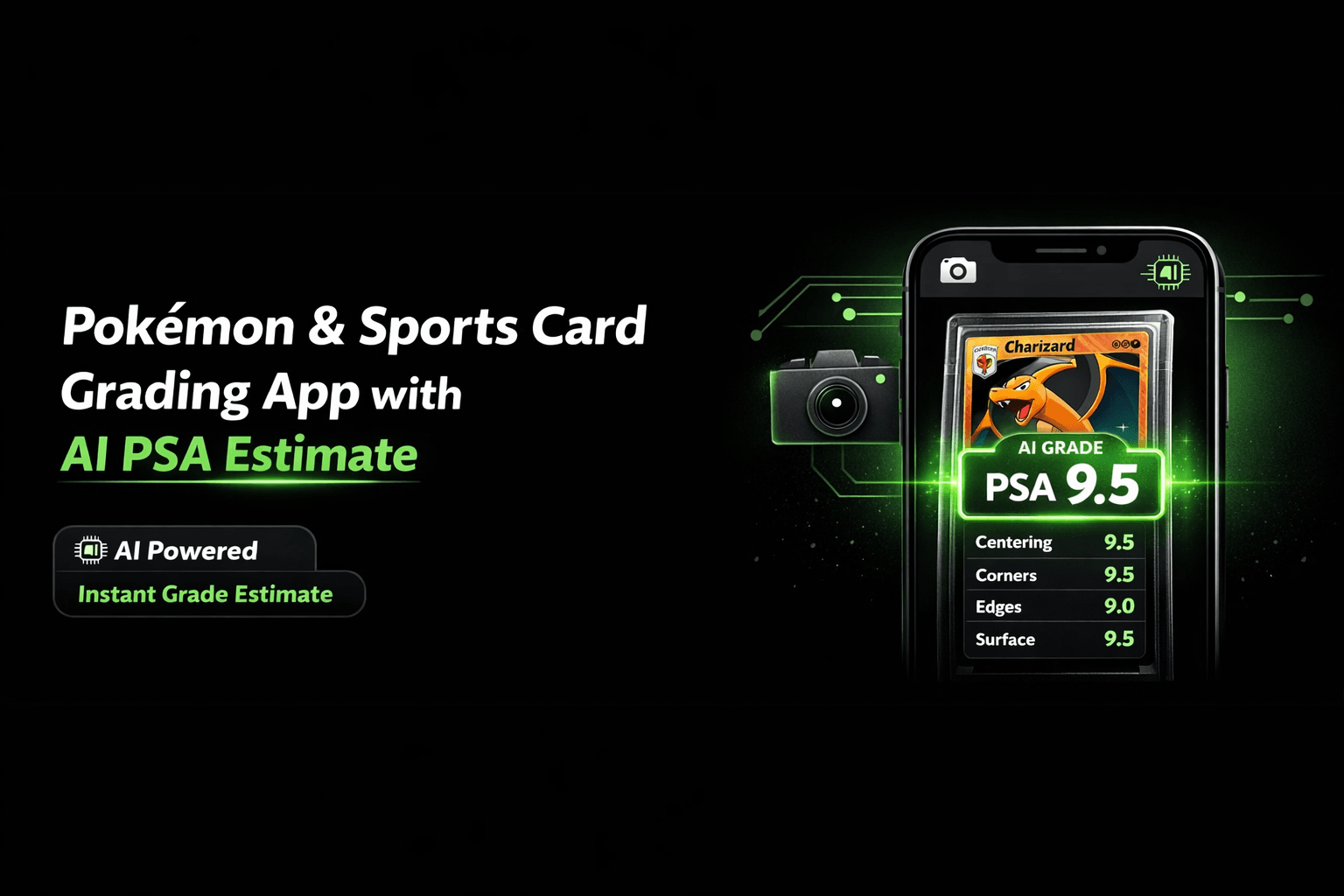
Pokémon & Sports Card Grading App with AI PSA Grade Estimate
Scan Pokémon and sports cards with AI, estimate PSA grades instantly, and decide what to submit before you spend — try the app now.
Pokémon & Sports Card Grading App with AI PSA Grade Estimate
Imagine stumbling upon a shoebox filled with Pokémon cards from 1999. Maybe you heard some stories about similar cards being sold for thousands. But it is impossible to tell which type of cards you have without a trained eye.
In the past you needed years of experience to judge a card’s true condition. Now, an AI card grading app allows you to do that instantly. It turns your smartphone into a professional-grade scanner.
By analyzing surface wear and centering instantly, this technology bridges the gap between raw cards and certified assets. Using a PSA card grading app provides the confidence to know which cards justify professional fees and which should stay in your binder.
AI Card Grader
Know your card's grade before you submit
Snap a photo with your phone and get an instant AI-powered grade estimate. Check centering, corners, edges, and surface — just like the pros.
- Instant grade estimate
- Sub-grades for all 4 pillars
- Built-in ROI calculator
- Free to use
Why Grading Your Rare Cards is a Must: Turning "Pocket Monsters" and "Player Autos" into Financial Assets
Finding a classic Charizard or a rookie sports card feels like winning the lottery, but selling it raw is risky. Grading services act as a birth certificate for your item, authenticating it so buyers know it is genuine. This verification turns a simple collectible into a liquid asset, a step often essential for safe transactions and long-term value preservation.
The financial gap between an ungraded card and one with a high score is often staggering. A raw copy might trade for fifty dollars, while that same item in a perfect "10" grade could command thousands. Tools that help with grading expected value make this difference easier to understand by showing when grading fees may actually be worth it.
Security also extends to physical protection through encapsulation, which seals the card in a hard, tamper-evident plastic case. This slab shields your asset against humidity, dust, and accidental bends. Before submitting, many collectors now use digital pre-grading to decide if a card truly deserves this level of investment.
Once encased, the grade is final, yet predicting that number used to be a guessing game. Today, AI is transforming card grading by looking closer than a human ever could.
How AI Computer Vision Spots Micro-Scratches on Holographic Cards
Reflecting light from a desk lamp can make it seem like a holographic card is warped or distorted. While humans can easily notice major flaws like a damaged corner, many surface issues such as holo scratches, print lines, and factory imperfections are much harder to detect. This is where AI-powered card scanning replaces uncertainty with measurable visual analysis.
Instead of evaluating the card as one object, the AI inspects it pixel by pixel, similar to how a jeweler inspects a diamond. It compares the card against thousands of similar examples to identify tiny surface defects that most collectors would miss at first glance.
To get that precise, the digital eye uses three primary detection methods:
- Pixel-Level Scan: Assesses the surface for color variations that the human eye cannot easily detect.
- Holographic Glare Filtering: Reduces reflections to access the real surface texture of the card.
- Edge Contrast Detection: Recognizes roughness, whitening, and uneven cuts along the card’s borders.
This level of analysis is why AI can spot issues even when a card looks perfect at first glance. But surface condition is only one part of grading. To judge whether a card could realistically earn a high grade, geometry matters too.
Mastering the Four Pillars of Condition: How to Use a Digital Centering Tool to Spot a PSA 10 Candidate
A card pulled straight from the pack is not automatically a PSA 10. Professional grading is typically based on four core condition categories. If you want to know whether your card is a true gem mint candidate, you need to understand these four pillars:
- Centering: The alignment of the card inside the borders.
- Corners: The sharpness of all four corners.
- Edges: The smoothness and cleanliness of the cuts.
- Surface: The condition of the front and back, including gloss, scratches, and print defects.
Think of a picture frame where the photo is pushed too far to the left. That is poor centering, and it is one of the most common invisible flaws collectors miss. A digital centering tool removes the guesswork and helps show whether the borders are truly balanced. If you want a deeper overview of what different grades actually mean, see this guide on PSA grades explained.
Edges and corners are often the first areas to show physical damage. Whitening, soft corners, and rough cuts can quickly knock a card down from gem mint territory to something much more ordinary. A single flaw in these areas can have an outsized effect on both the final grade and the card’s resale value.
That is why AI pre-grading is so useful. It gives collectors a way to filter likely submissions before spending money. Instead of guessing, you can identify which cards are worth grading and which are better left as raw copies.
Save $20 per Card by Pre-Grading at Home: When to Submit to PSA and When to Keep It Raw
Finding a valuable card is exciting, but grading fees can eat into profits very quickly. Before mailing anything out, you need to think in terms of cost versus expected return. Spending money to grade a card only makes sense if the likely final value justifies the submission.
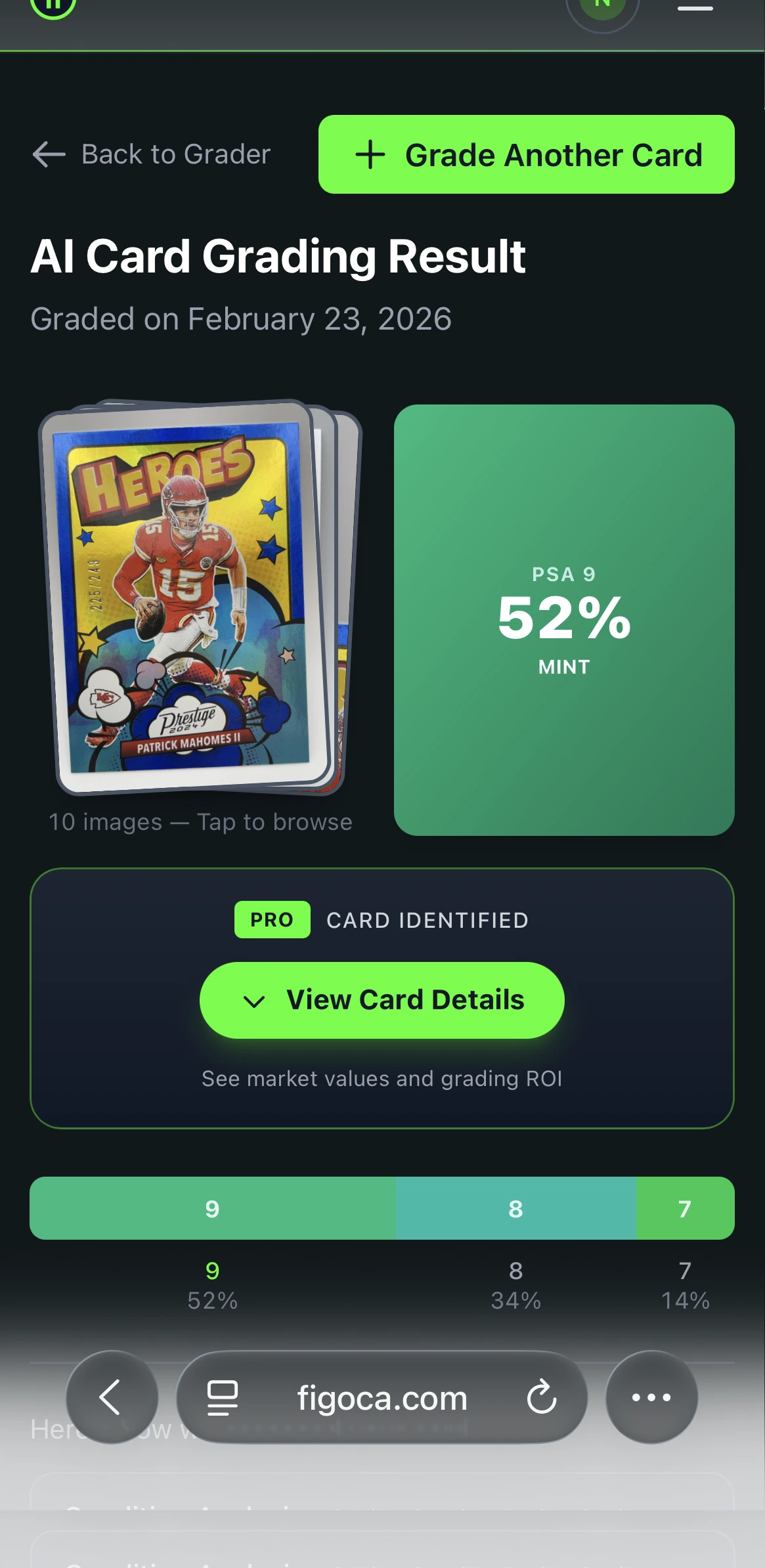
This is exactly why collectors use AI estimates before they submit. If the scan suggests a likely Grade 7, the market value may not improve enough to cover the grading fee. In that case, it can make more sense to keep the card raw. This idea is covered well in the card grading 80 dollar rule.
Different grading companies also view flaws differently. Some may punish centering more heavily, while others may be stricter on edges or surface issues. If you are comparing options, this guide on PSA vs CGC vs BGS vs SGC is a useful starting point, and you can also browse the full list of grading companies or go directly to the PSA grading company page.
Once you identify the cards that justify the cost, the next step is handling submission properly. That includes cleaning the card carefully, using the correct sleeves and semi-rigid holders, and filling out the forms correctly. For that process, follow this step-by-step PSA submission guide.
If you are still unsure which cards are worth sending in at all, this guide on how to select cards to submit for grading and this article on whether your card is worth grading pair especially well with AI pre-grading.
A 3-Step Plan for Instant Trading Card Grading Success
You no longer need to guess if a card is a hidden gem or just a keepsake. By using a high-resolution AI card grading app, you turn subjective questions into objective data. This bridges the gap between casual collecting and informed decision-making.
Start optimizing your collection today with this simple workflow:
- Scan: Capture your card for an instant trading card grading estimate.
- Sort: Use grading expected value tools and your own inventory process to flag the best candidates.
- Submit: Send only the strongest cards to PSA to save on fees and improve your grading ROI.
While AI predictions are guides rather than guarantees, they provide a practical roadmap for navigating the market with more confidence. Scan your first card today with the figoca AI Card Grading App and make smarter grading decisions before you spend.

Card enthusiast, figoca founder, and independent software developer
Nico is a card enthusiast who built figoca after running into the same problems many collectors face: uncertain pre-grading decisions, too much tab switching for comps, and no fast way to price cards on the go. He is also a big Kansas City Chiefs fan (❤️💛), follows the Kansas City Royals (💙), and enjoys Formula 1 and Golf.
- Sports Card enthusiast
- Founder of figoca
- Independent software developer with a TypeScript and AWS background