Online AI Card Grader – Predict Trading Card Grades Fast
Use an online AI card grader to predict trading card grades fast, spot top candidates, and avoid bad submissions—try it now.
Finding old trading cards still gives collectors a rush. Maybe you discovered a holo Pokémon card in a drawer, a rookie card in a forgotten binder, or a rare limited-edition card you tucked away years ago. Moments like that instantly raise the same question: is this card actually worth grading?
That is where an online AI card grader becomes valuable. Professional grading services often charge $20 to $50 or more per card, and sending cards in blindly can quickly turn into a losing bet. A card that looks clean to the naked eye may still come back with a mid-tier grade that does not justify the submission cost.
Instead of guessing, collectors can now use an AI card grading app to pre-screen cards at home. These tools analyze condition before submission and help you decide which cards are worth sending to PSA and which ones are better left raw.
AI cannot replace official grading companies, but it can reduce unnecessary submissions, improve decision-making, and help collectors protect their budget. For Pokémon cards, sports cards, and other collectibles, AI pre-grading is becoming an essential part of modern collecting.
The Rising Importance of AI in Trading Card Collecting
Over the last decade, the trading card market has grown dramatically. Cards that once sold for a few dollars can now be worth hundreds, thousands, or even more depending on rarity, demand, and condition. As prices rose, grading became one of the most important factors in determining value.
The challenge is that flaws are often difficult to spot. A collector may think a card looks perfect, while a grading company finds enough issues to assign a much lower score. In card collecting, tiny details matter.
Professional grading offers trust and standardization, but it also comes with real drawbacks:
- High grading fees
- Long turnaround times
- Subjective outcomes
- Financial risk on low-grade submissions
That is why AI grading tools are gaining traction. Instead of paying for every submission upfront, collectors can use digital pre-grading to estimate condition first. This makes it easier to spend money only on cards with a realistic chance of producing a strong return.
If you are still deciding whether grading is worth it at all, this guide on whether your card is worth grading is a strong companion resource.
AI Card Grader
Know your card's grade before you submit
Snap a photo with your phone and get an instant AI-powered grade estimate. Check centering, corners, edges, and surface — just like the pros.
- Instant grade estimate
- Sub-grades for all 4 pillars
- Built-in ROI calculator
- Free to use
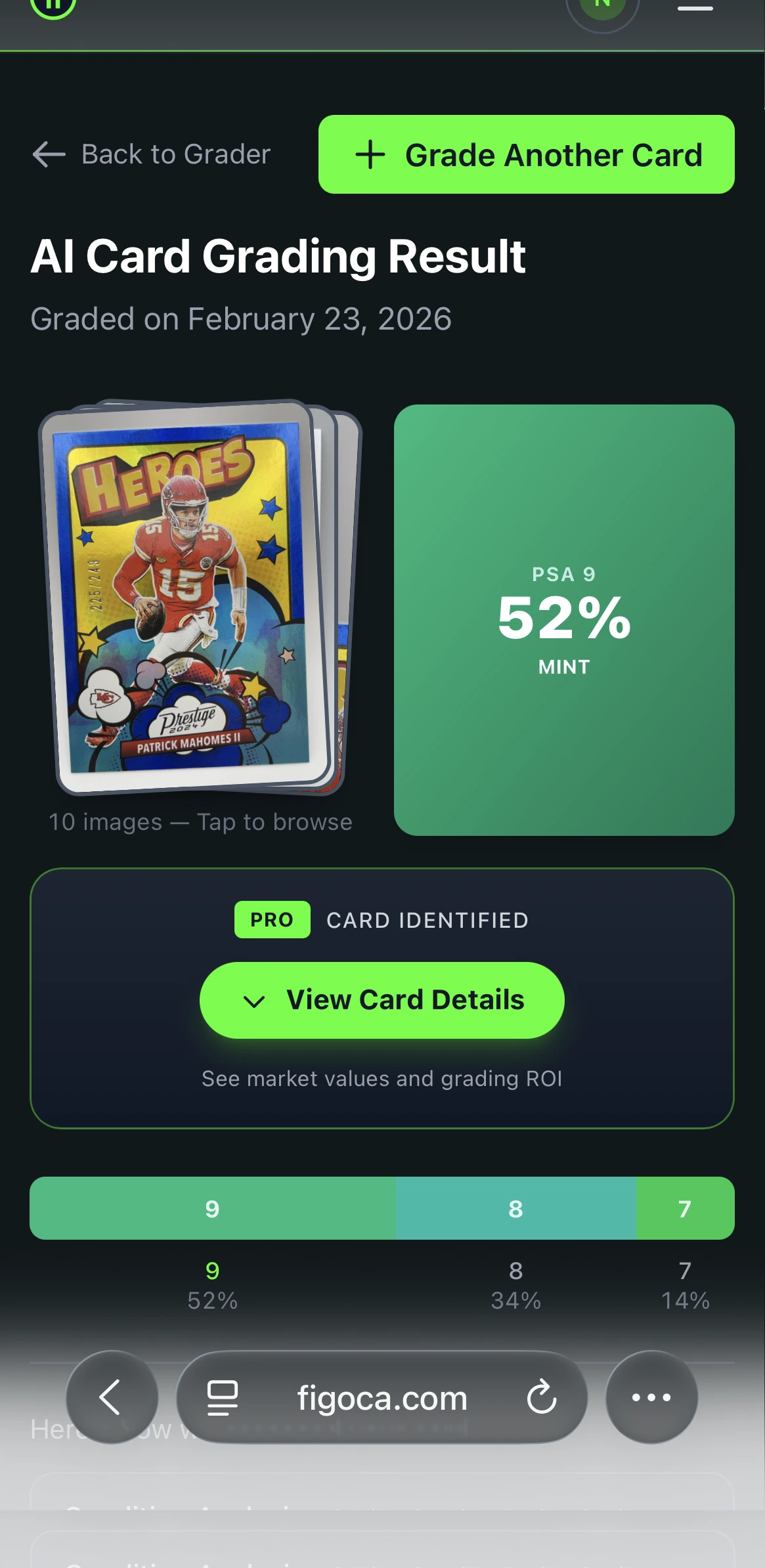
How AI “Sees” Your Card: Mastering the Four Pillars of Condition
Collectors often miss tiny flaws because they see what they want to see. A card may look flawless from a distance, but under closer inspection, issues like whitening, scratches, edge chipping, or bad centering become obvious.
An AI card grader treats each card image like a data map. It analyzes pixels for color, brightness, contrast, and texture, then compares the scan against reference patterns to identify flaws. Most systems evaluate cards using the same four major condition categories that professional graders focus on.
Centering
Centering refers to how the printed image aligns within the card’s borders. Ideally, the spacing is balanced on all sides. Even a slight imbalance can reduce the final grade.
AI tools evaluate centering by:
- Measuring border width on all four sides
- Calculating symmetry ratios
- Detecting image misalignment patterns
This is one of the areas where AI performs especially well because exact measurements matter. If you want more context on how grading scales work, see PSA grades explained.
Corners
Corners are highly sensitive to wear. Small bends, fraying, or softening can be easy to miss, especially on older cards.
AI systems inspect corners by looking at:
- Corner symmetry
- Pixel density near the tips
- Signs of rounding or fraying
- Tiny folds or bends
The sharper the corners remain, the better the card’s grading potential.
Edges
Even a card with strong centering and sharp corners can lose points because of edge issues. Common problems include:
- Whitening
- Chipping
- Small dents
- Micro tears
- Surface friction along the perimeter
AI tools scan the full perimeter of the card and flag irregularities in shape and color. Edge flaws are especially common on frequently handled cards or cards that were stored poorly.
Surface
Surface is often the most difficult part of grading. A card’s surface can show scratches, print lines, stains, dents, and creases, all of which affect the final grade.
AI evaluates surface condition using techniques such as:
- Texture recognition
- Reflection analysis
- Light contrast detection
- Pattern recognition
Surface flaws are often the deciding factor between a good grade and a great one. This is one reason why many collectors now use an AI trading card grading tool before submitting expensive cards.
The Unique Challenge of Holographic and Foil Cards
Holographic Pokémon cards and refractor sports cards are especially difficult to evaluate because their reflective surfaces can hide flaws depending on the viewing angle. Scratches, dents, and print issues may disappear under one light source and become obvious under another.
AI grading tools address this by analyzing brightness, contrast, and texture patterns across the card image. This type of optical analysis helps identify flaws that are harder to catch casually, especially on foil surfaces.
That makes AI especially useful for collectors dealing with shiny modern inserts, holo Pokémon cards, and chromium-style sports cards. It gives you a more consistent way to review condition before spending money on professional grading.
From Guessing to Strategic Collecting
Before AI grading tools became common, many collectors relied on instinct. They submitted batches of cards hoping a few would gem. Sometimes that worked, but often it meant wasting money on cards that never had strong grading upside.
AI pre-grading supports a more strategic workflow. Instead of relying on hope, you can evaluate risk before you submit.
When reviewing an AI grade prediction, do not treat it as an official final grade. Treat it as a probability-based estimate. The most useful questions are:
- Which parts of the card look problematic?
- How likely is the card to reach a high grade?
- Is the expected upside worth the grading fee?
This is also where an EV grading calculator becomes helpful. It lets you compare likely outcomes against submission cost and market value.
For a more detailed framework, this article on how to select cards to submit for grading fits perfectly here.
Saving Money by Pre-Screening Your Collection
AI grading can have a major impact on collecting costs. Grading a large batch of cards gets expensive fast. At $20 to $50 per card, even a modest submission can cost hundreds of dollars.
That only makes sense if the cards have a realistic chance of earning grades that justify the expense.
Pre-screening with AI helps collectors avoid paying to grade cards that are unlikely to perform well. That means:
- Fewer wasted submission fees
- Better grading ROI
- Stronger card selection
- More efficient collection management
Collectors who want a simple rule of thumb should also read the card grading 80 dollar rule, which pairs well with AI pre-screening.
Speed and Convenience in the Modern Collecting Era
Traditional grading can take weeks or months. For collectors who buy, sell, and trade actively, that delay slows everything down.
An online AI card grader makes it possible to evaluate cards in seconds. That speed is useful in situations like:
- Buying cards at a convention or card show
- Reviewing auction listings
- Sorting large personal collections
- Deciding whether to sell raw or submit for grading
This kind of immediate feedback helps collectors make faster and more informed decisions, especially when market values are moving quickly.
If your next step is a real submission, this step-by-step PSA submission guide is the best internal follow-up.
The Future of AI in Card Grading
Artificial intelligence is still evolving, and its role in the hobby continues to grow. Future AI grading systems may include:
- Multi-angle scanning
- Real-time grading during live sales
- Market value predictions tied to condition
- Deeper marketplace integrations
As datasets improve and image analysis becomes more sophisticated, AI grading tools should become even more accurate. Official grading companies will remain the final authority, but AI will continue to be a powerful first step in the grading process.
Collectors comparing different companies may also want this overview of PSA vs CGC vs BGS vs SGC and the broader grading companies hub.
Your Blueprint for Maximizing Collection Value
Serious collectors know that success is not just about luck. It is about making smart decisions, managing risk, and using better tools.
An AI card grading app acts like a gatekeeper for your collection. It helps you identify which cards have high grading potential and which do not. That allows you to:
- Screen your collection in advance
- Avoid unnecessary grading fees
- Spot the best submission candidates
- Make smarter buying and selling decisions
Instead of relying on guesswork, use technology to make a more informed call. Scan your best cards, get an instant grade estimate, and start building a smarter grading strategy with the figoca AI card grader.
AI Card Grader
Know your card's grade before you submit
Snap a photo with your phone and get an instant AI-powered grade estimate. Check centering, corners, edges, and surface — just like the pros.
- Instant grade estimate
- Sub-grades for all 4 pillars
- Built-in ROI calculator
- Free to use

Card enthusiast, figoca founder, and independent software developer
Nico is a card enthusiast who built figoca after running into the same problems many collectors face: uncertain pre-grading decisions, too much tab switching for comps, and no fast way to price cards on the go. He is also a big Kansas City Chiefs fan (❤️💛), follows the Kansas City Royals (💙), and enjoys Formula 1 and Golf.
- Sports Card enthusiast
- Founder of figoca
- Independent software developer with a TypeScript and AWS background