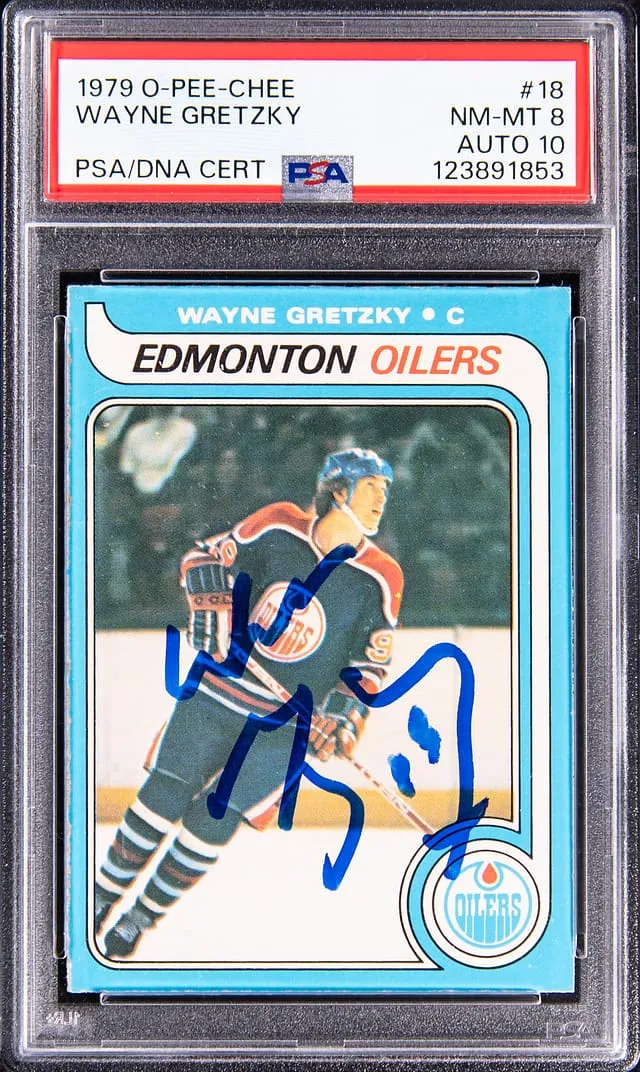
Wayne Gretzky 1979 OPC Signed Rookie PSA 8 Sells for $62K
Goldin sold a 1979-80 O-Pee-Chee #18 Wayne Gretzky signed rookie, PSA 8 with PSA/DNA 10 auto (Pop 6), for $62,220. Here’s what the sale means for collectors.
Sold Card
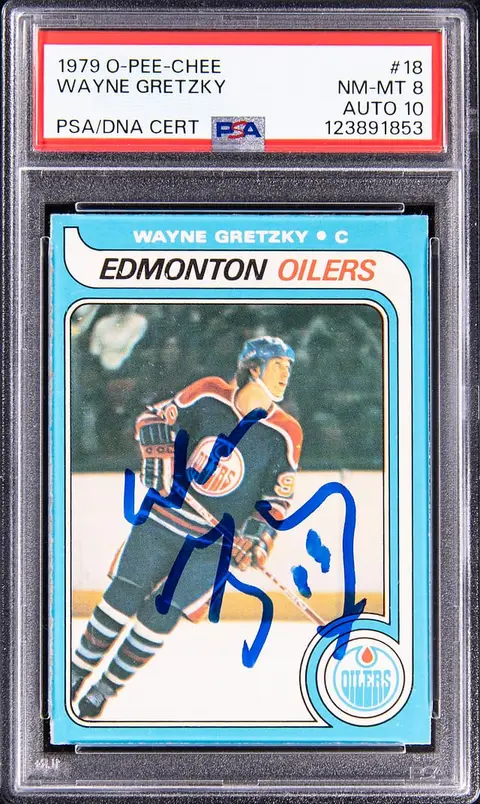
1979-80 O-Pee-Chee #18 Wayne Gretzky Signed Rookie Card - PSA NM-MT 8, PSA/DNA GEM MT 10 - Pop 6
Sale Price
Platform
Goldin1979-80 O-Pee-Chee Wayne Gretzky Rookie Auto Sets a Calm Benchmark at Goldin
On March 8, 2026, a key piece of hockey history quietly changed hands. Goldin auctioned a 1979-80 O-Pee-Chee #18 Wayne Gretzky Signed Rookie Card, graded PSA NM-MT 8 with a PSA/DNA GEM MT 10 autograph, for $62,220.
For collectors who track the long-term story of blue-chip cards, this result adds another useful data point to one of the most followed markets in vintage hockey.
The Card: 1979-80 O-Pee-Chee #18 Wayne Gretzky Rookie
Let’s start with what this card actually is:
- Player: Wayne Gretzky
- Team: Edmonton Oilers
- Year / Set: 1979-80 O-Pee-Chee Hockey
- Card number: #18
- Status: True flagship rookie card (first mainstream NHL card of Gretzky)
- Attributes: On-card autograph, PSA/DNA-certified
- Card grade: PSA NM-MT 8 (Near Mint–Mint)
- Autograph grade: PSA/DNA GEM MT 10
- Population: PSA/DNA GEM MT 10 auto on a PSA 8 copy is reported at Pop 6 (six copies in this exact configuration).
The 1979-80 O-Pee-Chee Gretzky is widely viewed as the iconic hockey rookie of the modern collecting era. It comes from a Canadian-printed set noted for rougher cardstock and centering issues, which makes high-grade examples noticeably tougher than their Topps counterparts.
Layering a GEM MT 10 autograph on top of a strong PSA 8 copy creates a niche within the broader rookie market: a vintage flagship rookie that also satisfies modern demand for premium, certified ink.
Why This Card Matters to Collectors
Collectors gravitate to this card for several reasons:
All-time player: Wayne Gretzky is commonly regarded as the greatest hockey player ever. His longevity, records, and cultural footprint give his rookie a long horizon of relevance.
Flagship rookie: When we say “flagship,” we mean the main, widely recognized base rookie card from a player’s first mainstream set. For Gretzky, the O-Pee-Chee #18 is that card.
Vintage era scarcity: Late-1970s O-Pee-Chee isn’t ultra-rare, but it’s far from the overproduced “junk wax” era. High-grade cards are constrained by production quality (rough cuts, off-centering, print defects) and decades of handling.
Autographed vintage rookie: Gretzky signed many items throughout his career, but a PSA-certified on-card signature on an original 1979-80 O-Pee-Chee rookie that still grades PSA 8 is a more selective lane than signed modern inserts.
Grading and autograph combo: A PSA 8 card grade combined with a PSA/DNA 10 autograph grade puts this in the upper tier of eye appeal. The Pop 6 figure for this exact combo underscores that it’s not something you can easily replace on demand.
Market Context: Where Does $62,220 Fit In?
In hobby shorthand, “comps” are recent, comparable sales that help us understand where a card has been trading. While exact figures move over time, we can outline how this sale fits among closely related versions of the Gretzky O-Pee-Chee rookie.
Raw and unsigned graded copies
Unsigned copies of the 1979-80 O-Pee-Chee Gretzky in recent years have generally fallen into rough tiers:
- Mid-grade (PSA 4–6): A more accessible entry point, with prices varying widely based on centering and eye appeal.
- Upper mid-grade (PSA 7–8): Noticeably stronger cards; prices move meaningfully with small shifts in grade and visual quality.
- High grade (PSA 9 and above): Sharp copies can command very large premiums due to true scarcity.
Against that backdrop, an autographed PSA 8 with a gem 10 auto naturally sits in a more specialized, premium lane than an unsigned PSA 8.
Signed PSA 8 / PSA/DNA 10 lane
Within the signed Gretzky rookie space, there are several important variables:
- Whether the card is O-Pee-Chee or Topps
- The underlying card grade (7 vs. 8 vs. 9, etc.)
- Whether the autograph is on-card and where it is placed
- Autograph grade (often 9 vs. 10)
A PSA 8 / PSA/DNA 10 O-Pee-Chee with only six copies in the population sits toward the upper end of this matrix. While there may be higher graded signed copies (for example PSA 9 with strong autos), the Pop 6 figure puts this particular configuration into a relatively thin supply band.
At $62,220, the Goldin sale lands in what can reasonably be viewed as the serious collector tier: significant, but not in the record-chasing territory we see for the very highest-graded unsigned examples.
Rather than representing a wild spike, the price fits comfortably into an emerging pattern where:
- Unsigned high-grade copies remain the main benchmark for the rookie’s overall market.
- Premium signed copies trade at a meaningful but measured premium to unsigned equivalents, reflecting both the added autograph and the smaller pool of certified, high-grade examples.
Pop Report and Scarcity: What “Pop 6” Tells Us
A “pop report” (population report) is a grading company’s count of how many copies of a specific card-and-grade combination exist in their system.
For this card:
- PSA 8 as a grade on the 1979-80 O-Pee-Chee Gretzky rookie is already not trivial to achieve.
- Adding an on-card autograph that still earns a PSA/DNA 10 means the card had to survive:
- Original printing and distribution issues
- Decades of storage
- A signing event that did not damage the card
- The scrutiny of both card and autograph graders
With only six PSA 8 copies carrying a GEM MT 10 auto, each sale is less about day-to-day price discovery and more about whether the right collector was in the room that day. That low population naturally introduces some volatility in sale-to-sale results, but it also helps explain why well-centered, strong-looking copies attract attention when they surface.
Why an Autographed Rookie, Not Just a Rookie?
Some collectors prefer their iconic rookies clean and unsigned; others specifically chase ink. This card sits at the intersection of both philosophies:
- It satisfies the desire for the original, period-correct rookie from Gretzky’s playing days.
- It layers on a modern expectation for high-end pieces to feature an authenticated signature.
From a collecting standpoint, a PSA/DNA 10 auto often signals:
- Strong pen pressure and clarity
- No major streaking, fading, or smudging
- Good placement that does not overly obstruct the portrait or key design elements
That attention to autograph quality is a big part of why some hobbyists are comfortable paying a premium for these combo-graded cards compared with unsigned counterparts.
Where This Fits in the Broader Gretzky Market
The Gretzky market has had a long run of visibility:
- Headline sales of top-graded unsigned O-Pee-Chee rookies have periodically made news, anchoring the card as a blue-chip within hockey.
- Autographed vintage pieces have evolved from being a niche to a well-defined segment, especially when paired with grading and authentication from PSA and similar companies.
This March 8, 2026 Goldin result doesn’t rewrite the story of the Gretzky rookie, but it does:
- Reinforce that high-end, certified signed copies continue to clear strong five-figure levels.
- Offer another reference point for collectors comparing unsigned PSA 8s to signed PSA 8 / auto 10 examples.
- Highlight the ongoing role of major auction houses in surfacing low-population vintage pieces.
Takeaways for Different Types of Collectors
Whether you’re just getting familiar with Gretzky rookies or you’ve tracked them for years, there are a few practical lessons in this sale.
For newer or returning collectors
- Know the key versions. Distinguish between O-Pee-Chee and Topps, and between unsigned and signed copies.
- Look beyond the number grade. Centering, surface and autograph quality can create big differences within the same numerical grade.
- Use comps as guides, not promises. Recent sales like this one are reference points, not guarantees of future prices.
For active hobbyists and small sellers
- Document the card thoroughly. For autographed vintage rookies, clear scans or photos showing both the card and the signature matter.
- Pay attention to label details. A PSA 8 with a PSA/DNA 10 auto is not the same as a PSA 8 with an ungraded or lower-grade autograph. Those label lines drive both desirability and comps.
- Track auction results over time. One result at $62,220 is part of a trend, not the trend by itself. Watching how similar Pop 6 or close-pop examples perform across different venues can provide a more balanced view.
Final Thoughts
The March 8, 2026 Goldin sale of the 1979-80 O-Pee-Chee #18 Wayne Gretzky Signed Rookie Card, PSA 8 with a PSA/DNA 10 autograph (Pop 6) is a clear, data-backed reminder that:
- The Gretzky O-Pee-Chee rookie remains one of the cornerstone cards in hockey.
- High-grade, certified signed copies occupy a distinct and tightly supplied niche.
- Serious collectors are still willing to pay strong five-figure prices for the right combination of grade, autograph quality, and provenance.
For collectors who think in decades rather than days, it’s another steady chapter in the ongoing story of one of the hobby’s most important vintage rookies.