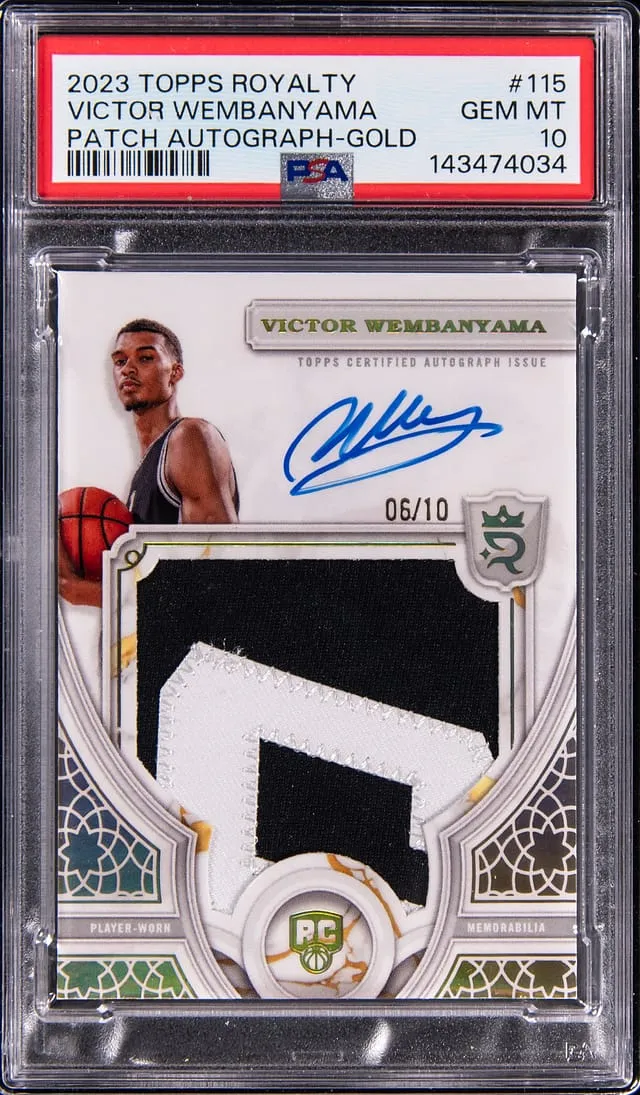
Victor Wembanyama Topps Royalty Gold RPA /10 PSA 10 Sale
Goldin sold a 2023-24 Topps Royalty Victor Wembanyama Gold RPA /10 PSA 10 (Pop 2) for $24,644. Figoca breaks down the card’s market and collector context.
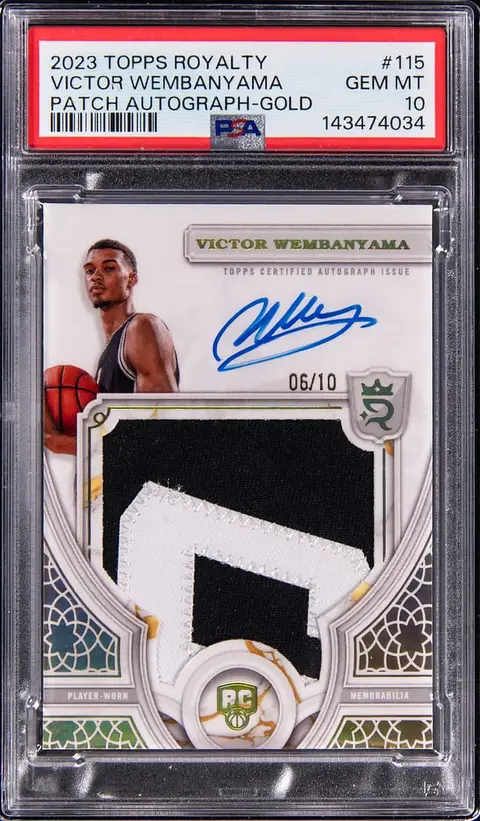
Sold Card
2023-24 Topps Royalty Rookie Patch Autograph (RPA) Gold #115 Victor Wembanyama Signed Patch Rookie Card (#06/10) - PSA GEM MT 10 - Pop 2
Sale Price
Platform
Goldin2023-24 Topps Royalty Rookie Patch Autograph (RPA) Gold #115 Victor Wembanyama Signed Patch Rookie Card (#06/10) - PSA GEM MT 10 - Pop 2
Sale overview On March 15, 2026, Goldin sold a 2023-24 Topps Royalty Rookie Patch Autograph Gold #115 Victor Wembanyama, serial numbered 06/10, graded PSA GEM MT 10, for $24,644. For clarity:
- Player: Victor Wembanyama (San Antonio Spurs)
- Year: 2023-24
- Set: Topps Royalty
- Card: Rookie Patch Autograph (RPA) Gold parallel #115
- Serial number: 06/10
- Autograph: signed (sticker or on-card as issued by Topps Royalty)
- Memorabilia: multi-color rookie jersey patch
- Grading: PSA GEM MT 10
- Population: Pop 2 (only two PSA 10 copies recorded at the time of sale)
- Auction house: Goldin
- Sale date: 2026-03-15 (UTC)
- Realized price: $24,644 (USD)
In hobby terms, this is a low-serial-numbered Wembanyama rookie patch autograph from a premium Topps basketball release, with one of the highest possible grades and extremely few copies in that grade.
Why this Wembanyama RPA matters
Rookie Patch Autograph (RPA) cards combine three elements that modern collectors tend to focus on:
- Rookie status: A player’s first-year cards are called rookie cards. For ultra-modern stars like Wembanyama, the most desirable rookies are typically on-card autos, RPAs, and key chromium parallels.
- Patch memorabilia: Patch cards include a swatch of game-worn or player-worn jersey. Multi-color and interesting patch windows tend to draw more attention because they visually separate high-end cards from plain jersey pieces.
- Autograph: A signed card, especially from a player with as much attention as Wembanyama, adds a layer of desirability. Collectors often prioritize authenticated pack-issued autos like this one.
On top of that, this is the Gold parallel, serial-numbered to just 10. Low-serial-numbered cards (often called “short prints” or “low-numbered parallels”) are attractive because collectors can quickly see how few copies exist. At only ten copies worldwide, the Gold RPA sits close to the top of the rarity ladder for this particular card.
PSA GEM MT 10 and population context
This copy is graded PSA GEM MT 10 by Professional Sports Authenticator (PSA), which is their highest standard grade for modern cards. GEM MT 10 generally indicates:
- Sharp corners
- Clean edges
- Centering within PSA’s Gem Mint tolerance
- A clean surface with essentially no visible flaws under normal viewing
The population report (often shortened to “pop report”) tells you how many copies of a specific card have received each grade from a grading company. This Wembanyama is listed as Pop 2, meaning only two examples of this exact card have achieved PSA 10 at the time of this sale.
For a card that is already limited to ten serial-numbered copies, a Pop 2 at PSA 10 underlines how narrow the supply is at the very top condition tier. Not every one of the ten raw copies will surface, and not all of them will achieve a Gem Mint grade.
Where this sale sits in the current market
Because Topps Royalty is a relatively new basketball release and Wembanyama is an ultra-modern player, sales data is still forming a pattern rather than reflecting a long history. What we can say with confidence:
- Low-numbered Wembanyama rookie autos and RPAs across high-end products have generally commanded five-figure prices when they present well and feature strong patches.
- Within an individual product line, Gold parallels numbered to 10 typically sit a tier below true one-of-ones or ultra-premium logo patch versions, but still at the high end of the hierarchy.
- PSA 10 examples tend to sell at a premium to ungraded or lower-grade copies, especially when the population at that grade is small.
Looking at related Wembanyama rookies over the past year and a half from major marketplaces and auction houses, we see a few patterns:
- Similar low-numbered RPAs from other premium 2023-24 sets have often landed in low-to-mid five figures, with outliers higher when the patch, brand, or card design stands out.
- Serial-numbered autograph parallels /10 without patches usually trail patch autos, but still contribute useful comparison points for pricing trends.
- In some cases, BGS or PSA 9 copies of comparable Wembanyama RPAs have sold significantly below top-grade examples, reinforcing the separation between Gem Mint and the rest of the grade curve.
Within that context, $24,644 for a Topps Royalty Gold RPA /10 in PSA 10 fits into the established band for “non-1/1 but clearly premium” Wembanyama rookie content. It reflects a market that treats him as one of the central ultra-modern basketball chases, while still distinguishing between products, parallels, and grading outcomes.
Collector significance and set positioning
Topps Royalty is positioned as a premium, design-forward release focusing on stars and key rookies. For collectors and small sellers, several aspects of this card stand out:
- Key rookie issue: It is a patch autograph from Wembanyama’s first NBA season, placing it among the hobby’s core Wembanyama rookie offerings.
- Parallel hierarchy: Gold /10 parallels are typically viewed as major chase cards in modern sets. They sit above base autos and higher-serial parallels (e.g., /49, /99) but below ultra-rare 1/1s.
- Aesthetic appeal: High-end RPAs tend to be displayed, not just stored. Patch quality, foil, and layout all matter for long-term collector interest.
Era also plays a role. Ultra-modern basketball (roughly mid-2010s to present) is characterized by:
- Large checklists, with many parallels and insert types
- A clear divide between mass-produced base cards and low-numbered chase cards
- Heavy emphasis on grading, with top population report spots often drawing extra attention
In that environment, a Gold /10 RPA in PSA 10 is the definition of a targeted, high-end chase rather than a broad-appeal base rookie.
Recent Wembanyama and hobby developments
Wembanyama’s performance since entering the league has been a major narrative point in both NBA coverage and the hobby. Standout scoring nights, defensive highlights, and award conversations all tend to show up quickly in card activity:
- Strong rookie-season production can give early support to high-end rookie prices.
- Major awards (like Rookie of the Year), milestones, or playoff appearances often correlate with short-term spikes in interest.
The Topps side of the basketball market has also been watched closely. As Topps continues to expand its basketball offerings, collectors are paying attention to how early premium Wembanyama issues are received, graded, and traded.
What this sale tells collectors and small sellers
A single auction result never tells the whole story, but this Goldin sale does offer a few practical signals:
High-end Wembanyama demand remains organized. When a Gold /10 RPA in PSA 10 from a premium set finds a five-figure buyer, it suggests that advanced collectors are still building structured Wembanyama portfolios rather than treating him as a short-lived hype cycle.
Condition and population matter. With only two PSA 10 copies in the population, the buyer was not just purchasing “a Wembanyama RPA” but one of the very few examples at the top grade tier. That separation in rarity often shows up in realized prices.
Product identity still counts. Not every Wembanyama rookie auto will behave the same way. Flagship-style rookies, notable chromium parallels, and clearly premium RPAs tend to chart distinct price paths. Understanding where a card sits within that structure is critical for both buying and selling.
Comps should be read carefully. “Comps” are recent comparable sales that collectors and sellers use as reference points. For a card like this, truly comparable comps are:
- The same card in the same grade, or
- The same card in closely related parallels and grades (e.g., /25, /49 RPAs, or BGS/SGC equivalents), adjusted for scarcity and brand perception. Simply looking at one Wembanyama rookie auto and another without considering serial number, set, and grading can easily lead to misleading expectations.
How collectors might use this sale as a reference
If you are a collector, small seller, or someone returning to the hobby, here are a few practical ways to think about this result:
- As a ceiling marker: A Pop 2 PSA 10 Gold /10 RPA is near the top of the Topps Royalty Wembanyama ladder. Lower serial numbers (e.g., 1/1s) or more elaborate patches might go higher, but this is certainly at the premium end.
- As a benchmarking tool: If you own lower-numbered but lower-grade versions, or higher-numbered but Gem Mint versions, this sale can be one anchor point when you look across other comps. It won’t give you exact pricing, but it can help frame relative tiers.
- As a reminder about timing: Market context—season performance, hobby headlines, and auction visibility—often affects realized prices. When reviewing comps like this Goldin sale, it’s helpful to note both the numerical result and the date.
Key takeaways
- Card: 2023-24 Topps Royalty Rookie Patch Autograph Gold #115 Victor Wembanyama, serial-numbered 06/10.
- Grade: PSA GEM MT 10, Pop 2.
- Auction: Goldin.
- Sale date: March 15, 2026 (UTC).
- Price: $24,644.
In a Wembanyama market defined by limited high-end supply and strong collector interest, this sale fits the pattern of serious buyers targeting low-numbered, premium rookie patch autographs in top grades. It reinforces how scarcity, condition, and set identity interact in ultra-modern basketball—and gives collectors a concrete, data-backed reference point as the early Wembanyama market continues to mature.