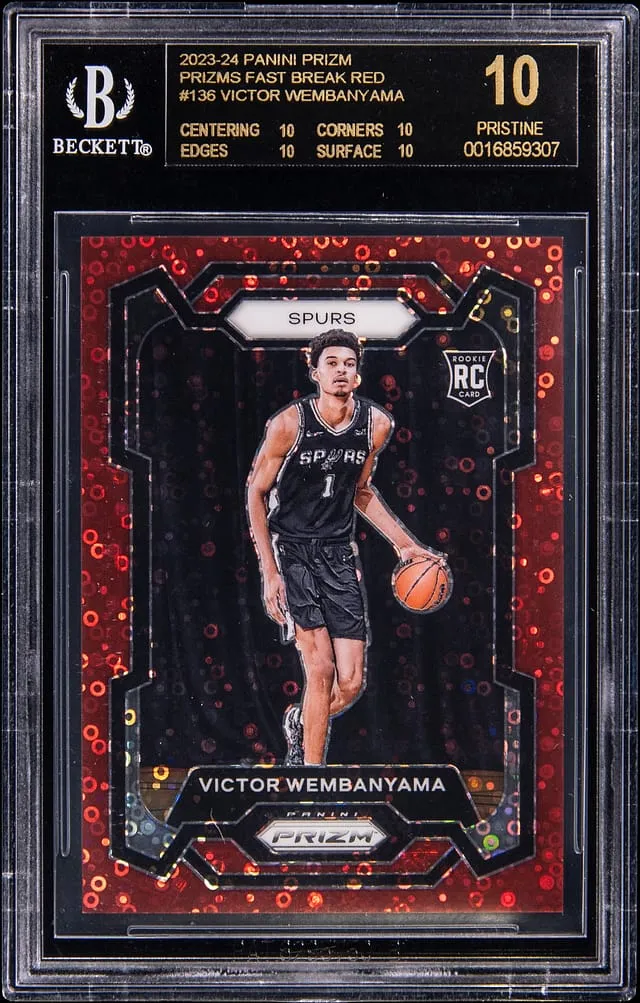
Victor Wembanyama Prizm Red Fast Break BGS 10 Sale
Figoca looks at Goldin’s $54,290 sale of a 2023-24 Prizm Red Fast Break Victor Wembanyama BGS Black Label 10 rookie, Pop 1, and its hobby context.
Sold Card
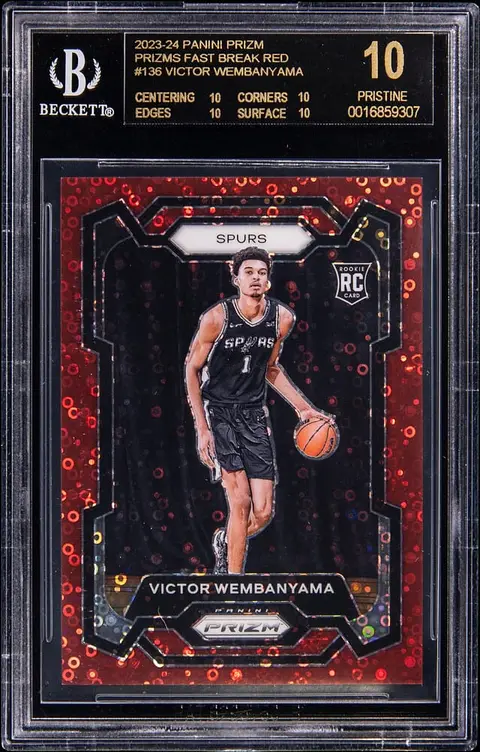
2023-24 Panini Prizm Red Fast Break Prizm #136 Victor Wembanyama Rookie Card (#024/100) - BGS PRISTINE/Black Label 10 - Pop 1
Sale Price
Platform
Goldin2023-24 Panini Prizm Red Fast Break Prizm #136 Victor Wembanyama Rookie Card (#024/100) - BGS PRISTINE/Black Label 10 - Pop 1 Sells for $54,290
On May 8, 2026, Goldin auctioned one of the cleanest early Victor Wembanyama rookies in the market:
- Player: Victor Wembanyama, San Antonio Spurs
- Year / Product: 2023-24 Panini Prizm Basketball
- Card: #136, base rookie
- Parallel: Red Fast Break Prizm, serial numbered 24/100
- Grading: BGS PRISTINE 10 Black Label (10s on all four subgrades)
- Population: Pop 1 (only one copy with this grade in the BGS population report at the time of sale)
- Sale Price: $54,290 (hammer + buyer’s premium, converted from cents)
- Auction House: Goldin
- Sale Date (UTC): 2026-05-08
For figoca users tracking modern basketball, this is a useful case study in how early Wembanyama Prizm parallels and Black Labels are being valued as the hobby digests his first full NBA season.
1. What exactly is this card?
The set: 2023-24 Panini Prizm
Panini Prizm is considered the modern flagship chromium set for basketball. When collectors say “flagship,” they usually mean the main, widely recognized rookie card brand for a sport and era. For ultra-modern NBA cards, Prizm has held that role for more than a decade.
2023-24 Prizm is Wembanyama’s first Prizm appearance in a Spurs uniform, making card #136 his core, non-autograph rookie in this product. From there, Panini produces a large ecosystem of parallels—variants with different colors, patterns, and serial numbering. These are typically more limited and more desirable than the base version.
The parallel: Red Fast Break Prizm /100
This card is the Red Fast Break Prizm parallel:
- Found in Fast Break (a separate configuration from hobby/retail), with a distinct disco-style background pattern.
- Serial numbered /100, making it a relatively low print run for a core color parallel, though not as scarce as /25, /10, or 1/1 cards.
- The copy sold is specifically 24/100. Some collectors care about jersey-matches or aesthetically pleasing serials; 24 is not Wembanyama’s jersey number, but numbered cards still carry a premium over non-numbered parallels.
Within the Fast Break rainbow, the Red /100 sits as a meaningful but not ultra-rare color. Its importance here is amplified by the grade.
The grade: BGS PRISTINE 10 Black Label, Pop 1
This copy was graded by Beckett Grading Services (BGS) and received a Pristine 10 Black Label, which means:
- The card received 10 subgrades in all four categories (centering, corners, edges, surface).
- BGS labels this combination with a black and gold label—often referred to as a Black Label—and it is widely considered an extremely tough grade for modern chromium cards.
The BGS population report showed this card as Pop 1 at the time of sale: only one example in existence with this exact grade. There may be other copies graded BGS 9.5, BGS 10 (non-Black), PSA 10, or raw, but this particular Black Label stands alone.
For collectors, a Pop 1 Black Label on a key player’s rookie-year Prizm parallel creates a clear top-of-the-pyramid copy in terms of condition rarity.
2. Market context and price comparison
The card closed at $54,290 in the May 8, 2026 Goldin auction. To understand what this means, it helps to set some context with related sales.
a. Direct comps: this exact card
Because this is Pop 1 and a Black Label, there are typically very few (if any) previous auction appearances of the exact same slab. For ultra-modern cards like this, it is common to see:
- Raw or PSA 9/10 sales first.
- Then a few BGS 9.5 or BGS 10 (non-Black) sales.
- Only occasionally a Pristine Black Label, which often appears once and then disappears into a long-term collection.
In other words, the Goldin result is likely one of the first clear public price signals for this specific combination of card + parallel + grade.
b. Nearby comps: other Wembanyama Prizm parallels and grades
When direct comps are thin, collectors look at nearby comps—sales that are not identical but close enough to give context. Examples of what buyers and sellers would have been looking at around this time include:
- Other 2023-24 Prizm Wembanyama rookies in PSA 10 or BGS 9.5.
- Scarcer or more visually preferred parallels (e.g., Gold, Mojo, Choice Blue, Hyper, or numbered hobby colors) in high grades.
- Sales of Fast Break Wembanyama parallels at different serial levels and in PSA 10.
Across the hobby, there has been a noticeable pattern:
- Color + serial numbering generally lifts values well above base Silver/Prizm.
- Early Wembanyama parallels have drawn strong bidding, especially when tied to his standout rookie season performances.
- Black Labels tend to command a multiple over PSA 10 or standard BGS 10 pricing, as long as the underlying card is already in demand.
Exact dollar figures for the closest comps shift quickly in an ultra-modern market, and not every sale is public. But the $54k range tells us this card is being treated as:
- A top-tier condition rarity within Wembanyama’s Prizm rainbow.
- Not on the same tier as true 1/1 logo patch autos or National Treasures RPAs, but clearly above most mass-available rookies.
c. High, low, or typical?
With Wembanyama still early in his career, pricing is sensitive to performance and broader market trends. This sale appears to sit toward the high end of what color, non-autograph Wembanyama rookies with strong rarity and condition can command:
- It reflects both player expectation (generational prospect) and
- Grade scarcity (a lone Black Label in the pop report).
Rather than reading this as a stable, long-term benchmark, it’s better viewed as a snapshot of how the market values this specific combination at this specific time.
3. Why this card matters to collectors
Wembanyama’s place in the hobby
Victor Wembanyama entered the league with one of the highest hobby expectations of any NBA prospect since LeBron James. By the time of this May 2026 sale, hobby sentiment was shaped by:
- His early NBA performance and development curve.
- Ongoing media coverage and comparison to past generational big men.
- The broader modern basketball market’s appetite for high-end, graded rookie cards.
For many collectors, Wembanyama represents the centerpiece name of the 2023-24 rookie class. That means his key rookies—especially in Prizm—are often treated as foundational pieces for player-focused or set-focused collections.
Why Prizm parallels matter
Within the ultra-modern era, many collectors treat three categories of Wembanyama cards as particularly important:
- Flagship chromium rookies (Prizm, Select, and comparable products).
- High-end patch autos (National Treasures, Flawless, Immaculate, etc.).
- Case hits and SSPs (super-short prints, and key inserts with limited print).
This card sits in the first group. Among flagship rookies, numbered color is prized because:
- It provides a clearer sense of scarcity (/100 in this case), compared to unlimited or unknown print runs.
- It combines the visual identity of Prizm with something measurably limited.
Even though this is a Fast Break color rather than a core hobby color like hobby-only Gold or Choice variations, the combination of serial numbering and a top-grade label gives it a distinct place in the Wembanyama hierarchy.
The role of a Black Label Pop 1
Condition-conscious collectors view Black Labels as a tier above standard gem mint grades. For a chromium rookie:
- Centering and surface are particularly difficult to perfect.
- Achieving 10s on all four subgrades indicates a card that is nearly flawless under magnification.
A Pop 1 Black Label:
- Creates a clear 1-of-1 in terms of grade, even if the card is /100.
- Often becomes a long-term “trophy” piece for set builders or serious player collectors.
- Can lead to disproportionate pricing compared with the next step down in grade, because there is no direct competitor at that level.
In that sense, this sale is as much about condition rarity as it is about the underlying card.
4. What this sale tells us about the market
For figoca users who track data across marketplaces, this Goldin result is informative in several ways.
a. The ongoing strength of flagship Prizm
Even as the hobby experiments with new designs and high-end products, Prizm continues to act as a baseline reference point for modern rookies. When collectors think of Wembanyama’s mainstream rookies, Prizm is almost always in the conversation.
A $54,290 sale for a numbered Prizm parallel (non-auto, non-patch) underscores that the market still:
- Recognizes Prizm as a primary rookie platform.
- Rewards color, numbering, and elite grading combinations.
b. Condition premiums are alive and well
The difference between a standard gem mint and a Black Label can be significant. This sale is a clear example of:
- How collectors price “best in the world” copies of key rookie cards.
- Why some buyers submit multiple copies to grading, chasing that one perfect slab.
For sellers, it’s a reminder that:
- Not all gem mints are treated equally in the market.
- Pop data (the number of copies at each grade) matters when setting expectations.
c. Ultra-modern volatility and context
Ultra-modern basketball, especially when centered around a single star, can be volatile. Factors that may influence future comps for cards like this include:
- Wembanyama’s continued development, awards, and playoff appearances.
- Overall macro trends in the sports card market.
- The release of future products that may introduce even more desirable Wembanyama cards.
Rather than viewing this sale as predictive, it’s more useful to log it as a data point—a marker of what a specific, top-condition Prizm parallel achieved at a particular moment in Wembanyama’s early career.
5. Takeaways for different types of collectors
If you’re new or returning to the hobby
- This card is a high-end example, but it highlights a few core concepts:
- Flagship product: Prizm is a key rookie brand for modern NBA cards.
- Parallel: Variants like Red Fast Break /100 are more limited than base.
- Grading: Black Label Pristine 10 is one of the strictest standards in the hobby.
- You don’t need to chase Black Labels, but understanding how these tiers work helps you interpret pricing across the board.
If you’re an active hobbyist or small seller
- Watch how prices for:
- PSA 10 vs BGS 9.5 vs BGS 10 vs Black Label Wembanyama Prizm rookies move relative to each other.
- Numbered vs non-numbered parallels behave as more product releases hit the market.
- Use population reports and recent sales data together instead of relying on either in isolation.
If you’re a player or set collector
- This sale effectively crowns this specific copy as one of the top condition Wembanyama Fast Break Prizm rookies currently known.
- Whether or not you pursue a copy at this level, it helps map the upper end of what serious Wembanyama or Prizm rainbow collectors may be willing to pay.
6. How figoca users can use this data point
Within figoca’s tools and market views, a sale like this can be useful in several ways:
- As a benchmark when you’re looking at other 2023-24 Prizm Wembanyama parallels.
- As a filter example when studying the impact of grade (PSA vs BGS, gem mint vs Black Label) on final prices.
- As part of a timeline of Wembanyama’s early hobby history—tracking how flagship rookies performed as his career unfolded.
The Goldin sale on May 8, 2026 doesn’t tell the whole story of Wembanyama’s market, but it does add an important line to the chart: a Pop 1 BGS Black Label, numbered Prizm rookie reaching $54,290 in a prominent auction.
For collectors and small sellers alike, logging these data points over time is one of the most practical ways to understand where the modern basketball market has been—and where it may be heading next, without assuming that any single sale guarantees what comes after.