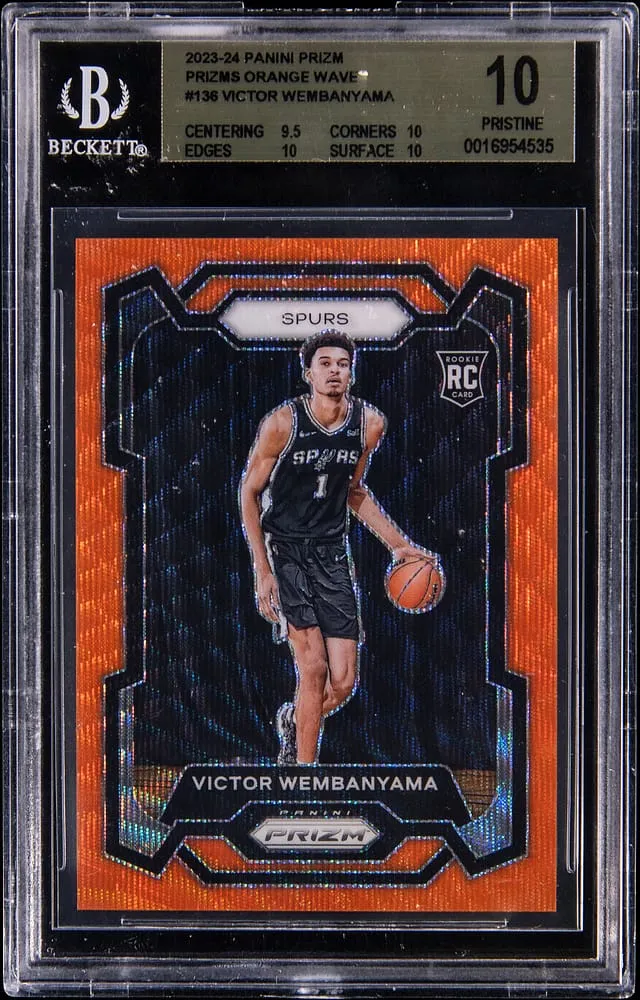
Victor Wembanyama Prizm Orange Wave /60 BGS 10 Sale
Figoca looks at the $62,834 Goldin sale of a 2023-24 Prizm Orange Wave /60 Victor Wembanyama BGS Pristine 10 rookie, pop 1, and its market context.
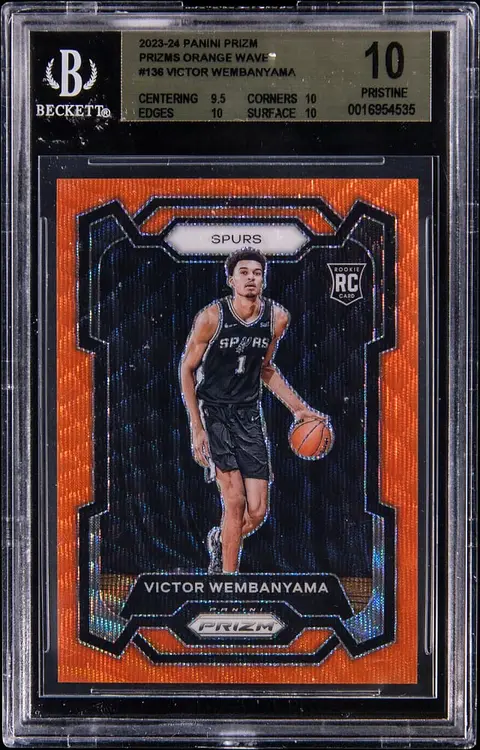
Sold Card
2023-24 Panini Prizm Orange Wave Prizm #136 Victor Wembanyama Rookie Card (#58/60) - BGS PRISTINE 10 - Pop 1
Sale Price
Platform
Goldin2023-24 Panini Prizm Orange Wave Prizm #136 Victor Wembanyama Rookie Card (#58/60) - BGS PRISTINE 10 - Pop 1 Sells for $62,834 at Goldin
On May 29, 2026, Goldin closed the auction on a major modern basketball rookie: a 2023-24 Panini Prizm Orange Wave Prizm #136 Victor Wembanyama Rookie Card, serial numbered 58/60, graded BGS PRISTINE 10 and noted as a population 1. The final price was $62,834.
For collectors trying to understand what this sale means, let’s break down the card, the grading, and how this result fits into the broader Wembanyama and Prizm market.
The card: a low-numbered Prizm Wembanyama rookie
Here’s what this specific card is:
- Player: Victor Wembanyama (San Antonio Spurs)
- Year: 2023-24
- Set: Panini Prizm Basketball
- Card number: #136
- Parallel: Orange Wave Prizm, serial numbered 58/60
- Rookie status: This is a true rookie card from Prizm, which is widely treated as Panini’s flagship chromium NBA set.
- Grading company: Beckett Grading Services (BGS)
- Grade: BGS PRISTINE 10 (often considered Beckett’s highest standard grade for pack-issued cards, just below the theoretical Black Label 10)
- Population: Pop 1 (at the time of grading, this was the only example with a BGS PRISTINE 10 grade)
The Orange Wave parallel combines two forms of scarcity:
- Serial numbering to 60 copies – only 60 exist in total, regardless of grade.
- Pristine 10 condition – only this copy has reached that grade at BGS so far.
This is not an autograph or patch card, but it sits in the core lane of what many basketball collectors prioritize: a color, serial-numbered parallel of a flagship chromium rookie.
Why Prizm matters for modern basketball rookies
Panini Prizm has, over the 2010s and early 2020s, become what many collectors think of as the “flagship” chromium rookie for NBA players. While there are premium brands above it in price (like National Treasures, Flawless, or high-end on-card autos), Prizm tends to be the most widely recognized base for:
- Rainbow chases – collectors trying to gather multiple color parallels of the same rookie.
- Long-term tracking – Prizm rookies are often used as a quick benchmark for where a player’s card market sits.
For Wembanyama specifically, his 2023-24 Prizm rookies were among the most anticipated cards of the ultra-modern era. A numbered color parallel from this set sits near the center of a lot of hobby attention.
What makes this copy special: grade and pop
Beckett’s Pristine 10 label typically implies subgrades that approach or reach 10 on corners, edges, surface, and centering (exact subgrade breakdown is on the label itself). In hobby shorthand, a Pristine 10 is commonly treated as a step above most PSA 10s and equivalent or above a typical BGS 9.5 Gem Mint.
The population report (often shortened to “pop report”) is Beckett’s count of how many copies of a card they’ve graded at each grade level. A "Pop 1" means that, so far, only one card has reached that grade. With modern chromium stock and relatively tight centering/print standards, getting to Pristine 10 is not trivial, especially for numbered color where print runs are smaller and some surface or centering issues are common.
In short, this card combines:
- A key rookie of a headline player.
- A serial-numbered color parallel (/60).
- Top-tier grading with a population of 1 at that level.
Market context: where does $62,834 fit?
This card sold at Goldin on May 29, 2026 for $62,834.
Because the Prizm Wembanyama market is still relatively young and population data is evolving, there are limited directly comparable sales that match all of the following at once: same parallel, same serial print run, same grading company, and same grade.
Instead, most price context comes from:
- Other Prizm Wembanyama parallels – different colors and serial numbers.
- Different grading tiers – PSA 10s, BGS 9.5s, and raw (ungraded) copies.
- Other key Wembanyama rookies – particularly from Prizm and high-end sets.
Across major marketplaces and auction houses, observed trends for Wembanyama’s early Prizm market have usually shown:
- Strong premiums for numbered color versus base and common non-numbered parallels.
- Clear step-ups for top grades (PSA 10, BGS 10, BGS Pristine) in ultra-modern chromium.
- Distinct tiers by scarcity – lower-numbered parallels (for example /60, /49, /25, /10, /5, /1) often forming a ladder of values.
Within that framework, a serial-numbered /60, pop 1 Pristine 10 selling in the low-to-mid five-figure range is consistent with how other premium Wembanyama Prizm color parallels have been treated so far, especially when they hold a standout grade.
Because this is a specific color (Orange Wave) with its own aesthetic and rarity, and because it is the lone Pristine 10 at BGS, there is no perfect one-to-one comp available yet. As more Orange Wave copies get graded across PSA, BGS, and SGC, and as they sell publicly, a clearer pricing ladder for this exact parallel will likely develop.
Why collectors care about this sale
A few hobby angles make this result notable:
1. Wembanyama’s status in the ultra-modern era
Victor Wembanyama entered the NBA with one of the highest expectation levels of any prospect in decades. His early performances, highlight plays, and statistical production have kept him at the center of the ultra-modern basketball conversation.
For collectors, this means his flagship rookies and key parallels are watched closely. When a notable card like a Prizm numbered parallel in a top grade sells at a public auction house, it becomes a reference point that people use when they think about his broader market.
2. The importance of serial-numbered Prizm color
Within Prizm, not all parallels are equal. While non-numbered colors (like Silver, Hyper, and many others depending on the year) are popular, serial-numbered color carries an extra layer of scarcity that is easier to quantify. Knowing exactly how many copies exist—here, 60 total—helps collectors think about how rare a card is compared to demand.
Orange Wave to /60 is a meaningful tier of scarcity for a flagship rookie, sitting above mass-produced non-numbered parallels but below very low-numbered golds and blacks.
3. Grading separation in ultra-modern cards
In crowded ultra-modern checklists, collectors often look for ways to differentiate their cards. Grade is one of those levers.
- A BGS Pristine 10 is more difficult to achieve than a BGS 9.5.
- The Pop 1 tag signals that this is currently the only card at that tier.
For some collectors, pop 1 in an elite grade on a core flagship rookie parallel is enough to make a specific copy feel like a “best available” version within that slice of the market.
4. Public auction signals
Because this sale happened at Goldin, a high-visibility auction house, and closed on May 29, 2026, it provides a timestamped data point that the hobby can look back on.
Public sales like this:
- Help establish rough price ranges for similar cards.
- Give small sellers and collectors a benchmark when they consider whether to grade, buy, or sell their own Wembanyama Prizm parallels.
- Add to the narrative around how high-end Wembanyama rookies trade in the early years of his career.
What this sale doesn’t tell us
There are a few important things this sale does not guarantee:
- It does not lock in a long-term price level for all Wembanyama cards.
- It does not mean every Prizm Wembanyama color parallel will follow the same trajectory.
- It does not predict the player’s on-court future.
Markets move as more supply appears (more cards graded and listed), as demand shifts, and as Wembanyama’s career develops. This Goldin result is best thought of as one high-end data point in a still-developing market for an ultra-modern star.
Takeaways for collectors and small sellers
For newcomers, returning collectors, and small sellers, here are a few practical lessons from this sale:
- Flagship matters: Even in an era with many sets, Prizm still carries weight as a go-to rookie for modern NBA players.
- Numbered color is a key tier: Serial-numbered color parallels like this Orange Wave /60 typically sit above base and non-numbered parallels in demand and pricing.
- Top-tier grading can separate a card: Achieving BGS Pristine 10 with a pop 1 designation can significantly distinguish a card even within a small print run.
- Public auctions create reference points: Results from auction houses such as Goldin offer useful context when you are checking recent sales (often called “comps”) for your own buying or selling decisions.
As more 2023-24 Prizm Wembanyama cards get opened, graded, and sold, the picture around where each parallel and grade tier sits will become clearer. For now, this BGS Pristine 10 Orange Wave /60 stands as one of the standout Prizm rookie sales recorded in late May 2026.
For figoca users tracking the market, this sale is worth bookmarking as a benchmark for high-end, graded, numbered Wembanyama Prizm rookies.