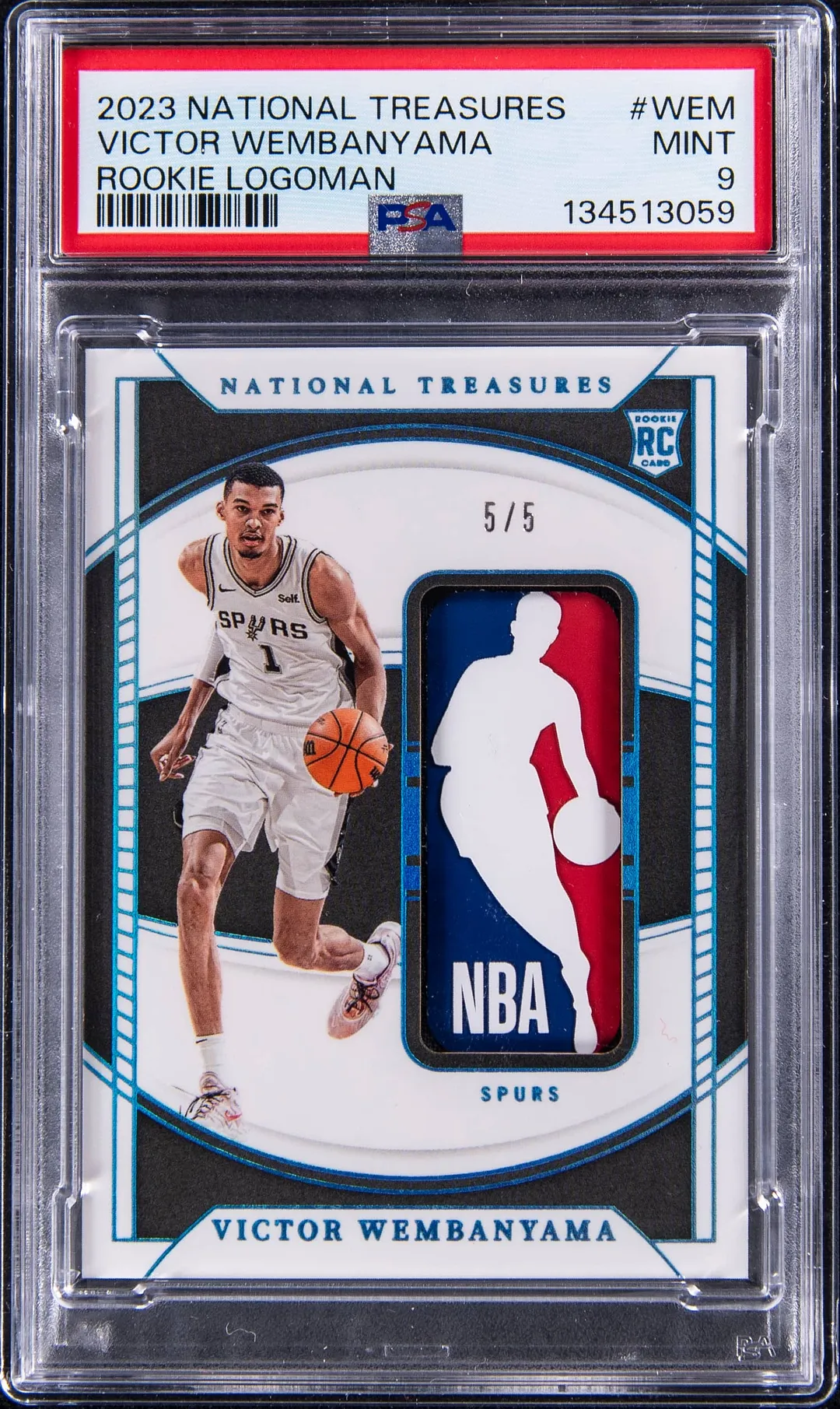
Victor Wembanyama NT Rookie Logoman Sells for $244K
Goldin sold a 2023-24 National Treasures Victor Wembanyama Rookie Logoman (#5/5) PSA 9 for $244,000. Here’s what it means for Wemby’s card market.
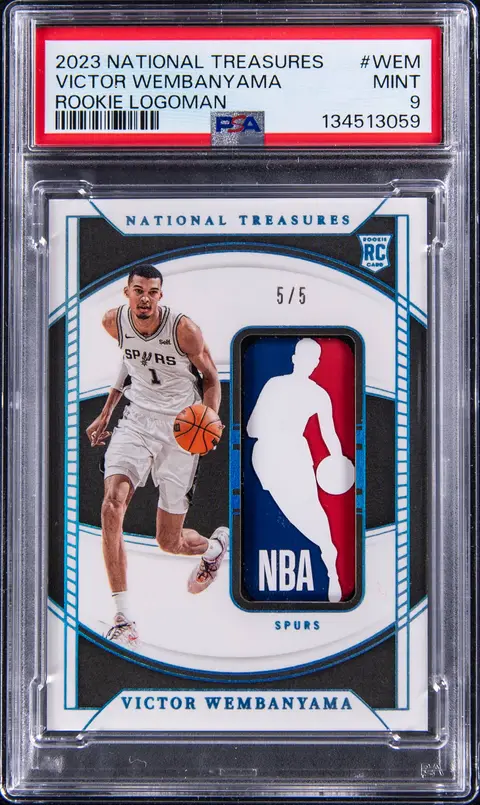
Sold Card
2023-24 Panini National Treasures Rookie Logoman #RL-WEM Victor Wembanyama Patch Rookie Card (#5/5) - PSA MINT 9
Sale Price
Platform
Goldin2023-24 Panini National Treasures Rookie Logoman #RL-WEM Victor Wembanyama Patch Rookie Card (#5/5) – PSA MINT 9
Sold for: $244,000
Auction house: Goldin
Sale date (UTC): 2/08/26
Victor Wembanyama’s ultra‑premium rookie cards continue to set the tone for the modern basketball market. This 2023-24 Panini National Treasures Rookie Logoman #RL-WEM, serial‑numbered 5/5 and graded PSA MINT 9, is a strong example of how high-end Wemby cardboard is being valued right now.
Below, we’ll break down what this card is, why it matters, and how this $244,000 Goldin sale fits into the broader price picture for Wembanyama and National Treasures.
Card breakdown: what exactly sold?
Let’s start with the basics collectors care about most:
- Player: Victor Wembanyama
- Team: San Antonio Spurs
- Season: 2023-24
- Product: Panini National Treasures Basketball
- Card: Rookie Logoman
- Card number: #RL-WEM
- Serial-numbering: #5/5 (five copies produced)
- Type: Rookie patch card (rookie-year memorabilia)
- Logoman: Features an NBA logo patch, the hobby’s most recognizable patch type
- Grading company: PSA (Professional Sports Authenticator)
- Grade: PSA MINT 9 (high grade for a thick patch card)
National Treasures is Panini’s long-running luxury brand. It’s known for low-print-run cards, on-card autographs, and jumbo patches. A Logoman is the patch version that contains the NBA logo from a jersey; in modern basketball, Logoman cards are often viewed as the peak of patch collecting.
This card is also a rookie card, meaning it comes from Wembanyama’s first year of fully licensed NBA products, which tends to be the main focus for long-term collectors.
This particular copy is not a 1-of-1, but at only five copies worldwide, it lives firmly in the ultra‑short‑print tier of modern inserts.
Where this sale sits in the market
The card sold at Goldin for $244,000 on 2/08/26 (UTC). To understand what that means, it helps to look at the surrounding market rather than this sale in isolation.
Because this is a very low-serial Logoman, direct “same card, same grade” comparisons are limited. Instead, collectors typically look at:
- Other copies of the same card (#RL-WEM /5) in different grades or raw (ungraded).
- Other high-end Wembanyama National Treasures rookies, especially:
- RPA (Rookie Patch Auto) cards numbered /99, /49, /25, and 1/1.
- Other Wembanyama Logoman and premium patch variations.
Across high-end marketplaces (major auction houses and large fixed-price platforms), recent Wembanyama National Treasures sales show a wide range, driven by:
- Serial number: 1/1 and ultra-low serials consistently command the top tier.
- Autograph vs. non-auto: On-card autographs usually carry a premium over non‑auto patch cards.
- Grade: On thick, premium cards, a PSA 9 or equivalent is generally viewed as a strong outcome; PSA 10s are rare and often priced accordingly.
Within that landscape, a $244,000 closing price positions this PSA 9 /5 Logoman firmly in the high-end segment of Wembanyama’s rookie market, but below the most extreme prices being discussed for his 1-of-1s or top RPAs. It reflects:
- Strong demand for any Wembanyama Logoman from a flagship premium set.
- A meaningful grading premium for a Mint 9 on a thick, sensitive card stock.
- Ongoing willingness among high-end buyers to allocate six figures to early-career Wembanyama pieces.
Because the exact card population is tiny (five copies total) and public sales are sporadic, this result should be read as one important data point rather than a full price guide all by itself.
Why collectors care about this card
Several factors combine to make this a significant card for Wembanyama collectors and for the broader modern basketball market:
1. Wembanyama as a franchise-level rookie
Victor Wembanyama entered the league as one of the most anticipated prospects in modern NBA history. For many collectors, his rookie-year cards are treated similarly to early LeBron, Durant, or Luka cards in terms of long-term interest—though the exact level of demand will always depend on his continued on-court performance.
This card captures that rookie-year window, which is where most of the long-term hobby focus sits for modern star players.
2. National Treasures as a flagship premium set
Within Panini’s basketball lineup, National Treasures (NT) is one of the key high-end releases. For ultra-modern rookies, NT often serves as a sort of “flagship premium” brand:
- It is widely recognized among both hobbyists and investors.
- Rookie Patch Autographs (RPAs) from NT have historically been treated as a player’s premier high-end rookie for the Panini era.
- The checklist is intentionally tight and low-print, keeping supply limited.
A Wembanyama Logoman from National Treasures sits in that same prestige lane, even though it is a patch (not RPA) variant.
3. Logoman as a patch type
Logoman patches are iconic in the modern hobby. The full NBA logo on a card signals:
- Game or event-worn jersey content (depending on Panini’s specific wording for the year).
- A highly visible, easily recognizable patch that even newer collectors understand as “special.”
Historically, Logoman cards—especially rookie-year versions—have been central to many of the hobby’s most discussed modern sales. They’re often seen as centerpiece items in player collections.
4. Ultra-short print (5 copies)
With only five serial-numbered copies, this card lives in a segment where traditional supply-and-demand models start to break down:
- Very few collectors will ever have a realistic chance to own one.
- Public sales become rare events, which can make each auction outcome more influential on perceived value.
In practical terms, that means each time one surfaces, it can reset or reinforce expectations for the card’s tier within Wembanyama’s overall card ladder.
5. PSA MINT 9 on a thick, premium card
Grading is particularly challenging on thick patch cards like those in National Treasures:
- Corners and edges are more prone to chipping.
- Surface issues can be harder to avoid due to the construction of the card.
A PSA MINT 9 doesn’t just signal condition—it also adds an extra layer of confidence for high-end buyers. With so few copies in existence, a top-grade example can stand apart even among the five total.
How to think about comps and price context
In the hobby, “comps” (short for comparables) refer to recent sales of the same or very similar cards, used to estimate current market levels. For a card like this, comps are inherently limited because:
- There are only five copies.
- Not all will be graded by the same company.
- Some may sit in long-term personal collections and never appear at auction.
So, instead of looking for an exact match, it can be more useful to:
- Compare to other Wembanyama Logoman and RPA cards from National Treasures and similar-tier sets.
- Note how grade, serial number, and autograph presence change pricing across those examples.
- Follow multiple auction houses (including Goldin) to watch how Wembanyama’s top-end rookies trend over time.
This $244,000 sale doesn’t guarantee anything about future results, but it does provide a clear reference point for what a high-grade, ultra-short-print Wembanyama Logoman from National Treasures can command in early 2026.
What this sale might signal to collectors
Without making predictions, there are a few practical takeaways for collectors and small sellers:
- High-end Wembanyama demand is real: Six-figure results for premier Wembanyama rookies are not isolated outliers anymore; they’re part of an emerging pattern.
- Set and card type matter: Being from National Treasures and being a Logoman together place this card at the top of the Wembanyama hierarchy, behind only the absolute elite 1-of-1s and the best RPAs.
- Condition remains a key differentiator: On ultra-modern, ultra-rare cards, a PSA 9 or equivalent can significantly separate a copy from ungraded or lower-grade examples.
For collectors who can’t or don’t want to chase six-figure cards, this sale still offers useful context. It helps:
- Map out where your own Wembanyama cards sit on the spectrum of rarity and prestige.
- Understand why certain serial numbers, patch types, and sets draw more attention and stronger bids.
How to use this data point in your own collecting
If you’re building a Wembanyama or modern basketball collection, here are some grounded ways to make use of this sale information without turning it into speculation:
- As a benchmark, not a target: Treat $244,000 as a marker for where one very specific, very rare card landed, not as a reference that everything Wembanyama-related will follow.
- For relative comparison: When you see another Wembanyama card—especially from National Treasures—compare its features (auto vs. non-auto, serial number, patch type, grade) to this Logoman to gauge relative tier, not price.
- For understanding hobby narratives: High-profile Goldin results often shape the way people talk about a player’s market. Following these sales can help you understand the conversation, even if you’re buying and selling at much lower price points.
Final thoughts
This 2023-24 Panini National Treasures Rookie Logoman #RL-WEM Victor Wembanyama Patch Rookie Card (#5/5) in PSA MINT 9 represents one of the more important Wembanyama sales to surface so far. At $244,000 via Goldin on 2/08/26 (UTC), it reinforces National Treasures Logoman cards as a central pillar of the ultra-modern high-end basketball market.
As always, the most useful approach is to place this sale alongside other recent results, consider the specific features of the card, and use that context to inform your own collecting—not to chase headlines, but to better understand where different cards sit in the evolving Wembanyama landscape.