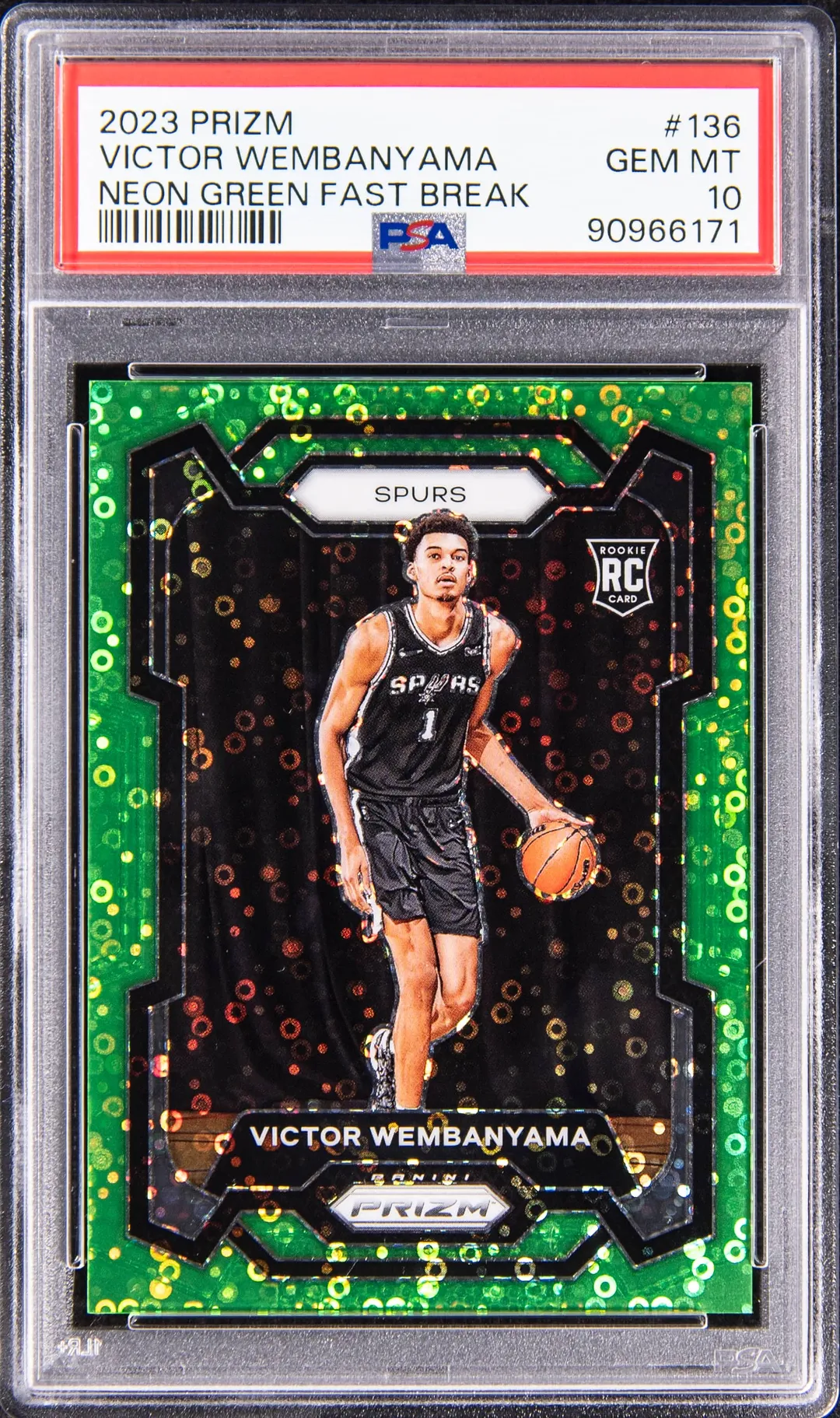
Victor Wembanyama Neon Green Prizm Rookie Sells for $732K
Deep dive on the $732,000 Goldin sale of a 2023-24 Prizm Neon Green Fast Break Victor Wembanyama rookie (#1/5) PSA 10, Pop 3.
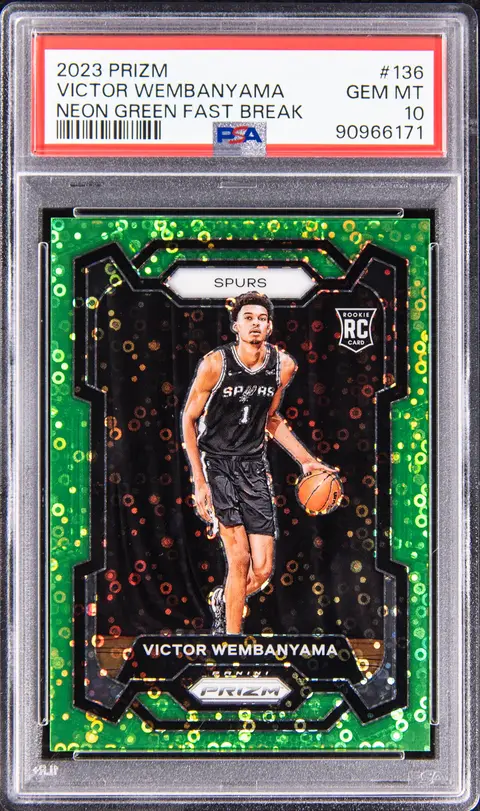
Sold Card
2023-24 Panini Prizm Neon Green Fast Break Prizm #136 Victor Wembanyama Rookie Card (#1/5) - Jersey Number - PSA GEM MT 10 - Pop 3
Sale Price
Platform
Goldin2023-24 Panini Prizm Neon Green Fast Break Prizm #136 Victor Wembanyama Rookie Card (#1/5) - Jersey Number - PSA GEM MT 10 - Pop 3
Sale snapshot
- Final price: $732,000
- Auction house: Goldin
- Sale date (UTC): 2026-01-04
- Player: Victor Wembanyama, San Antonio Spurs
- Year / set: 2023-24 Panini Prizm Basketball
- Card: #136, official rookie card
- Parallel: Neon Green Fast Break Prizm, serial-numbered 1/5
- Grade: PSA GEM MT 10
- Population: Pop 3 (only three PSA 10 copies in the PSA population report at the time of sale)
- Extra detail: jersey number match (1/5, matching Wembanyama’s #1)
What exactly is this card?
This card is from 2023-24 Panini Prizm, the flagship chromium set for modern NBA rookies. Within Prizm, “Fast Break” is a distinct configuration with its own parallel line, characterized by the disco-style circular pattern rather than the standard silver holo.
The specific parallel here is Neon Green Fast Break, numbered to just five copies. This one is serial-numbered 1/5, which matters for many collectors because it matches Wembanyama’s jersey number. Jersey-numbered copies (“jersey numbers”) are often treated as the premium example within an already short-printed run.
Layered on top of that, the card received a PSA GEM MT 10 grade, meaning PSA’s highest standard non-qualifier grade. At the time of the sale, PSA’s population report showed only three copies in PSA 10 (Pop 3), underscoring how few examples have both survived and graded at the top level.
Market context and comps
Because this is a very specific combination of attributes—Wembanyama, Prizm, low serial-number Fast Break, jersey number, PSA 10—direct one-to-one comparisons are limited. Instead, collectors usually look at a few related lanes:
Other 2023-24 Prizm Wembanyama rookies
- Base Prizm rookies in PSA 10 trade far lower and serve more as an access point than a benchmark for a card like this.
- Higher-end Prizm parallels (Gold /10, Black Gold /5, Choice Blue/Green /8, etc.) tend to set the tone for ultra-rare Wembanyama Prizm pricing.
Other low-serial Wembanyama rookies
- Non-Prizm, low-serial rookie cards (especially on-card autos or patch autos from premium brands) give an overall picture of where the market values his top-tier issues.
- Within those, serial-numbered parallels that are also jersey-numbered have often attracted a noticeable premium.
Other Fast Break and disco-style parallels
- For younger stars, Fast Break parallels typically sit below core hobby parallels like true Gold /10 or Black /1, but they still matter because they are visually distinct and often much rarer than standard color parallels.
Against that backdrop, a $732,000 result at Goldin places this copy firmly in the “headline sale” tier for early Wembanyama Prizm rookies. While exact dollars and rankings shift with every auction cycle, the combination of:
- PSA 10 grade
- Pop 3 scarcity
- Ultra-low serial number out of 5
- Jersey number match (1/5)
puts this card toward the very top of the non-autograph, non-logoman Wembanyama Prizm market.
Why collectors care about this card
A few hobby concepts help explain why this specific sale drew attention:
Flagship rookie 2023-24 Prizm is widely treated as Wembanyama’s main chromium rookie card line in traditional basketball collecting. Even as new brands arrive, Prizm remains a default reference point for rookies—especially for collectors who think in terms of Topps Chrome and early Panini-era parallels.
Ultra-modern, ultra-rare This card sits in the “ultra-modern” era (roughly mid-2010s to present). In this era, manufacturers intentionally create very low-serial parallels (like /5) as chase cards. Even though production for base cards is high, true low-serial Prizm parallels remain difficult to find in high grade, especially early in a player’s career when many copies are still raw.
Jersey-numbered serial Within any serial run, collectors often place a premium on:
- Jersey number (1/5 for Wembanyama #1)
- 1/first in the run (1/5)
- Last in the run (5/5) This card ticks two of those boxes at once, which is part of the appeal.
Grading and population A “pop report” (population report) is the grading company’s count of how many copies they’ve graded at each grade level. For this card, PSA showing only three PSA 10s helps reinforce its status as a top-of-the-pyramid example. With only five total copies in existence, even a few lower-grade subs would keep PSA 10s sharply limited.
Player and hobby backdrop
Victor Wembanyama’s arrival generated one of the strongest hobby storylines in recent memory. Key factors that matter to collectors:
- Prospect profile: A unique blend of size, skill, and two-way potential.
- Franchise context: Playing for the Spurs connects him—fairly or not—to the hobby’s memories of Tim Duncan, David Robinson, and the Popovich era.
- Early performance: Strong early stat lines, advanced metrics, and highlight plays reinforce the idea that he could sustain long-term relevance.
When a player with that profile gets a low-serial, jersey-numbered flagship rookie parallel in a top grade, the card quickly becomes a focal point for the market’s expectations.
What this sale tells us (and what it doesn’t)
A single auction, even at a venue like Goldin, is one data point rather than a complete story. Still, $732,000 for this card suggests a few things about the current state of the Wembanyama and Prizm markets:
- High-end Wembanyama demand remains deep. Multiple serious buyers likely competed to push an ultra-rare Prizm rookie parallel into the mid-six-figure range.
- Jersey-numbered, low-serial Prizm parallels are being treated as core long-term pieces for player-focused collectors.
- PSA 10 examples with low population counts are clearly separating from raw or lower-grade copies of similar cards.
At the same time, it is important not to over-interpret a single sale. High-end modern prices can be sensitive to:
- Short-term performance swings
- Macro hobby sentiment
- Timing (for example, mid-season vs. off-season auction calendars)
For collectors and small sellers, this result is most useful as context rather than a benchmark you should expect to match with related but different cards.
How collectors might use this result
For newcomers and returning collectors:
- It highlights how many layers can exist within “one” rookie card: base, parallel color, print run, jersey number, grading, and population.
- It’s a reminder that Prizm remains a central reference point for modern basketball rookies.
For active hobbyists and small sellers:
- It offers a reference point for how the market is assigning value to ultra-rare Prizm Wembanyama rookies relative to other brands and formats.
- It underlines the importance of accurately identifying parallels (Fast Break vs standard Prizm), serial numbers, and grade when you research your own comps (recent comparable sales).
For player-focused Wembanyama collectors:
- This sale reinforces that true low-serial, flagship rookies in top grades are being treated as anchor pieces.
- It also suggests that jersey-numbered copies within those low-serial runs can command significant attention.
Key takeaways
- The 2023-24 Panini Prizm Neon Green Fast Break Prizm #136 Victor Wembanyama Rookie Card, serial-numbered 1/5 and graded PSA GEM MT 10 (Pop 3), sold for $732,000 at Goldin on 2026-01-04.
- This is an ultra-rare, jersey-numbered version of Wembanyama’s flagship Prizm rookie, placed in the highest widely recognized PSA grade.
- Within the Wembanyama market, this result positions the card among the most notable non-auto, non-logoman Prizm rookies.
- For collectors, the sale is a useful case study in how scarcity, grading, and jersey numbering combine to shape pricing in the ultra-modern era.
As always, figures like this should be treated as part of a broader picture: useful for understanding the market’s current temperature, but not a promise of where prices will go next.