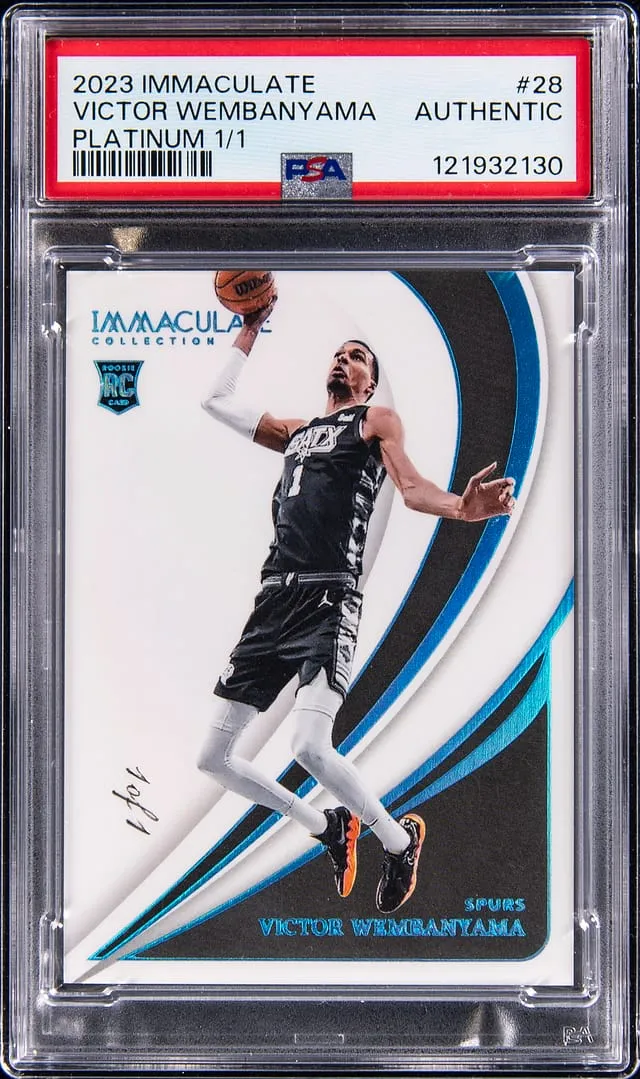
Victor Wembanyama Immaculate 1/1 Rookie Sells for $79K
Breakdown of the 2023-24 Immaculate Platinum 1/1 Victor Wembanyama rookie card that sold for $79,300 at Goldin on May 10, 2026.
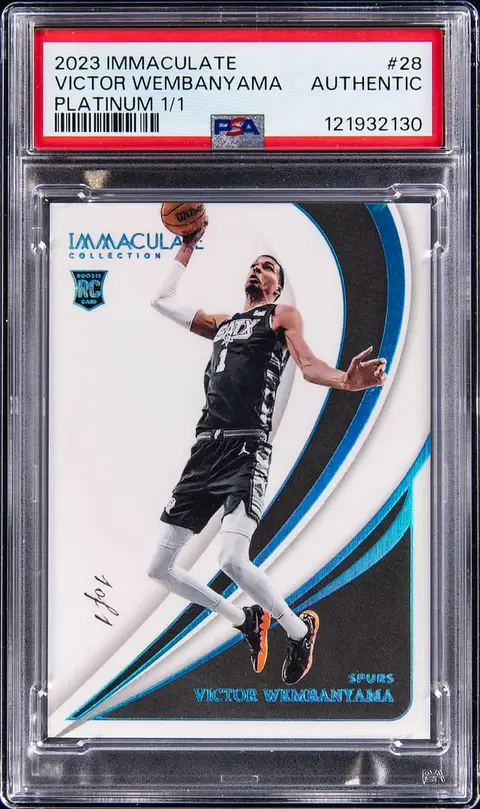
Sold Card
2023-24 Panini Immaculate Collection Platinum #28 Victor Wembanyama Rookie Card (#1/1) - Jersey Number - PSA Authentic
Sale Price
Platform
Goldin2023-24 Panini Immaculate Collection Platinum #28 Victor Wembanyama Rookie Card (#1/1) – Jersey Number – PSA Authentic
On May 10, 2026, Goldin closed the sale of a major ultra‑modern basketball grail: a 2023-24 Panini Immaculate Collection Platinum #28 Victor Wembanyama Rookie Card, serial‑numbered 1/1, matching his jersey number, and authenticated by PSA. The final price was $79,300.
For a card that exists only once, in a premium high‑end set, and tied to one of the most closely watched rookies in years, this sale offers useful data for collectors trying to understand the top of the Wembanyama market.
Card overview: what exactly sold?
Let’s break down the key details of this card:
- Player: Victor Wembanyama
- Team: San Antonio Spurs
- Season: 2023-24 (true rookie season)
- Set: 2023-24 Panini Immaculate Collection Basketball
- Card number: #28
- Parallel: Platinum
- Serial numbering: 1/1 (one of one)
- Special attribute: Jersey number match (Wembanyama wears #1, and this card is 1/1)
- Rookie status: Rookie card from a high‑end release
- Grading company: PSA (Professional Sports Authenticator)
- Grade: PSA Authentic (the card is certified as genuine; no numerical condition grade was assigned)
Immaculate is one of Panini’s premium brands, known for low print runs, thicker cardstock, and high‑end parallels. Platinum is typically the top or one of the top tiers within an Immaculate base or parallel rainbow, usually reserved for true 1/1s.
This particular card does not include an autograph or patch in the title provided, so it is best understood as an ultra‑premium 1/1 rookie parallel, rather than a patch auto (often called an “RPA,” short for rookie patch autograph). Even without ink or memorabilia, the combination of brand, parallel, and serial number makes it a significant high‑end rookie issue.
Why this card matters to collectors
Several hobby factors come together in this sale:
Wembanyama’s status in the hobby
Victor Wembanyama entered the league with one of the largest prospect spotlights the NBA has seen in the ultra‑modern era. For context, the hobby has recently seen big rookie markets for players like Luka Dončić, Zion Williamson, and Anthony Edwards. Wembanyama sits in that same conversation, with additional attention due to his unique size and skill profile.In this kind of environment, key rookie cards from premium brands tend to be watched closely. Immaculate, along with National Treasures and Flawless, typically anchors the high‑end segment of basketball collecting.
Immaculate as a high‑end brand
Immaculate Collection has a reputation for:- Low serial‑numbered base and parallels
- On‑card autographs in many subsets
- Multicolor jersey patches and logo patches
Even non‑auto, non‑patch 1/1 parallels from Immaculate are treated as serious centerpieces in advanced player or team collections.
The appeal of true 1/1s
A 1/1 (one‑of‑one) is exactly what it sounds like: only one copy of that exact card exists. For collectors, that means:- No direct competition with identical copies
- A built‑in sense of finality: if this card is locked away in a PC (personal collection), another one won’t appear
That scarcity can lead to wide price swings depending on who happens to be bidding at a given time. Unlike a serial‑numbered /99 card with many recent comps, there is rarely a neat “market level” for a true 1/1.
Jersey‑number match
A jersey‑number match occurs when the serial number on the card matches the player’s uniform number. Here, Wembanyama wears #1 and the card is numbered 1/1. That’s the strongest possible alignment: the only copy is also the jersey number.Many high‑end collectors see jersey‑number copies as a premium within a print run—sometimes referred to as “1st off the line” (if serial 1/x) or “player’s number.” With a 1/1, the fact it’s also the jersey number adds to its narrative appeal and can influence bidding if two or more determined collectors want that specific alignment.
PSA Authentic vs numerical grade
This card is labeled PSA Authentic, which means PSA has confirmed it is genuine, but has not assigned a 1–10 condition grade. This can happen for several reasons, including:- The submitter only wanted authentication
- The card may have condition issues where the owner preferred not to receive a low numerical grade
For ultra‑scarce 1/1s, some buyers focus far more on authenticity and eye appeal than on a specific number on the slab. Still, for newcomers it’s worth noting that an Authentic label differs from a graded PSA 9 or PSA 10 in terms of how many collectors compare comps.
Market context: where does $79,300 fit?
The realized price on Goldin was $79,300. When putting that figure in context, it’s helpful to consider three layers:
Exact‑card comps (same card, different sale)
With a 1/1, there are no direct same‑card comps beyond this single sale. There is no population report ("pop report"—a grading company’s count of how many copies of a card they’ve graded) in the usual sense for a one‑of‑one.Because of that, price history for this precise card is essentially limited to this transaction unless it reappears at auction in the future.
Nearby comps: similar Wembanyama high‑end rookies
To understand whether $79,300 is high, low, or in line for a Wembanyama 1/1 from a top‑tier brand, we look toward neighboring categories:- 1/1 parallels from other premium sets (such as National Treasures or Flawless)
- Immaculate Wembanyama rookie patch autos (RPAs) with low serial numbers
- Other 1/1 Immaculate Wembanyama cards (such as logo patches or alternate parallels)
Exact, up‑to‑the‑day comps for those categories can vary widely, especially as Wembanyama’s on‑court performance and awards profile change. In general, true 1/1s from top brands have been clearing at a level that reflects Wembanyama’s position near the top of the ultra‑modern hobby pyramid, but each auction has its own bidder mix and timing.
For context, recent Wembanyama sales across high‑end brands have produced:
- Strong five‑figure results for key low‑numbered rookies from flagship high‑end products
- Six‑figure potential for certain logo patch autos or top‑tier RPAs when competition is intense
Placing this Immaculate Platinum 1/1 at $79,300 situates it in the upper tier of Wembanyama rookies, but likely short of the absolute apex cards such as game‑used, multi‑color logo patch on‑card autos from the most coveted releases.
Set hierarchy: where Immaculate sits
In the modern Panini era, many collectors roughly organize premium basketball products into tiers. While opinions differ, one common view is:- Top tier: National Treasures, Flawless
- Upper tier: Immaculate, Impeccable, some high‑end inserts and case hits from other lines
Immaculate’s Platinum 1/1 rookies therefore represent some of the most desirable non‑auto, non‑patch rookie cards for a player like Wembanyama, particularly when combined with a jersey‑number match.
This helps explain why the card demands a strong price while still realistically sitting below the very top RPA and logo‑man territory.
Why the sale date and auction venue matter
This transaction closed on May 10, 2026, through Goldin, a major auction house known for handling high‑end sports cards and memorabilia.
Timing matters in the hobby:
- In‑season vs offseason: Player performance, playoff runs, injuries, and awards can all affect short‑term demand. A major auction during or shortly after a strong run can see heavier bidding than one in a quiet stretch.
- Macro hobby sentiment: Broader collector confidence—how people feel about the card market in general—also influences how aggressive bidding becomes on elite pieces.
Goldin’s audience skews toward serious collectors and investors who are comfortable bidding five and six figures on single items. That means cards like this typically find their way into the hands of buyers already familiar with Wembanyama’s long‑term narrative in the hobby.
How PSA Authentic might influence future comparisons
Because this card is labeled PSA Authentic instead of a numerical grade, future comparisons will likely consider:
- Eye appeal: Centering, corners, surface, and edges as visible through the slab.
- Potential alternative copies: For a 1/1, there are none; that makes condition less about choosing among several copies and more about how much a specific buyer values perfection versus uniqueness.
- Hypothetical value of a high‑grade copy: Some collectors mentally estimate what a PSA 9 or PSA 10 might fetch if the card were in that condition and then adjust for the Authentic label.
With only one copy in existence, though, the usual logic of “I’ll wait for a PSA 10” doesn’t really apply. Authenticity and provenance (where and when the card sold) become the reference points.
Takeaways for collectors and small sellers
For anyone watching Wembanyama’s market or the ultra‑modern high‑end basketball segment, this sale offers a few practical lessons:
True 1/1s defy neat pricing models
There is no print run to spread demand across or pop report to analyze. Prices depend heavily on who shows up to bid and how badly they want that specific card.Brand and parallel naming matter
Understanding the hierarchy (Immaculate Platinum vs base, Silver, Gold, etc.) helps you read auction descriptions accurately and compare them responsibly. A Platinum 1/1 sits at the top of that ladder.Jersey‑number premiums are real, but variable
Some collectors pay a clear premium for jersey‑number cards; others don’t. As you look at comps, remember that a jersey‑number 1/1 can’t be directly compared to a non‑jersey 1/1 or to a /10 or /25 without noting that detail.Auction house results can be reference points, not guarantees
This $79,300 Goldin sale is now a data point for future buyers and sellers discussing high‑end Wembanyama Immaculate cards. It’s evidence of what one serious marketplace was willing to bear on a given date, not a guaranteed baseline for all similar cards.
For collectors building a Wembanyama PC or tracking ultra‑modern basketball, this Platinum 1/1 Immaculate rookie now sits as a notable reference sale—an authenticated, jersey‑number, one‑of‑one from a premium release that helps map the very top end of his rookie‑year cardboard.
As always, anyone considering similar cards should use a mix of recent sales data, set knowledge, and personal collecting goals rather than assuming any single auction result will repeat on command.