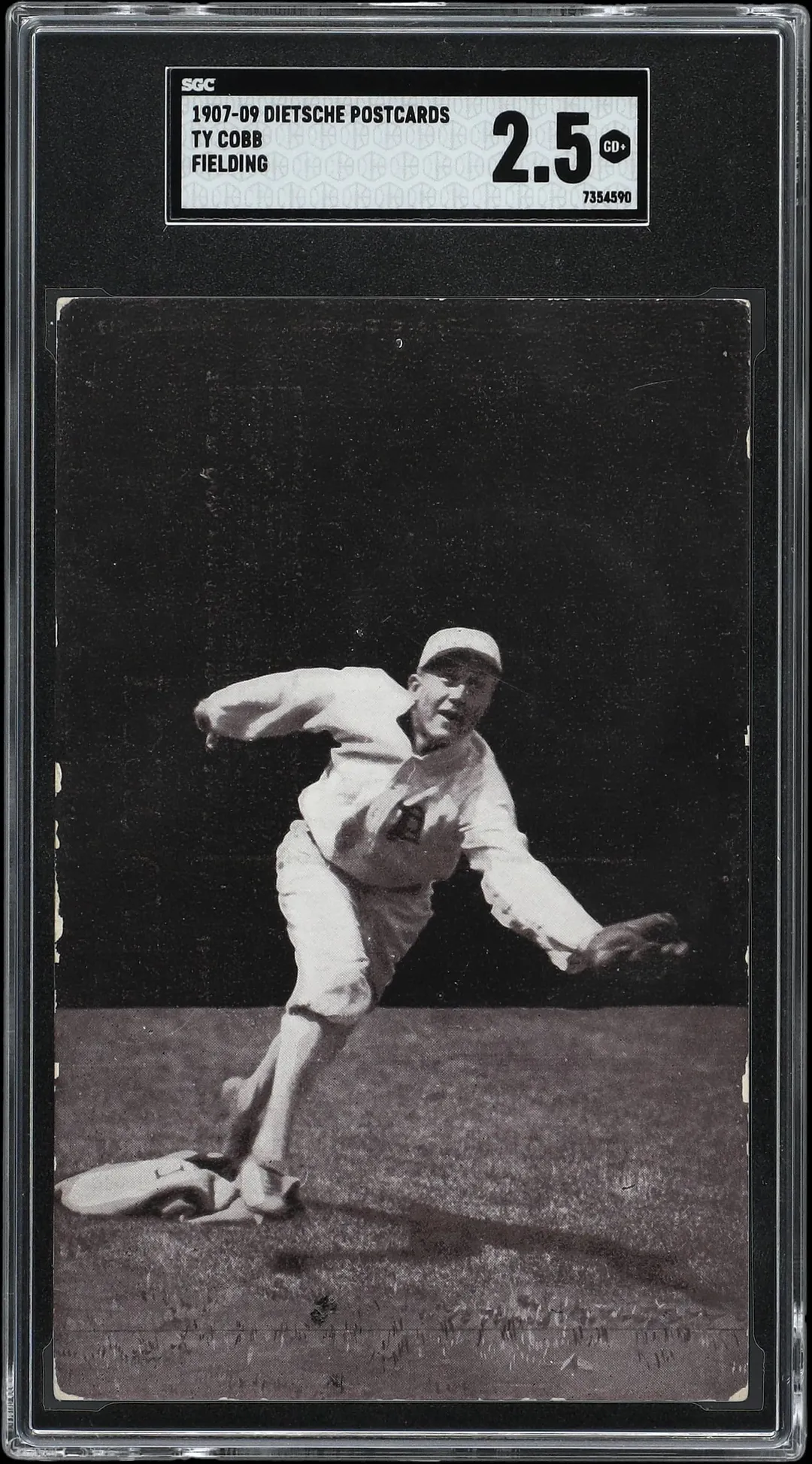
Ty Cobb 1907–09 Dietsche Rookie Postcard Sells for $18K
Goldin sold a 1907–09 PC765-1 Dietsche Detroit Tigers Ty Cobb fielding rookie postcard (SGC 2.5) for $18,910. Here’s the context for collectors.
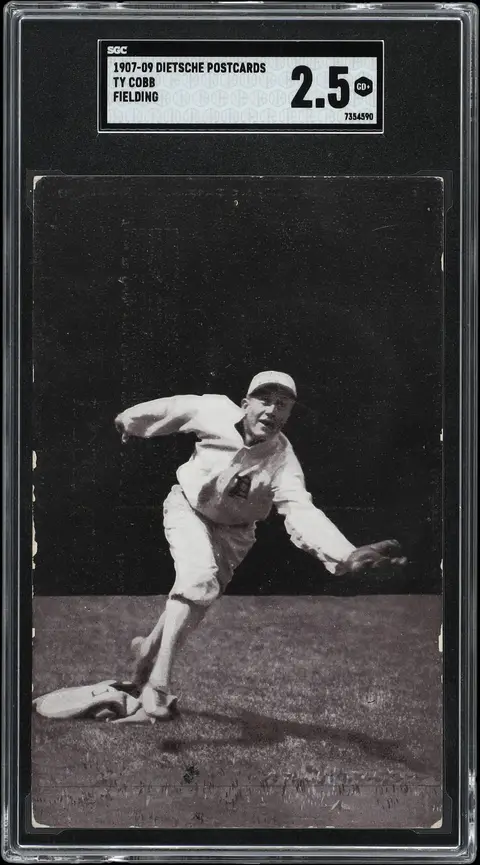
Sold Card
1907-09 PC765-1 Dietsche Detroit Tigers Postcards Ty Cobb, Fielding Rookie Card - SGC GD+ 2.5
Sale Price
Platform
Goldin1907–09 PC765-1 Dietsche Detroit Tigers Postcards Ty Cobb, Fielding Rookie Card - SGC GD+ 2.5 Sells for $18,910
On February 8, 2026, Goldin sold a true hobby cornerstone: a 1907–09 PC765-1 Dietsche Detroit Tigers Postcards Ty Cobb, Fielding pose, graded SGC GD+ 2.5, for $18,910.
For vintage baseball collectors, this postcard isn’t just an early Cobb. It’s widely treated as one of his true rookie issues and a key prewar cornerstone alongside his T206 cards. In lower and mid grades, it sits at the intersection of historical importance, visual appeal, and genuine scarcity.
The card at a glance
- Player: Ty Cobb
- Team: Detroit Tigers
- Years issued: 1907–1909
- Set: PC765-1 Dietsche Detroit Tigers Postcards
- Pose/Type: Fielding
- Type of item: Postcard (regional issue)
- Rookie status: Considered a Cobb rookie-era card and key early issue
- Grading company: SGC (Sportscard Guaranty Corporation)
- Grade: GD+ 2.5 (Good Plus)
- Auction house: Goldin
- Sale date (UTC): 02/08/26
- Sale price: $18,910
There is no autograph, relic, or serial numbering here. The appeal is completely driven by era, Cobb’s status, and the set’s scarcity.
What is the PC765-1 Dietsche Ty Cobb postcard?
The PC765-1 Dietsche Detroit Tigers Postcards set is an early 20th-century regional postcard issue featuring members of the Detroit Tigers. It was distributed around 1907–1909, right as Ty Cobb was emerging as a star.
Cobb’s cards from this window are some of the earliest collectibles of one of baseball’s most important and controversial figures. While the famous T206 Ty Cobb cards (issued 1909–1911) tend to get the most mainstream attention, the Dietsche postcard is an earlier, more specialized piece that many advanced collectors treat with equal seriousness.
Within the Dietsche run, Cobb appears in multiple poses (most commonly described as batting and fielding). The fielding pose, as in this sale, is one of the defining images of Cobb’s earliest cardboard.
Because this is a postcard-style issue, condition is often rough. These were not produced as dedicated trading cards, and many show postmarks, writing, creases, and handling wear. Even low to mid-grade examples can be challenging to find.
Why collectors care about this card
Several factors make this card important to both vintage specialists and broader hobbyists:
Rookie-era Cobb
This card falls squarely in Cobb’s earliest playing years with the Tigers, which places it in the same conversation as his recognized rookie and pre-rookie materials. For many collectors, any Cobb piece from 1907–1909 occupies a near “rookie card” tier of importance, even if postcard classifications can be nuanced.Prewar, regional scarcity
The PC765-1 Dietsche issue is a regional postcard set from over a century ago. Surviving copies are limited, and many are in lower grade. Unlike mass-produced modern cards, supply does not expand meaningfully over time.Historical and visual appeal
The fielding pose shows Cobb in a defensive stance, a different look from the more commonly seen batting images. For collectors building early Cobb runs or type collections (one representative card from many different early sets), this offers distinct eye appeal.SGC’s role in prewar grading
SGC has built a long-standing reputation in the vintage and prewar segment. For many collectors, an SGC label on a prewar piece feels “period appropriate” and can enhance demand compared to raw copies.
Market context and recent sales
When collectors talk about “comps,” they mean comparable recent sales of the same card (or very similar cards) that help frame a current sale’s price. For ultra-scarce prewar issues like this, truly direct comps can be few and far between.
Public auction records over the past several years show a pattern:
- Lower-grade Cobb Dietsche postcards (around SGC/PSA 1–2) have often surfaced in the mid four-figure to low five-figure range, depending on eye appeal, pose, and whether the postcard was used or postmarked.
- Stronger eye appeal or slightly higher technical grades (around 2.5–3.5) can upshift significantly, especially when the card presents better than the grade would indicate.
- High-grade examples (VG-EX and above) are considerably more scarce and have pushed into much higher price territory when they appear, sometimes establishing new benchmarks for the type.
Against that backdrop, an SGC GD+ 2.5 fielding pose at $18,910 sits in the upper portion of what has typically been a mid four-figure to low five-figure range for lower to mid-grade copies. While there have been stronger results for higher-grade or exceptional examples, this sale reinforces that even modestly graded Cobb Dietsche postcards can command serious attention.
In other words, this is not an outlier on the level of a record-shattering result, but it is a healthy, market-affirming sale that lines up with the card’s status and scarcity.
How grade and eye appeal matter here
Vintage postcards tend to grade harshly:
- Corners and edges often show significant wear.
- Creases, postal handling, and writing are common.
- Surface issues (toning, stains, small tears) appear regularly.
An SGC GD+ 2.5 means the card is clearly worn but structurally intact, with no major pieces missing. For a pre-1910 postcard, many collectors are comfortable targeting this level, valuing the image and overall presentation over strict numeric grade.
Because this card type is so old, collectors often talk about “eye appeal” – how good the card looks at arm’s length – as at least as important as the number. Two 2.5s can trade at very different prices if one has richer image quality, better centering, and fewer distracting creases.
Where this sale fits in the Cobb market
Ty Cobb’s market is anchored by a few pillars:
- His T206 cards (multiple backgrounds and the rare Ty Cobb back)
- Early postcards and regional issues like PC765-1 Dietsche
- Other prewar cards (E-cards, W-cards, and related early issues)
In the past decade, the Cobb market has shown that:
- Key early issues are resilient: Even as modern and ultra-modern cards move through hype cycles, demand for foundational Cobb pieces has remained steady over longer windows.
- Rarity plus narrative matters: Cards that tell a strong story (rookie-era, early team issues, iconic imagery) tend to retain hobby attention even when the broader market cools.
This $18,910 sale at Goldin does two things:
- Confirms that collectors still place serious value on non-T206 early Cobb issues.
- Reinforces the idea that a “collector grade” copy (2–3 range) of a historically important prewar card can be a long-term cornerstone, even if it is not a registry-chasing high grade.
Takeaways for collectors and small sellers
Whether you are new to prewar cards or just starting to pay attention:
- Expect irregular comps. Because of low supply and condition variation, prices don’t form a neat ladder from grade to grade the way they often do with modern flagship rookies.
- Look beyond the number. For prewar and postcards, a well-centered, strong-image 2.5 can be more desirable than a harsh-looking 3 in some collectors’ eyes.
- Understand the narrative. Early Cobb issues tie directly into the origin story of baseball card collecting. That historical weight is a big part of why collectors chase them.
For small sellers, this type of sale is a reminder that:
- Authentication and grading from a trusted vintage grader like SGC can be crucial for rare prewar items.
- Detailed, honest descriptions and high-resolution scans matter a lot when condition is this important.
Final thoughts
The 1907–09 PC765-1 Dietsche Detroit Tigers Postcards Ty Cobb, Fielding pose in SGC GD+ 2.5 closing at $18,910 via Goldin on February 8, 2026 is another data point in a long-running story: early Ty Cobb pieces continue to command deep respect from serious collectors.
It’s not a headline-grabbing record, but it’s exactly the kind of solid, well-supported result that keeps the prewar market steady – and keeps rookie-era Cobb at the center of vintage baseball conversations.