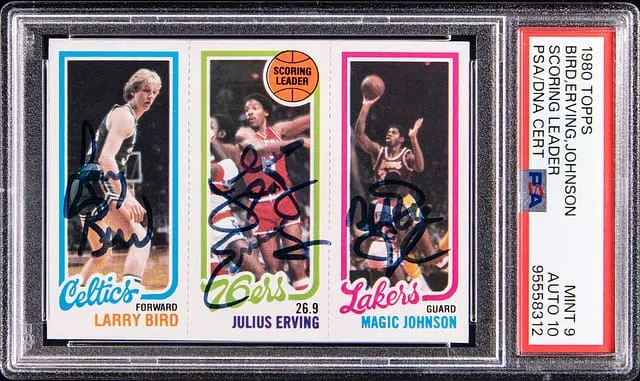
Triple-signed Bird/Erving/Magic PSA 9 rookie hits $112k
Goldin sells a PSA 9, PSA/DNA 10 auto 1980-81 Topps Bird/Erving/Magic rookie for $112,240. See how this landmark card fits into the modern market.
Sold Card
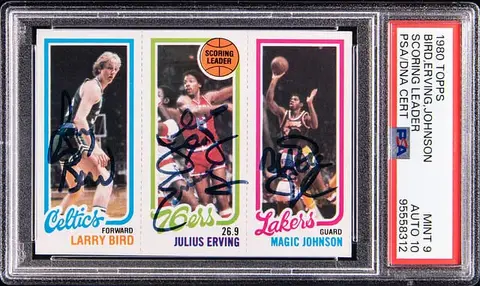
1980-81 Topps Scoring Leader Larry Bird/Julius Erving/Magic Johnson Multi-Signed Rookie Card - PSA MINT 9, PSA/DNA GEM MT 10
Sale Price
Platform
Goldin1980-81 Topps Scoring Leader Larry Bird/Julius Erving/Magic Johnson Multi-Signed Rookie Card - PSA MINT 9, PSA/DNA GEM MT 10 Sells for $112,240
On May 10, 2026, at Goldin, one of the most important basketball rookie cards ever produced crossed the auction block: a 1980-81 Topps Scoring Leader Larry Bird / Julius Erving / Magic Johnson multi-signed rookie card, graded PSA MINT 9 with a PSA/DNA GEM MT 10 autograph grade. The final price: $112,240.
For many collectors, this single card represents the intersection of three eras of basketball greatness and three major hobby lanes: vintage stars (Erving), early modern icons (Bird and Magic), and premium certified autographs.
Identifying the Card
Here’s what this specific card is:
- Year / Set: 1980-81 Topps Basketball
- Card type: Scoring Leader tri-panel card (three mini cards on one full-size card)
- Players:
- Left panel: Larry Bird (Boston Celtics) – rookie year
- Middle panel: Julius Erving (Philadelphia 76ers)
- Right panel: Magic Johnson (Los Angeles Lakers) – rookie year
- Status: Widely considered the key rookie card for both Bird and Magic
- Grading:
- Card: PSA MINT 9
- Autographs: PSA/DNA GEM MT 10 (meaning the signatures themselves are graded a perfect 10)
- Attributes:
- Multi-signed by Larry Bird, Julius Erving, and Magic Johnson
- On-card autographs (signed directly on the original card surface)
The 1980-81 Topps Bird/Erving/Magic is a hobby landmark even in unsigned form. When you combine a high-grade copy (PSA 9), all three signatures, and a perfect PSA/DNA 10 auto grade, you end up with a very small population of comparable examples.
Why the 1980-81 Topps Bird/Erving/Magic Matters
Even for newer collectors, this card is usually on the short list of “must-know” basketball issues.
Triple Icon, Single Rookie
- Larry Bird and Magic Johnson: This card is the flagship rookie for both. “Flagship” here means the main, widely recognized rookie card for a player—usually their most iconic base card from their first NBA season.
- Julius Erving: By 1980-81, Erving was already a superstar, but pairing his image with two incoming legends created a bridge between generations.
The tri-panel design reflects the 1980-81 Topps format, where a single card contains three mini cards that were originally intended to be separable. High-grade survivors often show full perforations but remain uncut. Collectors place a premium on uncut, well-centered examples.
Era and Scarcity
The 1980-81 Topps set sits in what many call the early modern era—post-vintage, pre-junk-wax. It’s:
- Printed in far lower quantities than the massive early 1990s “junk wax” era
- Not as scarce as 1950s–60s vintage, but clearly tighter than modern print runs
High-grade copies are tough because of:
- Perforations: The card is technically three mini cards in one, which adds condition sensitivity along the perforated lines.
- Centering: 1980-81 Topps basketball is notorious for poor centering.
- Surface & corners: Decades of handling, especially when cards were separated, left many examples creased or worn.
When signatures are added, condition challenges multiply—finding one that:
- Still grades PSA 9 on the card, and
- Carries a GEM MT 10 auto grade across three signatures
is rare by definition.
Market Context: Where Does $112,240 Fit?
This Goldin sale at $112,240 sits in the upper tier for this card, reflecting both card and autograph grades.
To understand the context, collectors usually look at “comps”—short for comparables, or recent sales of the same card in similar condition. While exact populations and private sales aren’t always visible, public auction data over the last several years has shown a basic pattern:
Unsigned PSA 9 Comps
- Unsigned PSA 9 copies of the Bird/Erving/Magic rookie have often traded at sizable five-figure prices, sometimes pushing toward or above the six-figure line in strong markets.
- Price swings have tracked broader hobby cycles: peaks in boom periods, followed by normalization.
Signed & Multi-Signed Examples
Once signatures enter the picture, direct comps become scarce:
- Single-signed versions (for example, only Magic or only Bird) will usually sell meaningfully below triple-signed copies.
- Triple-signed examples are a much smaller pool. Among those, not all have:
- A numerical PSA card grade as high as MINT 9, and
- A PSA/DNA GEM MT 10 auto grade.
Public results over the last few years suggest that high-end, triple-signed, high-grade examples tend to sit well above comparable unsigned copies and above most single- or dual-signed versions. In that context, $112,240 at Goldin for a PSA 9 / PSA/DNA 10 example lands firmly in the premium bracket but is not out of line with how advanced collectors value the combination of grade and signatures.
Because this specific configuration (PSA 9 card + PSA/DNA 10 autos, triple-signed) is uncommon, comps are thin. Rather than seeing it as an isolated “record,” many collectors will read this sale as a reference point for the top of the market for signed versions.
Grading and Population Considerations
Two grading layers matter here:
- PSA Card Grade (MINT 9): Indicates sharp corners, clean surface, and strong eye appeal with only very minor flaws.
- PSA/DNA Autograph Grade (GEM MT 10): Focuses on the quality of the signatures—ink strength, completeness, placement, and absence of flaws.
Most pop report tools (population reports—census-style counts of how many cards exist in each grade) do not perfectly break out every autograph and grade combo. However, the hobby generally agrees that:
- PSA 9 examples of the Bird/Erving/Magic rookie are much scarcer than mid-grade copies.
- Triple-signed, PSA/DNA-graded examples form a small subset of an already limited pool.
For collectors, this combination of card grade, auto grade, and player trio creates a layered scarcity: even if more raw copies get submitted, replicating this exact outcome is statistically difficult.
Why Collectors Care About This Sale
Several factors make this Goldin result meaningful:
- Historical significance: This is the main rookie card for two of the most important players in NBA history, plus one of the defining stars of the prior era.
- Autograph layer: On-card autographs from all three players bring the card into the modern “premium ink” conversation without losing its vintage feel.
- High grade: PSA MINT 9 is already near the top of the grading scale for this issue; pairing that with GEM MT 10 autos amplifies collector interest.
- Auction setting: Goldin has become a key venue for notable high-end sports card results. A strong sale there is often treated as a benchmark by the hobby.
For newer or returning collectors, this sale is a reminder that:
- Condition, grading, and authentication matter.
- Cross-era icons with cultural significance tend to hold attention over time.
- The same card can occupy many price tiers depending on grade and whether it is signed, inscribed, or otherwise unique.
Factors That Can Influence Interest
A few ongoing hobby and NBA themes often surface when collectors talk about this card:
- Legacy discussion: Bird, Magic, and Erving all remain central figures in how fans talk about the evolution of the NBA.
- Storytelling: This card connects the late-1970s/early-1980s NBA to the league’s modern global popularity.
- Autograph preferences: Some collectors prefer unsigned, strictly original rookies; others place a premium on authenticated on-card signatures from legends, especially when grouped like this.
None of these themes guarantee future prices. They do, however, help explain why advanced collectors are comfortable focusing meaningful budgets on core pieces like this.
Takeaways for Collectors and Small Sellers
Whether you’re just getting into basketball cards or you’ve been at it for years, this sale offers a few practical lessons:
- Know the key issues: Understanding which cards function as flagship rookies (like this Bird/Magic) helps you make more informed collecting decisions.
- Grade and authentication drive value: The difference between a raw copy, a mid-grade copy, and a PSA 9 with PSA/DNA 10 autos can be dramatic.
- Use comps thoughtfully: With rare configurations—like triple-signed, high-grade examples—there may not be perfect comparables. Focus on ranges, not exact predictions.
- Separate card value and autograph value: Each adds its own layer. A world-class rookie plus elite signatures is not just “a signed card”—it’s two premium assets combined.
The $112,240 sale of the 1980-81 Topps Scoring Leader Larry Bird/Julius Erving/Magic Johnson multi-signed rookie at Goldin on May 10, 2026, reinforces the card’s place near the top of the basketball hobby hierarchy. For many collectors, it remains a clear example of how history, condition, and ink can come together on one piece of cardboard.
At figoca, we track these kinds of sales to help collectors, investors, and small sellers understand both the stories and the data behind key cards. As more notable results appear for this and related issues, we’ll continue updating the picture of where this iconic rookie stands in the modern market.