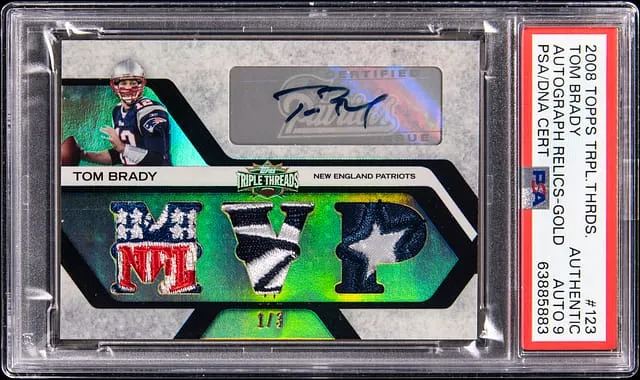
Tom Brady 2008 Triple Threads Gold Auto Patch #1/3 Sale
Figuring out the $16,333 sale of a 2008 Topps Triple Threads Gold Tom Brady auto patch #1/3 at Goldin on May 10, 2026. Pop 1, PSA Authentic, PSA/DNA 9.
Sold Card
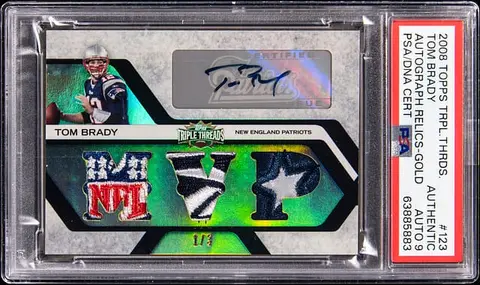
2008 Topps Triple Threads Autograph Relics Gold #TTRA-123 Tom Brady Signed Patch Card (#1/3) - PSA Authentic, PSA/DNA MINT 9 - Pop 1
Sale Price
Platform
Goldin2008 Topps Triple Threads Autograph Relics Gold #TTRA-123 Tom Brady Signed Patch Card (#1/3) - PSA Authentic, PSA/DNA MINT 9 - Pop 1 Sold for $16,333 on Goldin
On May 10, 2026, Goldin sold a 2008 Topps Triple Threads Autograph Relics Gold #TTRA-123 Tom Brady Signed Patch Card, serial numbered 1/3, for $16,333. The card is graded PSA Authentic with a PSA/DNA MINT 9 autograph and currently sits as a pop 1 (population 1) in PSA’s database.
In this breakdown, we’ll look at what this card is, why collectors care about it, and how this sale fits into the broader Brady and high-end patch-auto market.
Card Overview
Card details
- Player: Tom Brady
- Team: New England Patriots
- Year: 2008
- Set: Topps Triple Threads
- Card: Autograph Relics Gold #TTRA-123
- Serial numbering: #1/3 (only three copies made; this is the first)
- Attributes: Multi-color patch relic, on-card autograph (signed directly on the card), low-serial gold parallel
- Grading: PSA Authentic (card), PSA/DNA MINT 9 (autograph)
- Population: Pop 1 at this specific designation
This is not a rookie card; Brady’s rookies are from 2000. Instead, this is a premium veteran patch autograph from a well-known mid-2000s high-end product line.
About 2008 Topps Triple Threads
Topps Triple Threads in this era was positioned as a higher-end release, focused on:
- Multi-piece relics (jersey and patch windows)
- Low-serial-number parallels
- On-card signatures for top-tier players
For many collectors, Triple Threads from the mid/late 2000s is part of the “early modern” premium era—well after the junk wax years, but before the ultra-modern explosion of one-of-one and shield patches everywhere. Print runs were lower than mass products, and the better parallels still do not surface often.
Grading, Autograph, and Pop Context
This copy is labeled PSA Authentic for the card. That means PSA confirmed the card is genuine but did not assign a numerical grade to the card itself. In many high-end patch-auto examples, collectors are more focused on:
- Eye appeal of the patch
- Condition and boldness of the autograph
- Serial number and parallel
The PSA/DNA MINT 9 auto grade indicates the ink quality and presentation of Brady’s signature are high-end. For autograph collectors who value the signature as much as the cardboard, that MINT 9 label can be a significant differentiator compared to ungraded autos.
“Pop 1” here refers to population report—how many copies PSA has recorded with this exact label combination. With only three copies of the gold parallel in existence, the pop report will always be very low, but a pop 1 underscores how rarely these surface in encapsulated form.
Market Context and Comps
For a low-serial Tom Brady patch autograph like this, direct one-to-one comparisons are limited. When looking for “comps” (recent comparable sales used as a price reference), collectors usually check:
- The same card in other grades/labels
- Other 2008 Triple Threads Brady autos (different parallels or prints)
- Brady patch autos from similar-era premium products (e.g., Exquisite, National Treasures, SP Authentic)
Publicly accessible sales data for this exact card in any grade is very sparse. That’s not surprising:
- Only 3 copies exist of the gold parallel.
- Not all high-end sales are reported or stay visible long term.
However, some directional observations are possible:
Brady’s premium patch autos from the 2000s: High-end, low-serial Brady autographs with strong patches from respected brands have consistently commanded five-figure prices in recent years. Models with better brand recognition (like Exquisite or National Treasures RPAs and multi-color patches) often sit at the upper end of that range and beyond.
Triple Threads vs. top-tier brands: Triple Threads is generally considered a strong but not top-of-the-pyramid release compared with Exquisite or National Treasures. That said, its earliest years still carry significant respect because supply is genuinely low and the checklist is loaded with stars.
Impact of the ‘Authentic’ grade: Numerically graded examples (e.g., PSA 8, 9, BGS 9/10) can sometimes realize higher prices if the card condition is exceptional. An Authentic designation removes the card condition debate and places more focus on the patch, serial number, and the auto grade. This can sometimes temper the price when compared to gem-mint-level slabs, but it can also broaden the buyer pool who are less condition-sensitive.
Given this context, a $16,333 realized price fits within a realistic band for a low-serial Brady patch auto from a respected 2000s product, even if not at the absolute top of the Brady auto hierarchy. It recognizes:
- The 1/3 gold parallel scarcity
- The eye appeal and MINT 9 auto
- The mid/late-2000s origin of the card
Without a chain of recent, public sales of the exact TTRA-123 gold parallel, it’s hard to call this a clear record or a bargain; rather, it sits as a data point that helps define the market for high-end non-rookie Brady patch autos from the 2000s.
Why Collectors Care About This Card
1. Tom Brady’s Legacy
Brady is widely viewed as one of the most important figures in modern sports collecting. For many football collectors, he is the equivalent of Jordan in basketball:
- Multiple championships and MVPs
- Historical significance for the Patriots dynasty
- A large global fan base beyond Boston and New England
While rookie cards are the foundation of Brady’s market, premium patch-autographs from his playing years have become a separate, strong lane of collecting.
2. Early Modern Premium Patch-Auto Appeal
Cards like this 2008 Triple Threads gold parallel hit a sweet spot:
- They’re modern enough to have lower print runs and better design/patch technology than earlier sets.
- They’re old enough that supply coming to market is thin; many are locked in long-term collections.
This era is often where active hobbyists and returning collectors meet. People who were collecting or watching in the 2000s recognize the product, and newer collectors see it as an authentic bridge between older sets and the ultra-modern one-of-one era.
3. Ultra-Low Serial Number & Patch
A card numbered 1/3 is effectively a piece of memorabilia:
- Only three copies exist of this parallel.
- The specific patches used can make one copy more visually desirable than another.
Within such small runs, ‘comps’ become more about taste and timing than strict pricing formulas. If the patch and autograph present well, a single determined bidder can push the realized price meaningfully.
4. PSA/DNA MINT 9 Autograph
Autograph-only grading has gained traction, particularly for cards where surface or edge wear makes a high overall grade unlikely. A MINT 9 label on the auto provides clarity:
- The signature is bold, clean, and strong.
- It satisfies autograph-focused collectors as well as card collectors.
In some segments of the market, a strong auto grade can be more important than the card’s numerical grade, especially for on-card signatures.
How This Sale Fits the Brady Market in 2026
By 2026, Brady’s status as a retired legend is firmly established. The themes influencing his market include:
- Stability in key pieces: True rookie cards, iconic inserts, and top-tier patch-autos have shown resilience, with occasional spikes connected to hobby cycles or media attention.
- Selectivity: Collectors are increasingly focused on quality—on-card signatures, low serial numbering, strong patches, and clean presentation—rather than just any Brady auto.
- Separation between tiers: Rookie patch-autos and top brands sit in their own lane, but strong veteran patch-autos like this one continue to see solid demand because they check multiple “collector boxes” (on-card auto, low-serial, patch, major player).
This Goldin sale at $16,333 adds another confirmed data point to that landscape. It reinforces that:
- Early modern, low-serial Brady patch-autos from respected brands are still commanding five-figure prices.
- Cards graded Authentic but with strong autograph grades can be viable, liquid pieces for serious collectors.
Takeaways for Collectors and Small Sellers
If you’re learning the Brady or high-end football market, here are a few practical notes drawn from this sale:
Pay attention to the whole package
- Serial number (1/3 in this case)
- Patch quality (colors, breaks, and centering in the window)
- On-card vs. sticker autograph (on-card generally preferred)
- Autograph grade (PSA/DNA 9 or 10 can matter)
Use comps carefully with low-serial cards
- For something numbered to 3, there may be no perfect sales history.
- Look at similar-era, similar-tier products and parallels to triangulate a reasonable ballpark instead of expecting an exact comparable.
Understand the brand hierarchy
- Exquisite, National Treasures, SP Authentic, and a few others usually sit at the “top shelf.”
- Triple Threads is a respected premium brand, and its earliest years have a following, but its values will usually slot in under the very top-tier RPAs.
Grading strategy matters
- If the card’s corners or edges show wear but the autograph is exceptional, focusing on auto grade (as here with Authentic/auto 9) can make sense.
- Some buyers are more comfortable with a clearly labeled MINT 9 auto than with an ungraded signature.
Final Thoughts
The sale of the 2008 Topps Triple Threads Autograph Relics Gold #TTRA-123 Tom Brady, #1/3, for $16,333 at Goldin on May 10, 2026, underscores both the durability and nuance of the Brady high-end market.
It’s not a rookie, and it’s not from the single most iconic high-end brand, but it checks enough of the right boxes—short print, on-card auto, multi-color patch, PSA/DNA MINT 9—to anchor itself as a meaningful piece for advanced Brady and premium football collectors.
For collectors tracking long-term trends, data points like this help outline the middle and upper tiers of Brady’s non-rookie auto market. For newer or returning hobbyists, it’s a useful example of how scarcity, brand, era, and grading interact to create value in modern football cards.
As always, these realized prices are context, not guarantees. But they’re valuable signposts for understanding where key segments of the Brady market stand today.