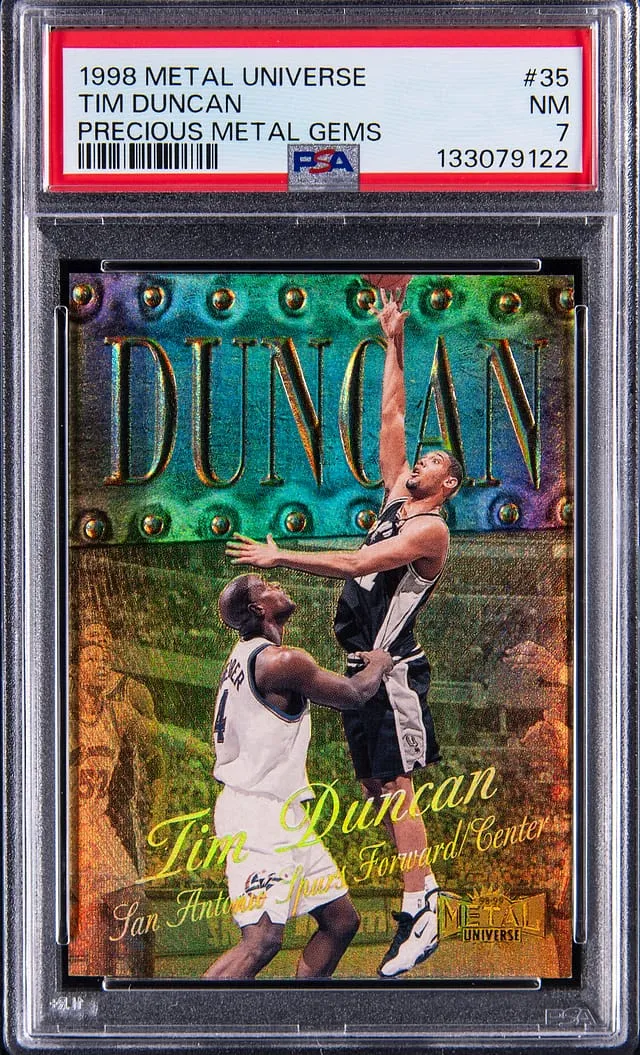
Tim Duncan 1998-99 PMG PSA 7 sells for $17,080
Goldin sold a 1998-99 SkyBox Metal Universe PMG Tim Duncan PSA 7 #30/50 for $17,080. See what this means for 90s inserts and Hall of Fame markets.
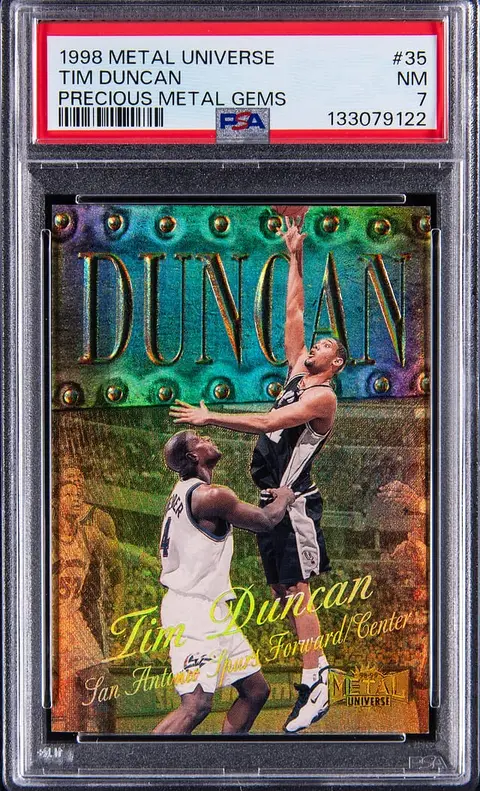
Sold Card
1998-99 SkyBox Metal Universe Precious Metal Gems (PMG) #35 Tim Duncan (#30/50) - PSA NM 7
Sale Price
Platform
Goldin1998-99 SkyBox Metal Universe Precious Metal Gems (PMG) cards sit near the top of many 90s basketball want-lists, and this Tim Duncan just reminded the market why.
On March 15, 2026, Goldin sold a 1998-99 SkyBox Metal Universe Precious Metal Gems #35 Tim Duncan, serial-numbered 30/50 and graded PSA NM 7, for $17,080. For a late‑90s Hall of Fame big man in one of the hobby’s most respected parallel lines, it’s a result worth unpacking.
The card at a glance
- Player: Tim Duncan
- Team: San Antonio Spurs
- Year / Set: 1998-99 SkyBox Metal Universe
- Parallel: Precious Metal Gems (PMG), serial-numbered to 50
- Card number: #35
- Serial number: 30/50
- Grading company: PSA
- Grade: NM 7 (Near Mint)
This is not a rookie card (Duncan’s rookie season is 1997-98), but it is a key late‑90s parallel from his early playing years. Precious Metal Gems parallels are ultra-short-printed versions of the base cards, famous for bold foil designs, color schemes, and condition sensitivity.
Why PMGs matter to collectors
For newer or returning collectors:
- A parallel is a version of a base card with a different design, numbering, or finish that’s usually harder to pull.
- PMG (Precious Metal Gems) is one of the most famous parallel brands in basketball, especially from the late 1990s.
Although 1997-98 Metal Universe PMGs are the best-known, the 1998-99 run still carries significant weight because:
Era and scarcity
Late‑90s Metal Universe products were printed in far smaller quantities than modern sets. A print run of 50 makes this Duncan parallel legitimately scarce, not just “short printed” in marketing terms.Condition sensitivity
PMGs are notorious for chipping, scratching, and edge wear due to their foil-heavy construction. High-end grades are tough. Even a PSA 7 can represent a relatively strong example compared with raw copies or heavily worn ones.Player caliber
Tim Duncan is a five-time NBA champion, two-time MVP, and widely regarded as one of the greatest power forwards of all time. His early, numbered parallels are considered cornerstone pieces for Spurs and Hall of Fame-focused collections.Set aesthetics and nostalgia
Metal Universe designs are instantly recognizable—bright, often wild backgrounds that defined a chunk of 90s basketball card culture. Collectors who grew up in that era often seek these cards as nostalgia pieces upgraded into high-end, graded form.
Grading context: PSA 7 for a late‑90s PMG
PSA uses a 1–10 scale, with 10 as Gem Mint. A PSA 7 (Near Mint) typically signals presentable eye appeal with some combination of visible edge or corner wear or minor surface flaws.
For condition-sensitive inserts like PMGs, a PSA 7 is often viewed differently than a PSA 7 on a standard glossy base card from a modern set. Many collectors simply want a clean, authenticated copy with strong centering and color, and are more forgiving of edge wear and print issues.
Population reports (or “pop reports”)—the grading company’s count of how many copies exist in each grade—are useful for understanding relative scarcity but can change as more cards get submitted. For this Duncan PMG, overall graded population remains low compared with most modern serial-numbered parallels.
Price context: how does $17,080 fit in?
The Goldin sale closed at $17,080 on March 15, 2026. Without overreaching beyond available public data, we can place that in general context:
- PMG hierarchy: 1997-98 PMGs, especially in higher grades, tend to command the strongest prices across most star and superstar names. 1998-99 PMGs usually come in below those peak levels but still trade as true premium inserts.
- Player tier: Within 90s PMGs, there’s a tiering: Jordan at the peak, followed by icons like Kobe, Shaq, and then Hall of Famers like Duncan, Garnett, and others. Duncan’s price levels reflect his quieter persona but elite résumé.
While exact, recent comps (comparable sales) for this specific card in PSA 7 are limited due to genuine scarcity, a $17,080 result is broadly consistent with where:
- Early‑era, numbered Duncan parallels from premium sets have been trending.
- Non-rookie, early‑career PMGs of top-tier Hall of Famers tend to settle when they appear at major auction houses.
Because these cards trade infrequently, there isn’t a smooth price curve. One or two sales can set the reference point for months. This Goldin auction now becomes a key data point the next time a similar Duncan PMG shows up, especially in a similar grade.
Comparing across grades and parallels
When comps are thin, collectors often look at:
- Other grades of the same card – For example, a PSA 8 or 9, if they exist and have traded, help anchor how much condition matters to buyers.
- Same player, different PMG year – Duncan’s 1997-98 PMGs (when available) will almost always sit at a premium due to first-year PMG status, but they help map collector demand for his Metal Universe parallels overall.
- Other Hall of Fame bigs from the same set – Players like Kevin Garnett or even secondary stars can serve as rough benchmarks. Duncan’s championships and awards usually place him near the top of any big-man price comparison from this era.
For active hobbyists and small sellers, the main takeaway is that grade, player tier, year of PMG, and color/serial run all interact. Sometimes a slightly lower grade with particularly strong eye appeal can compete closely with a higher numerical grade for PMGs, given how tough the card stock is.
Collector significance beyond the number
Why does this specific card resonate, beyond the price tag?
- Early-career Duncan: 1998-99 captures Duncan as a rising star who had just started laying the foundation for the Spurs’ dynasty. It’s an early, numbered snapshot of a player who went on to define winning basketball for nearly two decades.
- True scarcity: With only 50 copies printed—and only a fraction graded and traded publicly—many collectors will never see this card in person, let alone own one.
- Set prestige: Even for collectors who don’t chase Duncan specifically, a 90s PMG in any Hall of Fame name is often treated as a cornerstone piece.
For newer collectors, this sale is a reminder that iconic 90s inserts and parallels remain a separate ecosystem from ultra-modern color-chase rookies. Print runs are lower, designs are distinct, and the collector base is often longer-term and player-focused rather than purely driven by short-term performance.
What this sale suggests for the PMG and Duncan markets
A single auction never tells the full story, but a publicly visible $17,080 sale at a major house like Goldin does a few things:
- Reaffirms demand for high-end Duncan inserts, especially from respected 90s sets.
- Provides a new comp for auctioneers, consignors, and buyers who have been waiting for a fresh data point on this specific card.
- Highlights the stability of established Hall of Fame names in the insert/parallel lane, even without major current-player news driving attention.
Duncan hasn’t had recent on-court activity—his case is long established. That makes cards like this more about long-horizon appreciation of his career and the era’s design, rather than short bursts of hype.
Takeaways for different types of collectors
New or returning collectors:
- Use sales like this as a chance to learn the structure of 90s inserts: base, inserts, parallels, and how serial numbering works.
- When you see terms like “PMG,” know that you’re looking at an established, historically important parallel line, not just a random color variation.
Active hobbyists:
- Thin comp history means you’ll often need to triangulate value using population reports, past sales of related cards, and current auction interest.
- Eye appeal and provenance (big auction houses, well-known consignors) can nudge results within a grade band.
Small sellers and traders:
- If you handle 90s inserts, make sure you photograph condition closely. Collectors expect edge and corner wear, but transparency helps cards find the right buyers.
- Major recorded sales like this one can support conversations around pricing when you bring rare parallels to shows or online marketplaces.
Final thoughts
The March 15, 2026 Goldin sale of the 1998-99 SkyBox Metal Universe Precious Metal Gems #35 Tim Duncan (#30/50) in PSA NM 7 at $17,080 underlines how strongly the market continues to respect 90s PMGs and established Hall of Fame stars.
For collectors building Tim Duncan player runs, Spurs collections, or 90s insert portfolios, this card is a case study in how scarcity, set prestige, and player legacy intersect—and how that intersection continues to shape realized prices in today’s hobby.