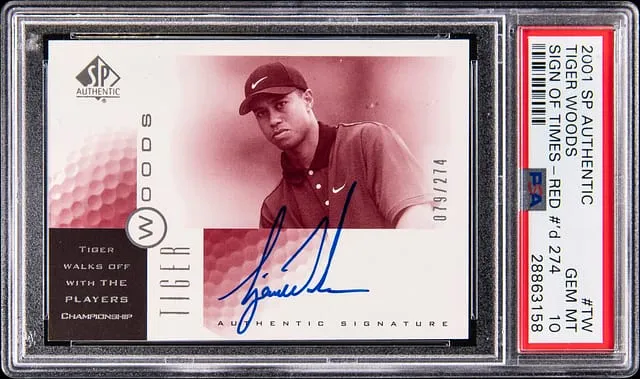
Tiger Woods 2001 SP Authentic SOTT Red PSA 10 Sale
A PSA 10 Tiger Woods 2001 SP Authentic Sign of the Times Red auto /274 just sold for $12,200 at Goldin. Here’s what it means for golf card collectors.
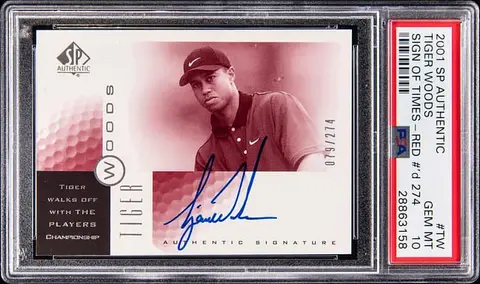
Sold Card
2001 Upper Deck SP Authentic Sign Of Times Red #TW Tiger Woods Signed Card (#079/274) - PSA GEM MT 10
Sale Price
Platform
GoldinTiger Woods’ early autographs sit in a small, carefully watched corner of the hobby, and the 2001 Upper Deck SP Authentic Sign of the Times Red is one of the key cards in that group. On May 22, 2026, Goldin sold a copy of the 2001 Upper Deck SP Authentic Sign Of Times Red #TW Tiger Woods Signed Card, serial numbered 079/274 and graded PSA GEM MT 10, for $12,200.
In this post, we’ll look at what this card is, why it matters to collectors, and how this sale fits into the broader Tiger Woods and golf card market.
The card at a glance
Card details
- Player: Tiger Woods
- Year: 2001
- Set: Upper Deck SP Authentic
- Subset/Insert: Sign of the Times
- Parallel: Red (serial numbered to 274)
- Card number: #TW
- Serial number: 079/274
- Autograph: On‑card (Tiger signed directly on the card)
- Grading: PSA GEM MT 10
This is not Tiger’s first card overall, but it is an important early‑era signed card from just after his 2001 season, during the peak years of his dominance. SP Authentic is Upper Deck’s premium, autographed‑focused brand, and the Sign of the Times line is one of its signature autograph inserts.
The Red parallel is limited to 274 copies, each hand‑numbered on the card. That kind of serial numbering (a fixed, printed run that’s actually shown on the card) gives collectors a concrete sense of scarcity.
Why this Tiger Woods auto matters
A key early‑2000s Tiger issue
For modern golf collectors, Tiger’s late‑1990s and early‑2000s cards form the foundation of the entire category. Within that window, you’ll see a few major themes:
- First‑wave Tiger rookies and early cards – Cards from 1996–2001, including his most recognized rookies and key inserts.
- On‑card autographs – Signed cards where Tiger signed directly on the card stock, usually in blue ink.
- Numbered premium inserts – Cards like Sign of the Times that combine an autograph with defined, relatively low print runs.
The 2001 SP Authentic Sign of the Times Red checks all three boxes: early career era, on‑card auto, and a numbered parallel. While it’s not his absolute earliest autograph, it is a core early‑period SP Authentic auto and a recognizable target for Tiger collectors building a small, focused run of his best issues.
SP Authentic and Sign of the Times in the hobby
SP Authentic is an Upper Deck brand that, across multiple sports, has become known for:
- Card designs that focus heavily on the signature
- Relatively controlled print runs
- A consistent autograph‑insert identity through sets like Sign of the Times
For many collectors, a Sign of the Times card is the definition of an “anchor” autograph for a player’s portfolio: not the rarest or flashiest issue, but a dependable, recognizable, and historically important signed card from a premium product.
That reputation carries into golf. Tiger’s Sign of the Times cards tend to sit in a tier just below his absolute top‑end, patch/auto or ultra‑short‑print pieces, but above mass‑produced, non‑numbered autos and later‑era cards.
Grading, condition, and why PSA 10 matters
This copy earned a PSA GEM MT 10, the highest standard grade from PSA.
- PSA (Professional Sports Authenticator) is one of the main grading companies in the hobby. They authenticate the card and assign a 1–10 condition grade.
- GEM MT 10 means the card shows virtually no visible wear under normal viewing, with sharp corners, clean edges, strong centering, and a clean autograph.
For signed cards from the early 2000s, GEM MINT grades can be harder to achieve than on modern ultra‑thick or chromium stock. Surface scratches, light chipping, and edge wear are common issues.
Collectors often look at something called a pop report (population report), which is the grading company’s tally of how many copies of a specific card have received each grade. Even without quoting specific pop numbers, the general dynamic on a card like this is:
- Total graded population is modest, because this is a numbered insert from a niche sport relative to basketball or baseball.
- PSA 10s are typically a small slice of that graded population.
That scarcity at the top grade usually creates a noticeable price gap between PSA 10 copies and those in PSA 9 or BGS 9.5.
Price context: how does $12,200 fit in?
The card sold at Goldin on May 22, 2026 for $12,200.
When collectors talk about “comps” (comparables), they mean recent recorded sales of the same card or very similar versions, used as a rough reference for current market levels.
For this Tiger Woods card, useful comps include:
- Other PSA 10 copies of the 2001 SP Authentic Sign of the Times Red
- The same card in PSA 9 or other high‑end grades
- Closely related Tiger autos from similar years and sets
Across major marketplaces and auction houses, recent results for Tiger’s early numbered SP Authentic autos generally show:
- PSA 10s commanding a clear premium over PSA 9s and raw (ungraded) copies
- Some pullback versus the peak Tiger card prices seen during the broader hobby surge of 2020–2021
Within that landscape, a $12,200 sale sits in what appears to be a strong but not extreme range for a high‑grade, early‑era, numbered Tiger auto. It reinforces the idea that:
- Demand for Tiger’s better early autographs remains steady.
- Buyers are still willing to pay a notable premium for top‑pop, PSA 10 examples.
Because sales of this exact card in PSA 10 are relatively infrequent compared with mass‑market issues, each auction helps refine the market’s sense of value rather than producing a tidal shift.
Collector significance and appeal
Tiger’s place in the golf card ecosystem
Tiger Woods is to modern golf cards what Michael Jordan is to 1990s basketball: the central figure around which much of the market is built. For many hobbyists, Tiger is:
- The entry point into golf cards
- The benchmark for how the category is doing
- The player PC (personal collection) cornerstone they build around
Early‑2000s Tiger autos like this one are appealing because they capture him while he was actively rewriting the record books, not in a retrospective or legend phase.
Why collectors chase this specific card
Several factors make the 2001 SP Authentic Sign of the Times Red a solid target:
Recognizable brand and insert
SP Authentic and Sign of the Times are familiar names even to collectors who mainly focus on other sports.On‑card autograph
Many collectors prefer on‑card signatures over sticker autos, because the player signed the card itself.Defined scarcity
The run of 274 copies is low enough to feel genuinely scarce but high enough that a few surface for sale each year, which helps keep a transparent price history.High‑end grade
A PSA 10 designation on an early‑2000s, signed, serial‑numbered insert will always command attention.Crossover interest
This is a card that appeals not only to golf specialists but also to broader iconic‑athlete collectors who keep small collections of Jordan, Brady, Tiger, Serena, etc.
Market backdrop: Tiger and the hobby in 2026
A few broad trends frame this sale:
- Stabilization after a boom – The wider trading card market has cooled from its peak surge years, with many segments settling into more sustainable, data‑driven price ranges.
- Selective strength at the top – Iconic players and true key issues (low‑numbered, early, on‑card autos in strong grades) tend to hold buyer interest better than speculative or high‑print‑run cards.
- Ongoing Tiger relevance – Even as Tiger plays less frequently, his historical achievements continue to anchor long‑term interest in his best cards.
In that context, a $12,200 sale for a PSA 10 example of a numbered early‑era Tiger auto looks like a reaffirmation of his status: not a spike driven by sudden news, but part of a steady pattern where high‑quality Tiger pieces find ready bidders.
Takeaways for collectors and small sellers
For collectors considering this card or similar Tiger Woods issues, a few practical notes:
- Know your tiers – Within Tiger’s catalog, there’s a hierarchy: flagship rookies, early‑era numbered autos like this, patch/autos, and then later‑career products. Prices and demand follow that structure.
- Grade sensitivity matters – On this type of card, the difference between PSA 9 and PSA 10 can be significant. If you’re buying raw (ungraded), factor in grading risk and potential variance.
- Follow multiple venues – Tracking sales across Goldin, other auction houses, and fixed‑price marketplaces can give a clearer view of the real range of outcomes.
- Think in ranges, not absolutes – A single $12,200 sale is a data point, not a guarantee. Using several recent comps gives a more realistic sense of where the market tends to settle.
For small sellers, this sale underscores that it can be worth the time and cost to:
- Authenticate and grade higher‑end Tiger autos with a major grader like PSA.
- Consider consigning standout pieces to established auction houses such as Goldin, where the right audience is already paying attention.
Final thoughts
The 2001 Upper Deck SP Authentic Sign Of Times Red #TW Tiger Woods Signed Card (#079/274) in PSA GEM MT 10 that sold for $12,200 at Goldin on May 22, 2026 is a good snapshot of where serious Tiger Woods cards sit today.
It’s an early, on‑card, numbered autograph from a respected premium brand, in the top available grade, changing hands at a strong but grounded price level. For collectors who care about the long‑term story of the golf card market, it’s another data point showing that Tiger’s best early‑era issues continue to serve as a stable reference point in an otherwise changing hobby landscape.