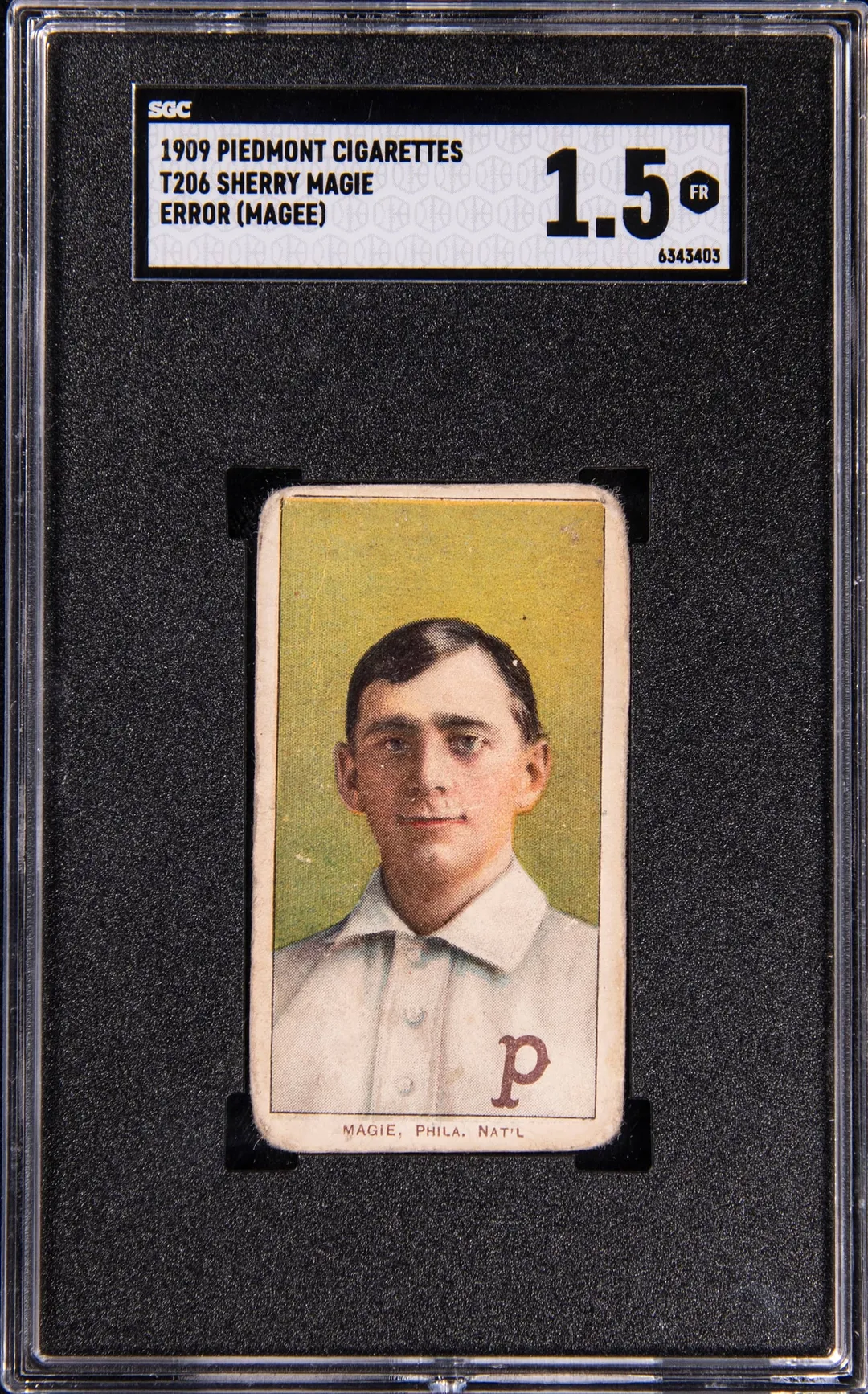
T206 Sherry Magie Error SGC 1.5 Sells for $15,860
Figoca breaks down the $15,860 sale of a T206 Sherry Magie error SGC 1.5 at Goldin on 2/22/26 and what it means for vintage baseball collectors.
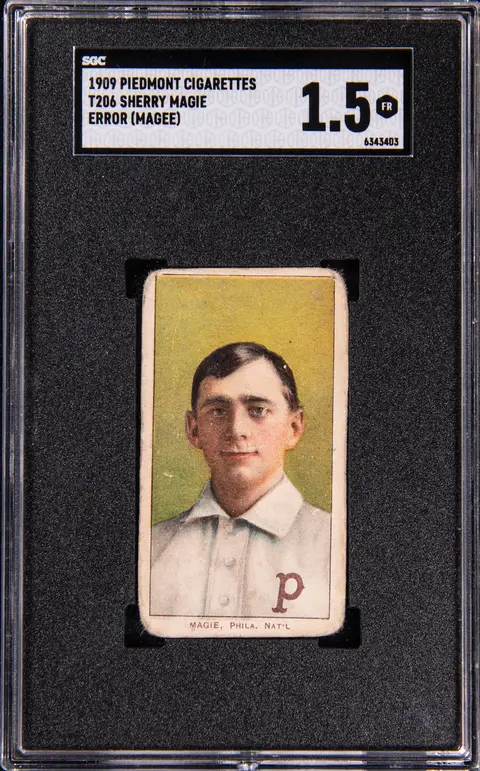
Sold Card
1909-11 T206 White Border Sherry Magie Error (Magee) - Piedmont - SGC FR 1.5
Sale Price
Platform
Goldin1909-11 T206 White Border Sherry Magie Error (Magee) - Piedmont - SGC FR 1.5 Sells for $15,860 at Goldin
The T206 set is one of the pillars of pre-war baseball collecting, and within that already iconic checklist, a few cards stand out as true hobby landmarks. One of those is the famous Sherry “Magie” error card.
In Goldin’s 2/22/26 auction, an SGC-graded example of this key error – a 1909-11 T206 White Border Sherry Magie Error (Magee), Piedmont back, in SGC FR 1.5 – realized $15,860. For a low-grade copy, that’s an important data point for collectors tracking the market for one of the true classics of the T206 run.
What exactly is this card?
- Player: Sherry Magee (printed as “Magie” on the error)
- Team: Philadelphia Phillies
- Year / Set: 1909-11 T206 White Border
- Card type: Name spelling error, corrected later; considered a key issue
- Back: Piedmont (a common tobacco brand back in the set)
- Grading company: SGC (Sportscard Guaranty Corporation)
- Grade: FR 1.5 (Fair)
Sherry Magee was a star outfielder of the dead-ball era, and the T206 set – issued in tobacco products from 1909 to 1911 – is widely viewed as the foundational baseball card issue. It includes names like Ty Cobb, Walter Johnson, Christy Mathewson, Cy Young, and the famous Honus Wagner.
The “Magie” card is a printing error where Magee’s last name was misspelled. Importantly, the error was corrected fairly early in production, which makes the error version significantly scarcer than the corrected “Magee” card. That combination – part of T206, a tough error, and a known checklist need for set builders – is why this card is treated as one of the classic pre-war rarities.
Why collectors care about the Sherry Magie error
For many collectors, there are four T206 cards that sit on a tier of their own:
- Honus Wagner
- Eddie Plank
- Sherry Magie error
- Joe Doyle N.Y. Nat’l error
The Magie is generally considered the third or fourth “big” card from the set, depending on how you rank the Doyle error. It is:
- A key set card: Anyone attempting a complete T206 master run (all major variations) will eventually need a Magie.
- A true error, not a minor variation: This isn’t just a font change or a small layout tweak; the player’s name is wrong, and that’s central to the card’s identity.
- Shorter printed than the corrected version: Correction during the print run means fewer error copies survived.
Because the T206 set is over a century old, survival rates are low and most examples show heavy wear. That’s especially true for cards that have been chased for decades by advanced collectors, like the Magie. As a result, even low-grade copies – including ones with creases, rounded corners, and surface wear – carry significant value.
Understanding the SGC FR 1.5 grade
SGC’s FR 1.5 (Fair) grade sits between Poor (1) and Good (2). A card in this range typically shows:
- Multiple creases or heavy folds
- Rounding or chipping at the corners
- Noticeable surface wear
- Possible minor paper loss or staining
In the vintage world, especially for truly scarce key issues, “collector grade” often means exactly this kind of condition. Many hobbyists prioritize simply owning an authentic example of an important card rather than holding out for higher technical grades.
Market context and recent sales
Because this is a landmark pre-war error card, sales are less frequent than for modern or even standard vintage hall of famers. A “comp” (short for comparable sale) is a recent transaction that helps establish a realistic price range.
Over the last several years, public auction records for the T206 Sherry Magie error show a wide spread depending on:
- Grade (from low-grade authentic/1.0 up to mid- and high-grade examples)
- Eye appeal within the same grade
- Back type (Piedmont, Sweet Caporal, and scarcer backs)
Low-grade examples in the SGC/PSA 1–2 range have typically sold in the low-to-mid five-figure range, while mid- and high-grade examples can reach far higher numbers. Within that context, the Goldin sale at $15,860 for an SGC 1.5 Piedmont back lines up with the general pattern for heavily worn but fully collectible copies.
This Goldin result does not appear to be an extreme outlier so much as another solid data point in an already well-established market for the card. It continues to confirm that even well-loved Magie errors remain firmly in five-figure territory.
Why the Piedmont back matters (and why it doesn’t)
T206 cards can be found with many different advertising backs, corresponding to the tobacco brands that distributed them (Piedmont, Sweet Caporal, Sovereign, Old Mill, and more). Some backs are far rarer than others and can heavily influence value.
For the Magie error specifically:
- Piedmont is one of the more common backs in the T206 universe.
- Scarcer backs on this error card can command a stronger premium.
However, because the error itself is so important, even a common back like Piedmont still draws intense interest. Most collectors who simply want to add a Magie to their collection are more concerned that it is authentic, graded, and reasonably presentable than whether it has an ultra-rare back.
How this sale fits into broader T206 and pre-war trends
In the last several hobby cycles, pre-war staples have tended to behave differently from modern “chase” cards:
- Supply is fixed and tiny. No new Magie errors are being printed. What survives is all there is.
- Demand is deep and long-term. Collectors have pursued T206 legends for generations, creating a stable base of interest.
- Condition is relative. A rough copy of a key T206 card is still a major piece. That’s different from many modern issues where low-grade often means low demand.
The $15,860 sale on 2/22/26 reinforces a few themes collectors often talk about:
- Key pre-war issues remain highly liquid. Liquidity means the card can usually find a buyer at a fair market price.
- Error legends still command a premium over standard stars. Many hall of famers from the same era sell for less, even in higher grades.
- Graded authentication is valued. SGC’s holder and label give buyers confidence that the card is genuine and correctly identified as the error version.
Takeaways for collectors and small sellers
For collectors:
- If you are building a T206 set, this sale is a useful benchmark for what a low-grade Magie error can bring through a major auction house.
- Eye appeal and back type can still move the needle within the same grade, so comparing images and auction descriptions is important when using comps.
For small sellers and hobbyists:
- When you encounter pre-war cards, even in rough condition, it’s worth checking for known errors and variations. The Magie error is one of the more famous, but there are others.
- For high-value vintage cards, third-party grading from companies like SGC can help establish authenticity and broaden your buyer pool.
Final thoughts
The 1909-11 T206 White Border Sherry Magie Error (Magee) with a Piedmont back, graded SGC FR 1.5, selling for $15,860 in Goldin’s 2/22/26 auction is another steady, informative datapoint for one of pre-war baseball’s cornerstone errors. It underscores how much long-term respect there is for true T206 keys, even in heavily worn condition.
For anyone mapping out a T206 journey – whether it’s a team run, star run, or an ambitious master set – this sale helps frame what it might take to cross the Magie error off the list.