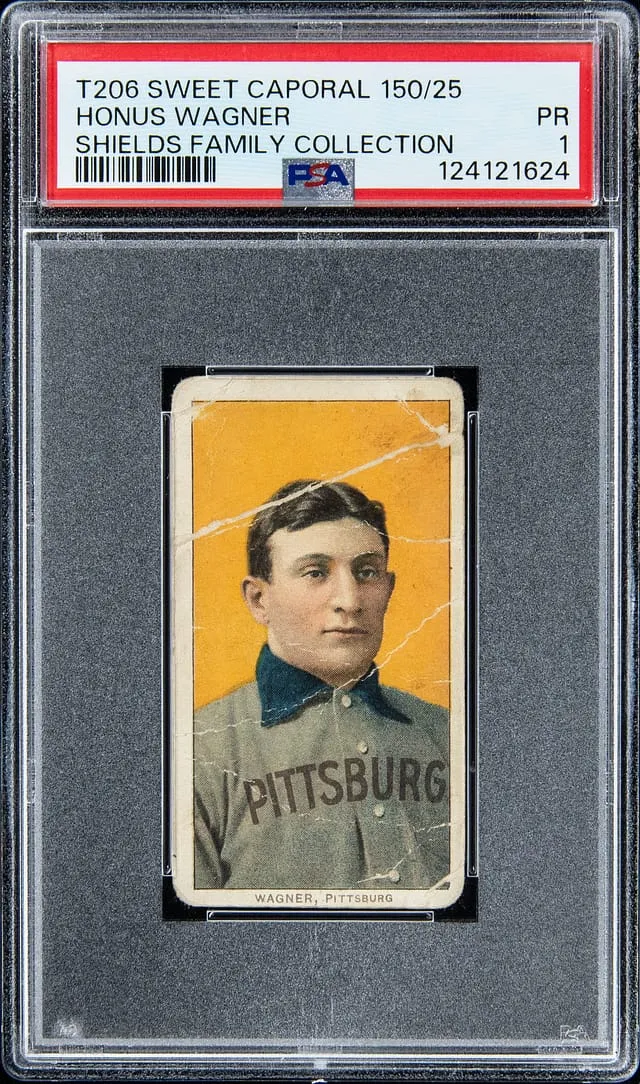
T206 Honus Wagner PSA 1 Sells for $5.12M at Goldin
A PSA 1 T206 Honus Wagner from the Shields Family Collection sold for $5,124,000 at Goldin on Feb 22, 2026. Here’s what that means for collectors.
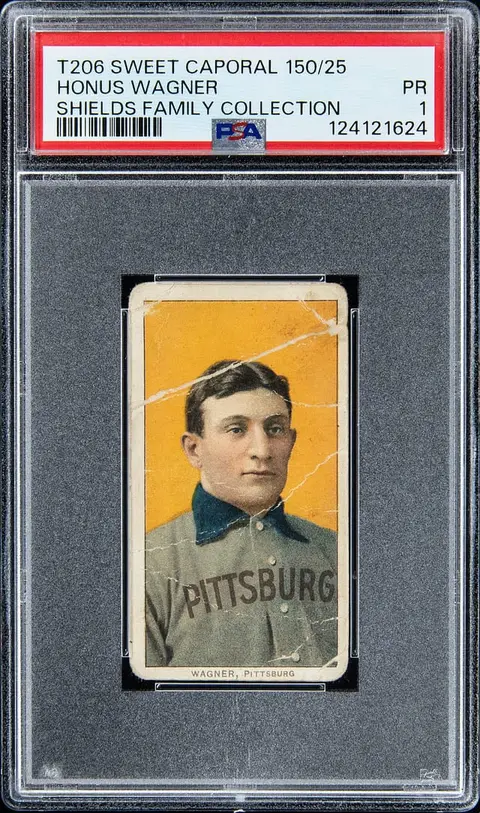
Sold Card
1909-11 T206 White Border Honus Wagner - Sweet Caporal 150/25 - Shields Family Collection - PSA PR-FR 1
Sale Price
Platform
Goldin1909-11 T206 Honus Wagner Sells for $5,124,000: What It Means for the Hobby
On February 22, 2026, Goldin sold one of the most important baseball cards ever produced: a 1909-11 T206 White Border Honus Wagner – Sweet Caporal 150/25 – Shields Family Collection, graded PSA PR-FR 1. The final price was $5,124,000.
For vintage collectors, this is more than a headline. It’s a fresh data point in the long, evolving story of the T206 Wagner—the card many people outside the hobby think of when they hear the words “rare baseball card.”
The Card: T206 Honus Wagner, Sweet Caporal 150/25
Let’s start with the basics:
- Player: Honus Wagner, Pittsburgh Pirates
- Team: Pittsburgh Pirates
- Years/Issue: 1909–1911
- Set: T206 White Border (often just called “T206”)
- Brand/Back: Sweet Caporal Cigarettes, Factory 25, Series 150 (printed on the back as “Sweet Caporal 150/25”)
- Type: Key short print and hobby icon; effectively a “grail” card rather than a traditional rookie chase
- Era: Pre-war vintage tobacco issue
- Grading company: PSA (Professional Sports Authenticator)
- Grade: PR-FR 1 (Poor–Fair)
- Provenance: Shields Family Collection
T206 is one of the most studied and collected baseball sets ever made. Produced by the American Tobacco Company between 1909 and 1911, the set covers hundreds of players and multiple tobacco brands. Within that huge checklist, the Honus Wagner card is the defining short print: famously scarce, heavily researched, and central to the hobby’s history.
The Sweet Caporal 150/25 back is one of several back variations seen on Wagner’s card. Back variations (the ad on the reverse, such as Sweet Caporal, Piedmont, etc.) are a major sub-specialty in T206 collecting, and they contribute to how collectors compare and track populations. While certain backs are dramatically rarer than others, all Wagner backs are inherently scarce.
Why the T206 Wagner Matters
The T206 Wagoner isn’t important only because it’s old or valuable. Collectors care about it for a combination of historical, aesthetic, and scarcity reasons:
True hobby icon
The T206 Wagner is often called the “Mona Lisa of baseball cards.” It has been at the center of hobby coverage for decades, including mainstream media and auction records.Short print with a story
Compared to the rest of the T206 set, Wagner’s card had a much more limited print run. Various theories exist—concerns over tobacco advertising, contract issues, or personal preference—but the result is clear: far fewer Wagner cards were distributed.Pre-war vintage scarcity
Pre-war tobacco cards were never produced with modern collecting in mind. Survivors went through pockets, bike spokes, decades of storage, and in many cases, neglect. That’s why even low-grade examples are so fiercely pursued.PSA population context
While exact numbers change as more cards are discovered, cross over, or are regraded, the PSA population for T206 Wagners is extremely low, especially when compared to more common stars from the same set. Each individual copy tends to be well documented and discussed.Grade vs. importance
With most modern cards, a PSA 1 is a budget option. For the T206 Wagner, even a PSA 1 is a centerpiece card and part of elite hobby conversations.
The Shields Family Collection Provenance
Several prominent Wagners are known by the collections they’ve long resided in. Provenance—an established record of prior ownership—plays a meaningful role in how collectors evaluate museum-level pieces.
The PSA PR-FR 1 Sweet Caporal 150/25 example sold by Goldin is known as part of the Shields Family Collection, adding another layer of identity to a card that’s already well defined. Long-term family ownership and well-documented history can be appealing to collectors, especially in the pre-war space where each card’s journey is part of its story.
Market Context: How Does $5,124,000 Fit In?
The hammer price converted from cents is $5,124,000 USD. To understand this sale, it helps to zoom out and look at the broader Wagner market.
Historical Wagner Highlights
Over the last two decades, multiple T206 Wagners have set hobby benchmarks. Some key themes from past public sales (across various grades and back types):
- Record-setting prices for higher-grade copies: When mid- to high-grade examples appear (for example, PSA 5 and above), they have historically set new public records for the hobby.
- Strong results even in low grade: Authenticated and graded Wagner cards in authentic/altered, 1, or 2 have regularly sold for seven figures, reflecting how much collectors prize ownership over condition in this specific case.
- Back type and eye appeal matter: Within the same numerical grade, cards with stronger visual appeal or especially desirable backs often command a premium.
How This Sale Compares
For this specific Sweet Caporal 150/25, PSA PR-FR 1 Shields Family example:
- Grade: A PSA 1 is at the low end of the numeric scale, but still desirable given the card’s importance.
- Result: At $5,124,000, this sale slots into the upper tier of public results for low-grade Wagners. It reflects the ongoing trend that iconic, historically significant cards can maintain and even grow their standing over long periods, even as the broader market cycles up and down.
Recent comps (comparable sales, meaning other examples of the same card or very similar versions) show that Wagners continue to attract deep bidding from advanced collectors and institutions. Exact price comparisons vary by:
- Back type (Sweet Caporal, Piedmont, etc.)
- Visual appeal (color, centering, creases, paper loss)
- Provenance and story
- Timing and auction house marketing
Within that context, the Goldin February 22, 2026 sale confirms that demand for the Wagner remains robust.
Why Collectors Still Chase Low-Grade Wagners
Understanding this sale means understanding vintage grading culture.
Grading is the process where a third party (like PSA) evaluates a card’s condition and assigns a numeric grade—1 (Poor) up to 10 (Gem Mint) for PSA. For modern cards, condition is often everything. For pre-war icons, the equation is different.
For the T206 Wagner:
- Ownership over perfection: Many collectors simply want any authentic example. A PSA 1 can still hold sharp color or a strong portrait, even with creases or surface wear.
- Survivor bias: Every surviving copy has passed through more than a century of handling. Wear is expected, and in some cases, even appreciated as part of the storytelling.
- Limited supply: There are far fewer Wagners than there are advanced collectors who want one. That imbalance keeps demand strong across the grade spectrum.
The Shields Family PSA 1 sale reinforces that for truly iconic cards, lower technical condition does not mean “entry-level pricing” in the way it might for more common vintage.
What This Means for the Wider Market
For newcomers and returning collectors, it’s important to separate two ideas:
The T206 Wagner is its own market.
Its history, scarcity, and established mythology make it behave differently than most cards. You can’t simply take Wagner prices and project them onto more typical vintage or modern cards.But it still sends signals.
When an all-time key card performs well, it suggests there is ongoing confidence and interest at the high end of the hobby. That doesn’t guarantee anything about specific players, sets, or eras, but it does show that serious collectors continue to allocate capital to blue-chip pieces.
Other takeaways for collectors:
- Provenance matters: Named examples with documented histories can stand out even among already-rare cards.
- Eye appeal and back variations are key details: When you research comps, look beyond the grade. Back, centering, color, and creasing patterns can all affect price.
- Long timelines: Many of the strongest results in vintage involve cards that have been in collections for decades. Vintage is often a long-hold segment of the hobby.
How to Read Comps Without Overreacting
“Comps” (comparable sales) are recent transaction prices that collectors look at to understand the current range for a card. With something as thinly traded as a T206 Wagner, each public sale becomes a major data point, but it still has limits:
- Low transaction volume: There simply aren’t many Wagners, so one sale can reflect specific bidder dynamics rather than a universal market move.
- Card-specific features: Two PSA 1s can have very different eye appeal and provenance, which may justify different prices.
- Auction timing: Market sentiment, competing inventory, and even macroeconomic conditions can influence results.
For most collectors, the lesson isn’t “everything is now worth more,” but rather “the most established, historically significant cards continue to be taken seriously by advanced buyers.”
Final Thoughts
The February 22, 2026 Goldin sale of the 1909-11 T206 White Border Honus Wagner – Sweet Caporal 150/25 – Shields Family Collection – PSA PR-FR 1 at $5,124,000 is another chapter in the card’s long-running market story.
For the broader hobby, it’s a reminder that:
- Truly historic cards behave differently than the rest of the market.
- Low-grade doesn’t mean low importance for pre-war icons.
- Provenance and story can be just as compelling as the number on the flip.
Whether you’re just learning about T206 or you’re already deep into tobacco-era checklists, tracking sales like this helps build a clearer picture of how scarcity, history, and collector demand intersect at the top of the hobby.