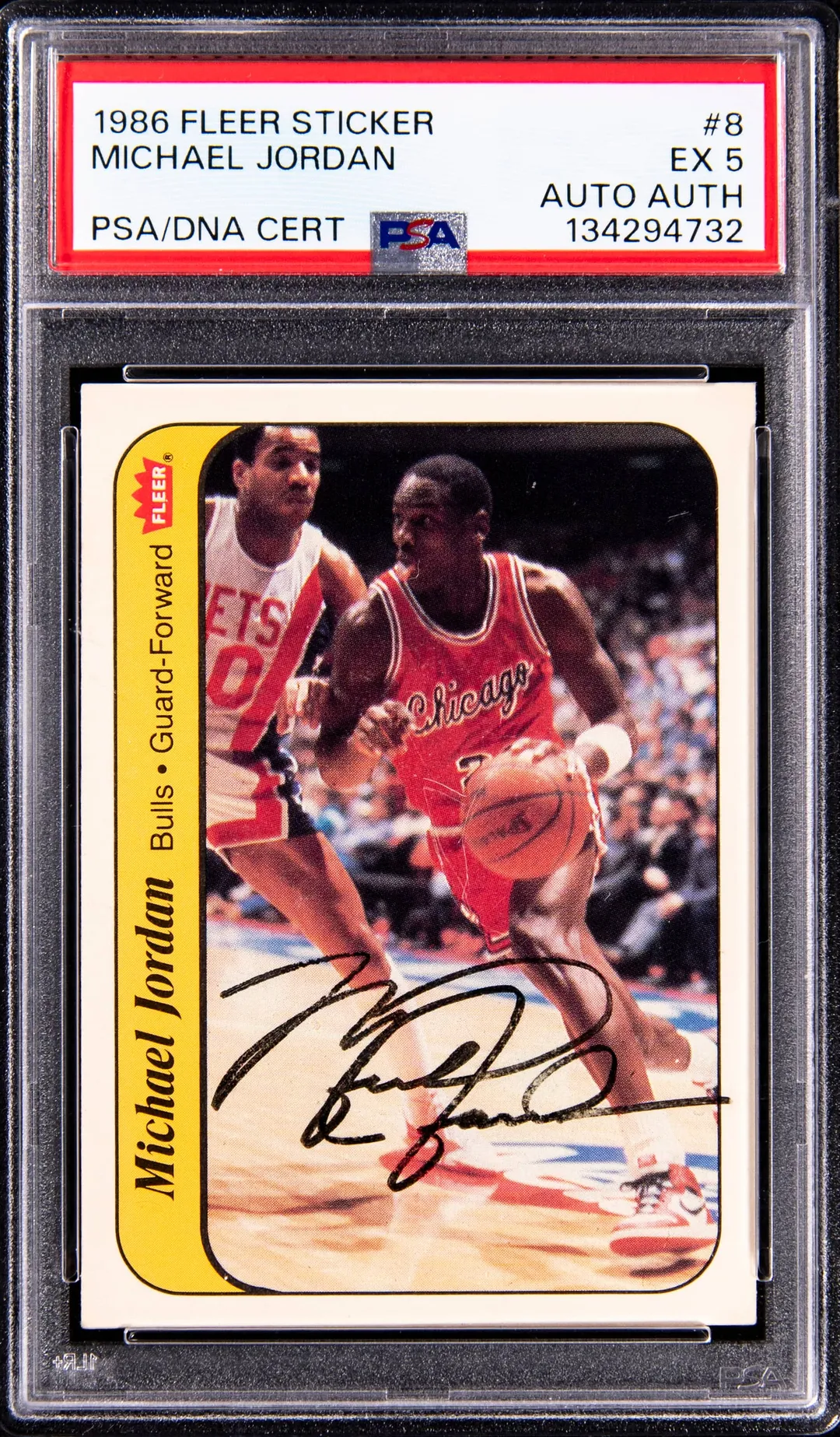
Signed 1986-87 Fleer Jordan Sticker Rookie Sells
Goldin sold a PSA 5, PSA/DNA authentic 1986-87 Fleer Sticker #8 Michael Jordan signed rookie card for $37,820. Here’s what it means for the market.
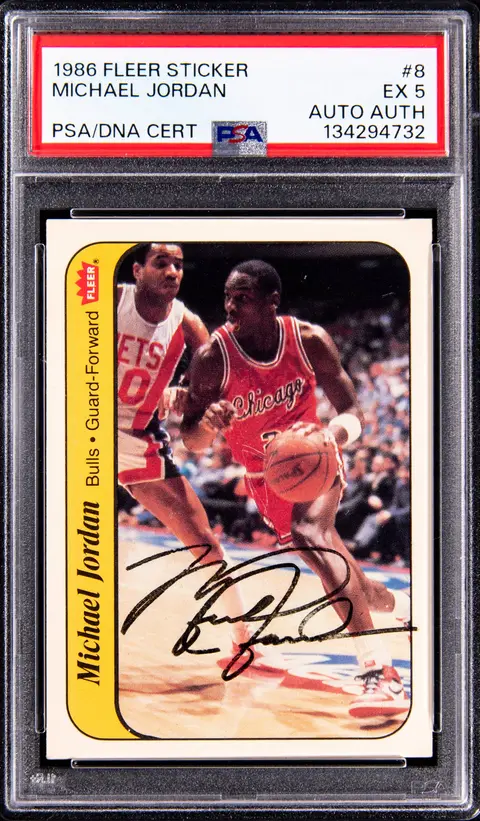
Sold Card
1986-87 Fleer Sticker #8 Michael Jordan Signed Rookie Card - PSA EX 5, PSA/DNA Authentic
Sale Price
Platform
Goldin1986-87 Fleer Sticker #8 Michael Jordan Signed Rookie Card Sold for $37,820
On February 8, 2026, Goldin sold a 1986-87 Fleer Sticker #8 Michael Jordan signed rookie card for $37,820. For collectors tracking key Jordan pieces and the vintage autograph market, this is a useful data point in a segment that often flies under the radar compared with unsigned rookies.
Card overview
- Player: Michael Jordan
- Team: Chicago Bulls
- Year / Set: 1986-87 Fleer Sticker
- Card number: #8
- Type: Rookie-year sticker card (widely treated as a companion rookie to his 1986 Fleer base #57)
- Attributes: On-card autograph, authenticated by PSA/DNA
- Grading: PSA EX 5 for the card, PSA/DNA Authentic for the signature
The 1986-87 Fleer run is widely considered Jordan’s flagship rookie issue. The standard base card is #57, while the sticker subset includes #8 and is commonly regarded as his primary rookie sticker. PSA’s EX 5 grade sits in the middle of the scale: presentable, but with noticeable wear typical for a 1980s sticker that was prone to surface and corner issues.
Why this card matters
Importance of the 1986-87 Fleer Sticker
The 1986-87 Fleer release is one of the landmark sets in basketball history. It arrived after a multi-year gap without major licensed NBA card sets, and it captured a wave of stars—Jordan, Barkley, Olajuwon, Ewing, Malone and more—in what collectors often call their “true” pack-issued rookies.
Within that release, the sticker subset has a few characteristics that matter to collectors:
- Condition sensitivity: Stickers are more susceptible to edge and surface wear, making high grades difficult.
- Companion rookie status: While the base #57 is the flagship, the sticker #8 is a recognized rookie-year Jordan and a core piece for 1986 Fleer master collectors.
- Visual appeal: The bold yellow border and portrait-style photo help it stand out next to the base card.
Signed vintage rookies vs modern autographs
This particular copy is not just graded—it is also signed by Michael Jordan, with the autograph authenticated by PSA/DNA. That places it in a smaller niche of vintage, on-card autographed rookie-era items, which differs from today’s pack-inserted autographs.
A few distinctions matter here:
- Aftermarket autograph: Jordan’s signature was added after the card left the pack, then authenticated by PSA/DNA. It is not a pack-issued auto.
- On-card signature: The autograph is directly on the card surface, not on a sticker label later applied to the card.
- Dual grading: The card receives a condition grade (PSA 5 EX), and the autograph is labeled “Authentic” by PSA/DNA rather than receiving a numeric grade.
For many Jordan collectors, the combination of a true rookie-year issue and a verified Jordan signature creates a different kind of centerpiece than a typical modern signed card. Even though it doesn’t carry a serial number like modern chase cards, its age and connection to the iconic 1986-87 Fleer release give it a level of historical weight.
Market context and recent sales
When collectors talk about “comps” (short for comparable sales), they’re looking at recent, similar transactions to understand where a current sale sits within the market. With Jordan’s signed 1986 Fleer Sticker #8, exact comps can be sparse because:
- Not every Jordan rookie sticker has been signed.
- Those that are signed may have different combinations of card grade and autograph assessment (e.g., PSA 4 / Auto 9, PSA 6 / Authentic auto, etc.).
- Many sales occur in major auctions rather than steady, repeatable fixed-price marketplaces.
This Goldin sale at $37,820 on February 8, 2026 lands in the broader context of:
- Unsigned 1986 Fleer Sticker #8 Jordan: Higher-grade unsigned copies (PSA 8–9) can reach strong five-figure levels, while mid-grade unsigned copies are typically lower. The signed example here commands a premium above many equivalent mid-grade unsigned stickers, reflecting the added demand for authenticated Jordan signatures on rookie-era cardboard.
- Signed 1986 Fleer Jordan rookies overall: Historically, signed 1986 Fleer Jordan base and sticker cards tend to command notable premiums over unsigned equivalents, but the premium size can vary widely depending on card grade and the autograph’s presentation.
The exact premium of this sale will depend on the most recent, directly comparable auction results. Available public data shows that Jordan’s signed 1986 Fleer rookies—both base and sticker—can vary significantly from sale to sale because of eye appeal, auction timing, and bidder competition.
Rather than viewing $37,820 as an outlier in either direction, it fits into the mid- to high five-figure range that serious collectors have been willing to pay for vintage, authenticated Jordan rookie-era autographs. It’s a meaningful marker for what a PSA 5 / PSA-DNA Authentic configuration can achieve in a major auction setting.
Population, scarcity, and grade realities
“Pop report” is short for population report—a grading company’s public count of how many copies of a card exist at each grade level. For 1986-87 Fleer Jordan cards, population reports tell a clear story:
- The base and sticker rookies have thousands of graded copies overall.
- High grades (PSA 9–10) are relatively scarce compared to the total print run, especially for the sticker subset.
- Signed and authenticated examples are only a fraction of the total graded population.
Within the PSA 5 EX tier, the card is not rare by 1980s standards, but combining that with a PSA/DNA-authenticated on-card autograph makes this a narrower lane. Only a small share of the graded population is both signed and slabbed with dual PSA + PSA/DNA labeling.
Why collectors care about this specific sale
For newcomers and returning collectors trying to understand why this card matters, a few themes stand out:
- Historical importance: The 1986-87 Fleer run is a cornerstone set for basketball, and Jordan is its central figure. Owning any piece of that set—with an added Jordan autograph—is a way of tying into hobby history.
- Vintage auto niche: As more collectors pay attention to the gap between modern pack-issued autographs and vintage, aftermarket-signed rookies, sales like this help define expectations for that segment.
- Data point for signed mid-grade rookies: Price transparency is limited for specific combinations like PSA 5 / PSA-DNA Authentic. This Goldin sale provides a fresh benchmark for future comparisons.
What this means for different types of collectors
New and returning collectors
If you’re just coming back to the hobby or starting out, this sale is a reminder that:
- You don’t need to chase five-figure cards to enjoy the set. Raw (ungraded) or lower-grade 1986-87 Fleer commons, semi-stars, and even some stars can be more accessible.
- The difference between unsigned and signed copies can be huge in price, even when the underlying card is the same.
Use sales like this to learn how grading, autograph authentication, and card history interact, rather than as a target price to “beat.”
Active hobbyists and small sellers
For hobbyists who buy and sell regularly, this $37,820 result can be useful in a few ways:
- Pricing context: It provides a reference point when evaluating other Jordan rookie-era autographs, especially signed stickers around the mid-grade level.
- Risk awareness: Thinly traded segments—like signed vintage rookies—can be volatile from auction to auction. A single sale can move perceived value, but it’s wise to watch several results over time before drawing firm conclusions.
- Eye appeal focus: As more collectors scrutinize centering, surface, and autograph placement, small differences in presentation may justify very different final prices, even within the same nominal grade.
Takeaways
The 1986-87 Fleer Sticker #8 Michael Jordan Signed Rookie Card – PSA EX 5, PSA/DNA Authentic that sold for $37,820 at Goldin on February 8, 2026 (UTC) is another data point in the evolving market for signed Jordan rookie-era pieces. It underscores a few consistent hobby themes:
- The 1986-87 Fleer ecosystem—base and sticker—remains a central focus of high-end basketball collecting.
- Authenticated on-card signatures on vintage, iconic issues continue to attract serious bidding.
- Exact pricing can swing based on grade, autograph labeling, and auction context, so tracking multiple comps over time is essential.
For collectors and small sellers, the value of this sale isn’t in treating it as a prediction, but as a grounded reference: a real-world number for a specific combination of card, grade, and autograph that helps calibrate expectations the next time a similar card surfaces.