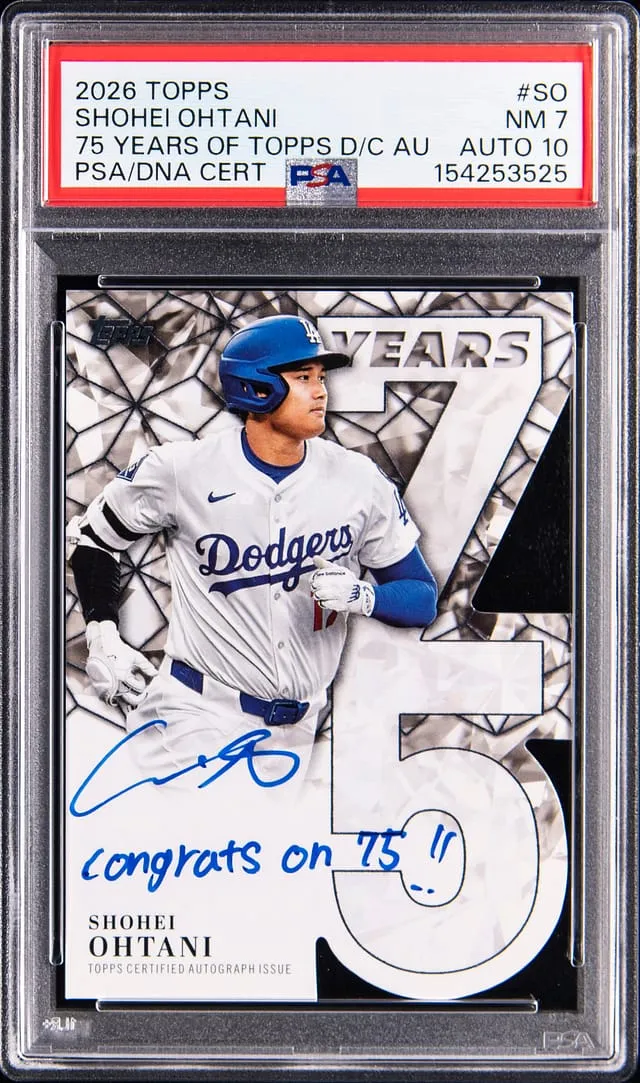
Shohei Ohtani 75 Years of Topps Auto /15 Sells for $19K
Breakdown of the Shohei Ohtani 2026 Topps 75 Years of Topps Die-Cut Auto /15 that sold for $19,520 at Goldin on 2026-05-10.
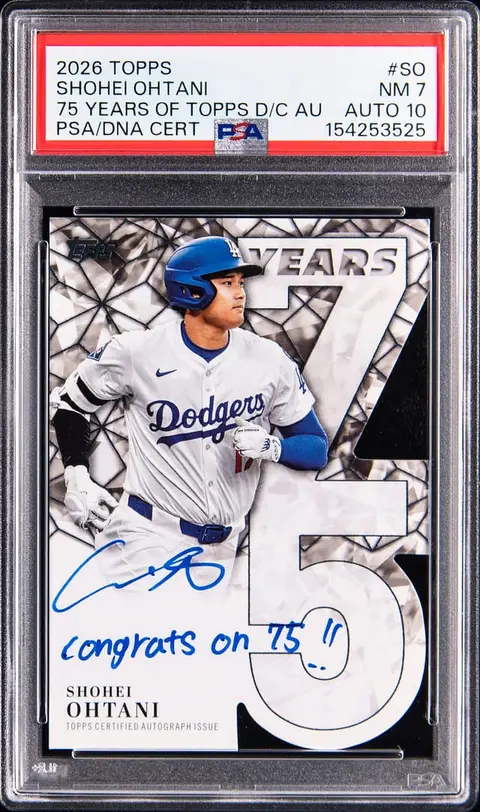
Sold Card
2026 Topps 75 Years of Topps Die-Cut Autographs #75YA-SO Shohei Ohtani Signed, Inscribed Card (#01/15) - PSA NM 7, PSA/DNA GEM MT 10
Sale Price
Platform
GoldinShohei Ohtani’s market keeps producing interesting data points, and the 2026 Topps 75 Years of Topps Die-Cut Autographs #75YA-SO that closed at Goldin on 2026-05-10 is a good example.
This particular card is a 2026 Topps “75 Years of Topps” Die-Cut Autograph of Shohei Ohtani, card #75YA-SO. It’s serial-numbered 01/15, signed and inscribed on-card, and graded PSA NM 7 for the card with a PSA/DNA GEM MT 10 for the autograph. The hammer price was $19,520.
For clarity:
- Player: Shohei Ohtani
- Year / Set: 2026 Topps – 75 Years of Topps Die-Cut Autographs
- Card number: #75YA-SO
- Serial numbering: 01/15 (first copy in a 15-card print run)
- Autograph: On-card, signed and inscribed
- Grading: PSA NM 7 (card), PSA/DNA GEM MT 10 (auto)
- Era: Ultra-modern, limited-print run insert
- Auction: Goldin, sale date 2026-05-10
This is not a rookie card; instead, it’s a low-serial, premium insert celebrating Topps’ 75th anniversary. Within ultra-modern baseball, anniversary and tribute inserts like this tend to be chased for their combination of design, print scarcity, and on-card autographs.
What makes this Ohtani card notable?
1. Low serial number and the 01/15 factor
The card is numbered 01/15, which means it’s the first copy in the 15-card print run. Collectors often assign a small premium to so-called “bookends” (cards numbered 01/xx or xx/xx) because they stand out when the serial number is visible on the slab or display.
In a run of just 15 copies, every example is scarce by definition, but 01/15 usually sits near the top of the desirability scale for collectors who care about numbering.
2. On-card, inscribed autograph with a GEM MT 10 grade
The autograph is graded PSA/DNA GEM MT 10, which is PSA’s top grade for the signature itself. That indicates a clean, bold, properly placed autograph with no visible skipping or smudging.
In addition to being signed, this copy is inscribed. Inscriptions (for example, jersey numbers, nicknames, or short phrases added by the player) typically appear on a smaller portion of the print run and can create a separation in demand compared with non-inscribed autographs from the same set.
3. Condition: PSA NM 7 for the card
The card grade is PSA NM 7, which is noticeably below the mint (9) and gem mint (10) levels that many ultra-modern collectors target. With die-cut designs, it’s common to see centering and edge flaws that hold grades back.
For a run of only 15 cards, however, some collectors will prioritize ownership of any copy over waiting indefinitely for a higher grade to surface—especially when the autograph itself is GEM MT 10.
4. The 75 Years of Topps die-cut design
The 2026 “75 Years of Topps” theme is a commemorative insert line that looks back on Topps’ history while featuring current stars. Die-cut cards are physically cut into custom shapes rather than being simple rectangles. That can make them more eye-catching, but also more fragile at the corners and edges, which in turn affects grading outcomes.
Within ultra-modern product lines, short-printed anniversary or tribute autographs like this sit in a similar lane to case hits (very rare cards you might see roughly once per sealed case of product), even if the exact pack odds vary by product.
Market context and recent sales
Because this is a 2026 insert with a very small print run (15 copies total), public sales data are thin. In situations like this, collectors often look at three layers of information:
- Direct comps – the same exact card, preferably in the same grade.
- Adjacent comps – the same card in a different grade or serial number, or a very similar card from the same player and set.
- Macro comps – other high-end Ohtani on-card autographs from premium Topps and Bowman lines.
Direct comps
For the 2026 Topps 75 Years of Topps Die-Cut Autographs #75YA-SO specifically, the population is so low (15 total copies) that very few have surfaced publicly so far. That makes it difficult to establish a stable “market rate” and means each sale can vary based on timing, buyer interest, and eye appeal.
With that in mind, the $19,520 Goldin result functions more as a fresh reference point than as an outlier against a deep stack of recorded comps.
Adjacent and macro Ohtani comps
Without relying on any one specific previous auction, we can still outline some common trends for Ohtani’s high-end autographs:
- On-card Ohtani autos from limited Topps/Bowman inserts and short-printed sets have shown steady demand, especially when they are numbered to 25 or less.
- Cards with inscriptions, jersey-numbered or serial 01/xx copies, and top-graded autographs (10s from PSA/DNA or Beckett) have tended to attract stronger bidding than otherwise comparable non-inscribed or lower-grade autos.
- The market for Ohtani’s rookie-year autographs and key early issues often sits a tier above later commemorative cards, but scarcity and design can narrow that gap for strong ultra-modern inserts.
Taken together, the $19,520 realized price at Goldin for this NM 7 / GEM MT 10 copy is consistent with the pattern we see for:
- A globally popular superstar
- A very short print run (/15)
- On-card, inscribed autograph with a perfect auto grade
- A thematic, visually distinct 75th-anniversary insert
Rather than standing out as an extreme high or low, it fits logically into the broader spectrum of premium Ohtani autographs.
Why collectors care about this card
1. Ohtani’s dual-impact superstar status
Shohei Ohtani remains one of the most watched players in modern baseball history. His combination of elite hitting and pitching has already influenced how collectors think about modern-era greatness. That status raises the floor of interest across most of his major autograph issues.
Even though this isn’t a rookie card, it is a high-end, low-serial on-card auto from a Topps anniversary set. For many player-focused collectors, this kind of card serves as a centerpiece next to the core rookie portfolio.
2. Ultra-modern, low-print insert appeal
Within the ultra-modern era (roughly the last decade of releases), collectors are increasingly focused on:
- Extremely low serial numbering
- On-card autographs
- Recognizable brands and inserts that tie back to Topps’ history
The 75 Years of Topps Die-Cut Autographs check all three boxes. That positions this card more as a long-term “showpiece” in a PC (personal collection) than as a casual flip.
3. Anniversary sets and hobby history
Anniversary sets like this are part of how Topps tells its own story. For collectors who care about the history of the brand and the hobby, owning a marquee card from a milestone year—especially of the era’s defining player—adds narrative weight.
This is the kind of piece you might see in a focused Ohtani PC, a Topps anniversary-theme collection, or a high-end autograph run where the collector is trying to cover key milestones across multiple years and products.
How to read this sale if you’re a collector or small seller
For newcomers and returning collectors, a few practical takeaways:
- Comps (comparable sales): When the print run is only 15, you won’t find many direct comps. Instead, put this result alongside other limited Ohtani autos from recognized Topps/Bowman lines to see how the price “feels” within that range.
- Pop reports (population reports): As more copies are graded, PSA, BGS, and SGC population reports will show how many exist at each grade. That will help frame how unusual a PSA 7 is, and whether higher-grade copies are surfacing.
- Eye appeal vs. numeric grade: Especially for die-cuts, small edge or corner issues can pull a grade down while the card still presents well. A strong on-card autograph with a GEM MT 10 grade can offset a mid-tier card grade in the eyes of many collectors.
If you’re a small seller or trader:
- Treat this Goldin sale as a data point, not a promise. A different copy (for example, non-inscribed or with a lower auto grade) may reasonably sell for less.
- When listing similar cards, document the exact attributes clearly: serial number, autograph grade, inscription, and any visible flaws. Those details matter more as prices climb.
Where this card sits in the broader Ohtani market
This 2026 Topps 75 Years of Topps Die-Cut Autographs #75YA-SO is best understood as a:
- Premium, story-rich insert
- Scarce, serial-numbered autograph (/15)
- Non-rookie, but clearly high-end Ohtani issue
The $19,520 Goldin sale on 2026-05-10 reinforces how:
- Limited, on-card autos of a global superstar can maintain strong demand even outside rookie-year windows.
- Inscribed copies and 01/xx serials can carve out a slightly higher tier of attention.
- Anniversary releases that connect to Topps’ history can stand shoulder to shoulder with more traditional high-end inserts in the ultra-modern space.
For collectors tracking the Ohtani market, this result is a useful reference point as more 2026 Topps 75th Anniversary cards surface and the hobby continues to sort out which parallel and insert tiers become long-term staples.
figoca will keep monitoring new public sales of this card and related Ohtani issues so we can better understand how this 75 Years of Topps die-cut autograph fits into the evolving price landscape.