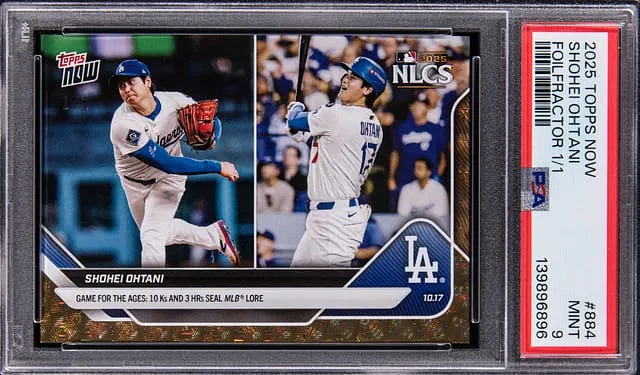
Shohei Ohtani 2025 Topps Now 1/1 FoilFractor Sale
Goldin sold a 2025 Topps Now FoilFractor #884 Shohei Ohtani 1/1 PSA 9 for $48,190 on March 15, 2026. Here’s what that price says about the market.
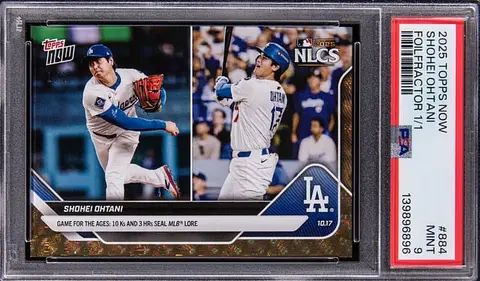
Sold Card
2025 Topps Now FoilFractor #884 Shohei Ohtani (#1/1) - PSA MINT 9
Sale Price
Platform
Goldin2025 Topps Now FoilFractor #884 Shohei Ohtani (#1/1) – PSA MINT 9 Sold for $48,190
On March 15, 2026, Goldin closed a notable ultra‑modern baseball sale: a 2025 Topps Now FoilFractor #884 Shohei Ohtani, serial‑numbered 1/1 and graded PSA MINT 9, realized $48,190.
For a one‑of‑one parallel of the hobby’s most followed player, this result offers a useful snapshot of how collectors are currently valuing high‑end Ohtani cards in the post‑Dodgers‑signing landscape.
Card basics: what exactly sold?
Let’s break down the key details of this card:
- Player: Shohei Ohtani
- Team: Los Angeles Dodgers (Topps Now typically reflects current team/moment at print time)
- Year: 2025
- Product: Topps Now (print‑on‑demand, moment‑based set)
- Card number: #884
- Parallel: FoilFractor, serial‑numbered 1/1 (only one copy produced)
- Serial numbering: "#1/1" stamped
- Rookie status: Not a rookie card (Ohtani’s MLB rookies are 2018 issues), but a premium ultra‑modern parallel
- Grading company: PSA (Professional Sports Authenticator)
- Grade: PSA MINT 9
The FoilFractor treatment here is essentially the top of the parallel ladder for this specific Topps Now card – the single scarcest version of card #884.
Why this card matters to collectors
1. A premium one‑of‑one of the hobby’s key modern star
Ohtani sits at the center of modern baseball collecting. He’s a two‑way MVP, a global star, and a driver of demand in both the U.S. and international markets. While his 2018 rookie cards remain foundational, later‑year 1/1s – especially from brands with strong followings like Topps – have become important “trophy cards” for player collectors.
This FoilFractor checks several boxes:
- Star power: Ohtani remains one of the most in‑demand modern players.
- True scarcity: A verified 1/1 parallel means there is literally only one copy of this exact card.
- Graded high: PSA 9 is a strong grade for a modern, glossy, condition‑sensitive parallel.
2. Topps Now as a moment‑driven product
Topps Now is a print‑on‑demand line: cards are made only for a short window in response to specific on‑field moments. Collectors order during that window; the print run is then fixed.
Within that structure, ultra‑low‑serial parallels like this FoilFractor function as chase pieces – they’re the version that serious player or team collectors often target when building a “moment” run.
While Topps Now doesn’t carry the same long‑term brand weight as flagship Topps or high‑end releases, it has carved out a niche among:
- Moment collectors (who like to track a season’s big plays or milestones)
- Player super‑collectors (who chase every parallel of a given player)
- Set and team builders
A one‑of‑one FoilFractor merges that moment focus with true scarcity.
3. Ultra‑modern era dynamics
This card sits squarely in the ultra modern era (roughly mid‑2010s onward). In this era:
- Serial‑numbered and one‑of‑one parallels are common across products.
- Collector attention tends to concentrate in a relatively small number of star players.
- Condition sensitivity matters, but the difference between PSA 9 and 10 can sometimes be more about scarcity and eye appeal than dramatic physical flaws.
Because there is only one copy of this exact FoilFractor, traditional "pop report" (population report) analysis – how many exist in each grade – is less relevant than for mass‑produced base cards. For a 1/1, the competition is more about owning the card at all than owning the top grade.
Price context: how does $48,190 fit in?
This Goldin sale closed at $48,190. For context, collectors typically look at comps – shorthand for comparable recent sales – to understand where a result sits.
For a unique 1/1 like this, there are no direct, repeated comps. Instead, the market tends to triangulate value using:
- Other Ohtani 1/1s (from different years or products)
- High‑end, low‑serial Ohtani cards (like /5 or /10 autos or patches)
- Topps Now Ohtani parallels with similar scarcity
Across major marketplaces and auction houses, recent high‑end Ohtani sales show a wide spread depending on:
- Whether the card is a rookie (2018) or later year
- Whether it’s autographed or game‑used memorabilia
- The brand pedigree (flagship, chrome, or premium lines vs. secondary lines)
This $48k result for a non‑rookie, non‑autographed 1/1 from a print‑on‑demand line indicates that:
- The buyer pool for truly scarce Ohtani pieces remains active.
- Collectors are still willing to allocate meaningful budgets to ultra‑modern, non‑rookie Ohtani cards when they offer unique attributes (like 1/1 status and strong grading).
Because each 1/1 is unique in design, moment, and brand, it’s more accurate to view this sale as a reference point rather than a firm benchmark. It contributes to the broader picture of where top‑end Ohtani cardboard is trading, rather than defining a strict price level for all similar cards.
PSA 9 for a modern 1/1: meaningful, but secondary to uniqueness
In mass‑produced base issues, the jump from PSA 9 to PSA 10 can have an outsized impact on value because collectors can choose among many copies. With 1/1s, the decision matrix is different:
- There is only one copy: If you want this exact FoilFractor, this PSA 9 slab is your only path.
- PSA’s brand: PSA is widely accepted in the hobby; a PSA 9 is considered high‑end, especially for a modern foil card that can easily pick up print lines or surface wear.
- Eye appeal: For many collectors, how the card looks in‑hand matters more than the single grade point.
In other words, the 1/1 serial numbering is the primary value driver; the PSA 9 label helps by confirming condition and authenticity, but it doesn’t create a traditional "competition" between populations of the same card.
What this sale may signal for the Ohtani market
A few takeaways for collectors watching Ohtani and ultra‑modern baseball more broadly:
High‑end Ohtani demand is still deep. A near‑$50k result for a non‑rookie, non‑auto 1/1 suggests that the upper tier of Ohtani collectors and investors remains engaged.
Moment‑based cards can matter when coupled with true scarcity. Not every Topps Now card will draw this kind of attention. But when a Topps Now release intersects with a star player and a true 1/1 parallel, the market is clearly willing to take notice.
Ultra‑modern pricing is event‑sensitive. Ohtani’s on‑field performance, health, awards, and team context will continue to shape how collectors value his later‑year parallels. Rather than assuming a straight line of appreciation, it can be useful to track how key sales like this correlate with major seasons or milestones.
How collectors might use this data point
For newcomers and smaller sellers, this Goldin sale can be helpful in a few ways:
- As a ceiling reference: While most Ohtani cards will never approach this price range, seeing what the very top of the market bears can help frame where more common parallels sit.
- As an example of how scarcity and brand interact: A 1/1 from a widely known manufacturer, featuring a premier player, and supported by a strong grade from a top grading company, will usually draw more attention than a similar 1/1 from an obscure line.
- As a reminder to document provenance: For ultra‑scarce cards, noting where and when a card sold (e.g., "Goldin, March 15, 2026") can matter down the line, especially if it trades again at auction.
Final thoughts
The 2025 Topps Now FoilFractor #884 Shohei Ohtani (#1/1) PSA MINT 9 sale at Goldin on March 15, 2026, adds another significant entry to the short list of high‑end Ohtani results. While unique one‑of‑ones resist simple pricing formulas, this $48,190 hammer helps map out how the hobby is currently weighing ultra‑modern scarcity, player star power, and grading for one of baseball’s defining talents.
For collectors, it’s a reminder that even outside flagship rookies and autographs, there is real attention – and capital – focused on well‑chosen, truly scarce modern parallels.