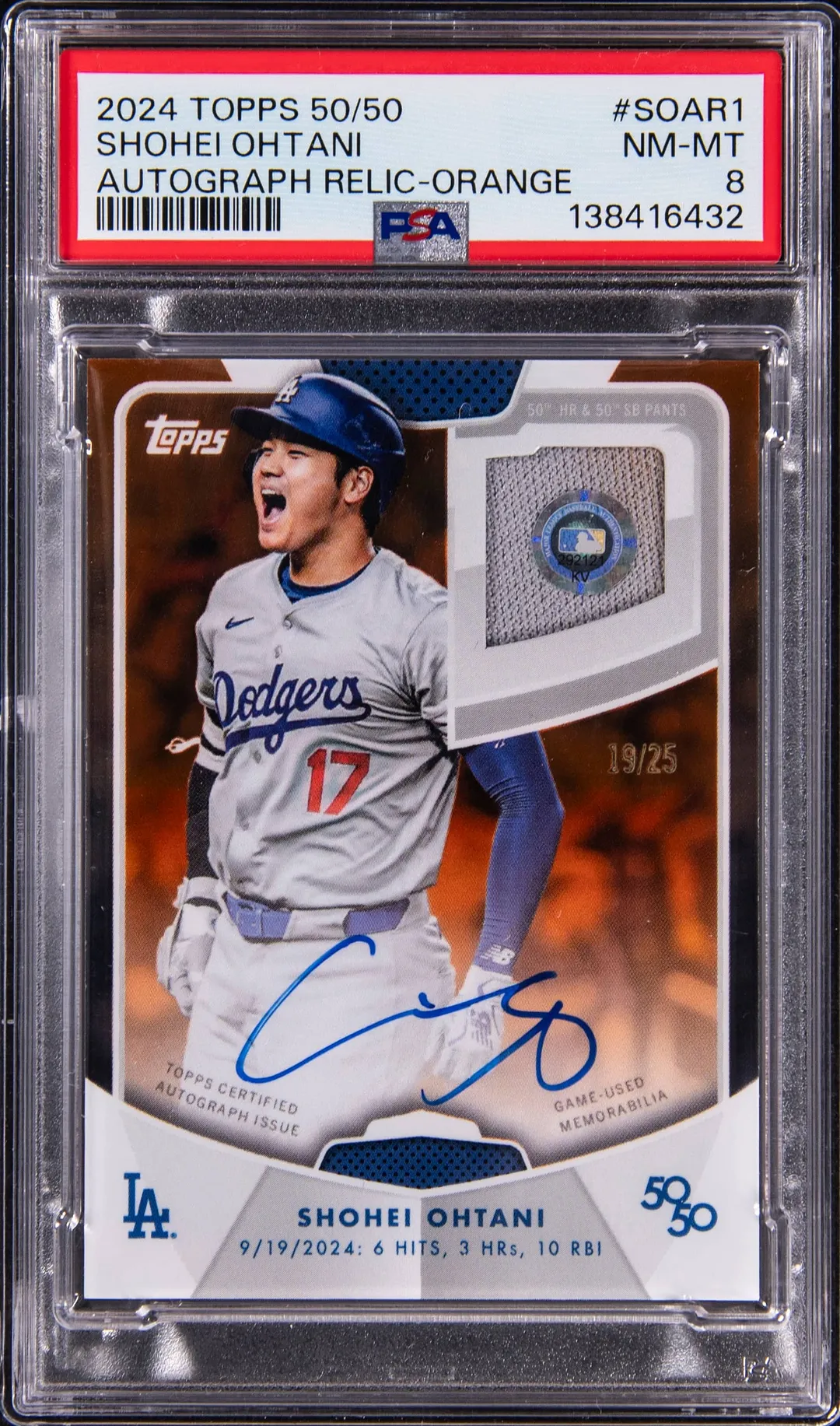
Shohei Ohtani 2024 Topps 50/50 Orange /25 Goldin Sale
Breakdown of the 2024 Topps 50/50 Shohei Ohtani Orange auto relic /25, PSA 8 Pop 1, sold for $26,850 at Goldin on Feb. 8, 2026 (UTC).
Sold Card
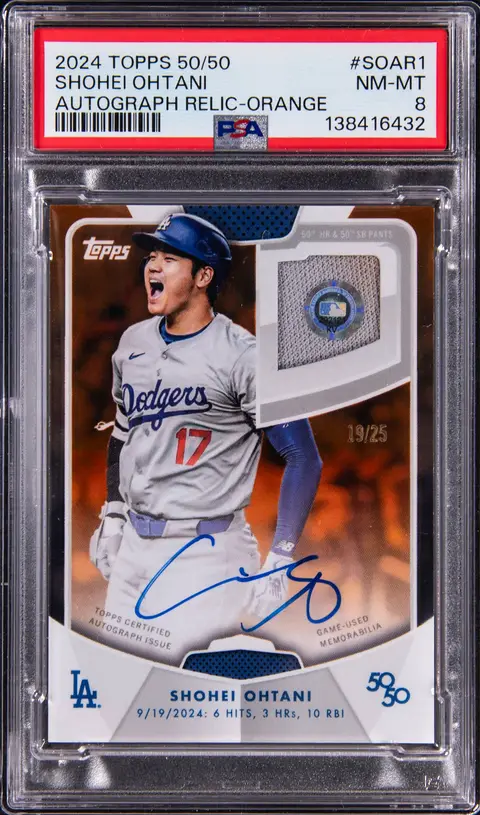
2024 Topps 50/50 Shohei Ohtani Autograph Relic Orange #SOAR-1 Shohei Ohtani Signed Game-Used Pants Relic Card (#19/25) - Used in Historic 50/50 Game on Sept. 19, 2024 - 6 Hits, 3 HRs, 10 RBI - PSA NM-MT 8 - Pop 1
Sale Price
Platform
GoldinOn February 8, 2026 (UTC), Goldin closed a notable modern baseball auction: a 2024 Topps 50/50 Shohei Ohtani Autograph Relic Orange #SOAR-1, featuring a signed game‑used pants relic from his historic 50/50 game on September 19, 2024. The card is serial‑numbered 19/25, graded PSA NM‑MT 8, and recorded as a Pop 1 (population 1) in that grade at the time of sale. The final price was $26,850.
For collectors tracking Ohtani’s market and modern high‑end memorabilia cards, this sale offers a useful datapoint at the intersection of player performance, game‑used content, and ultra‑modern scarcity.
Card overview: 2024 Topps 50/50 Shohei Ohtani Autograph Relic Orange
Let’s break down what this card is and why it matters:
- Player: Shohei Ohtani
- Team (at time of the 50/50 game): Los Angeles Dodgers
- Year: 2024
- Set: 2024 Topps 50/50
- Card: Autograph Relic Orange #SOAR-1
- Serial numbering: #19/25 (only 25 copies of this Orange parallel)
- Relic: Signed game‑used pants from the September 19, 2024 50/50 game
- Autograph: On‑card auto (signed directly on the card surface, not a sticker)
- Grading: PSA NM‑MT 8 (Near Mint‑Mint)
- Pop report: Pop 1 in PSA 8 at the time of sale
This is not a rookie card, but it is a clear “key issue” for collectors focused on Ohtani’s Dodgers era and specific historic performances. Modern sets that tie memorabilia directly to a documented game (and stat line) have been gaining steady attention from collectors who want a tangible link to a single moment, not just a generic game‑used tag.
The 2024 Topps 50/50 release is built around Ohtani’s unprecedented two‑way production and milestone performances. Within that context, an Orange parallel /25 with an on‑card autograph and game‑used pants from the very game where he went 6 hits, 3 home runs, and 10 RBI stands out as a premium chase.
Why this specific game matters
Topps clearly positions this card as a “moment card,” not just a generic star auto relic. The relic pants are documented as being used on September 19, 2024, when Ohtani posted a 50/50 performance line:
- 6 hits
- 3 home runs
- 10 RBI
Whether or not you view the “50/50” branding as a formal stat milestone, it’s a highly unusual box score line and exactly the type of single‑game spike that tends to become a reference point in a player’s career narrative.
For collectors, that matters for a few reasons:
- Specificity of the relic – Instead of a generic “game‑used” or “player‑worn” swatch with no date, the card ties the pants to a single, well‑documented game. That gives the piece a story: you can look up the box score, watch highlights, and connect the cardboard to a single night.
- Stat line appeal – Cards tied to signature games (cycles, multi‑HR games, playoff heroics, awards) typically age better in collector memory than items from random regular‑season dates.
- Early‑Dodgers narrative – For collectors building a timeline of Ohtani’s Dodgers career, this is the type of card that could sit alongside first‑Dodgers autos, first homers, and award‑season issues.
Grading and population: PSA NM‑MT 8, Pop 1
The card graded PSA NM‑MT 8. In modern ultra‑high‑end cards, collectors often aim for PSA 9 (Mint) or PSA 10 (Gem Mint), but low‑serial autograph relics behave a little differently than mass‑printed base rookies.
Key points about the grade:
- PSA 8 is still a strong copy in the context of thick autograph relic cards, which naturally face more risk of edge and corner wear out of the pack.
- Pop 1 at PSA 8 means that, at the time of the sale, this was the only example in PSA’s population report at that grade. That doesn’t mean it is the only graded copy overall; there may be raw (ungraded) examples or versions graded by other companies.
Because only 25 Orange copies exist, the PSA pop report will likely remain thin. Instead of seeing dozens or hundreds of graded examples (as you might with a flagship rookie), collectors should expect a very small graded sample, spread across PSA, BGS, SGC, and raw copies kept in personal collections.
Market context: how does $26,850 fit in?
Using available public records and recent data at the time of writing, here’s how this sale fits into the broader Ohtani market and comparable card types.
1. Direct comps for this exact card
As of now, public auction records for this exact card (2024 Topps 50/50 Autograph Relic Orange #SOAR‑1 /25, PSA 8) are limited. That is typical for:
- A new 2024 release
- A low‑serial card /25
- A card wired to a very specific game and narrative
In other words, we do not yet have a deep stack of historical sales of this precise card across multiple grades.
2. Nearby comps and reference points
Because exact comps are sparse, it’s useful to look at nearby categories:
- Other 2024 Topps 50/50 Ohtani autos and relics: Early sales for base autos or higher‑print inserts tend to come in lower ranges, as expected, with premiums attached to the lowest serial numbers (Gold, Orange, Red, 1/1) and game‑specific relics.
- Ohtani on‑card autos with game‑used relics from other modern Topps and Topps Chrome brands: These often land in the mid‑four‑figure to low‑five‑figure range, depending on serial numbering, uniform piece quality (logo patches vs. base fabric), and whether the card is tied to a specific achievement or date.
At $26,850, this sale sits comfortably in the upper tier of non‑rookie Ohtani cards with direct game‑used provenance, but below the truly record‑level cards such as:
- Early Bowman Chrome and Topps Chrome autograph rookie cards in top grades (PSA 10 / BGS 9.5/10)
- Numbered rookie autos and superfractors
- Unique 1/1 logo patch autos from premium products
Within the lane of event‑specific, low‑serial, on‑card auto relics, this result is strong but not outlandish, especially considering the 50/50 narrative and the fact that it’s a PSA‑graded copy from a fresh, story‑driven 2024 release.
3. Modern ultra‑modern context
This card lives in the ultra‑modern era: 2018‑present, where:
- Print runs are higher at the base level, but
- Short‑printed parallels (like /25) and on‑card autos still carry clear scarcity, and
- Collectors pay premiums for story + scarcity + condition.
The result suggests that:
- Collectors are willing to pay a clear premium for documented game‑used relics tied to a specific box score, even outside of rookie‑year cards.
- Ohtani’s Dodgers era market continues to sustain high‑end interest, not just for rookies and early MLB issues.
Why collectors care: more than just “another Ohtani auto”
Several layers of collector appeal converge on this card:
- Player tier – Ohtani already occupies a rare tier of modern demand, alongside names like Trout and pre‑injury superstar arms, with a global collector base across North America and Asia.
- Historic game tie‑in – A 6‑hit, 3‑HR, 10‑RBI line is the kind of box score that lands on “all‑time” lists. Cards that document these nights become markers of career chapters rather than generic star pieces.
- Autograph + relic combination – For many collectors, an on‑card autograph with a real game‑used piece is the most satisfying middle ground between a pure autograph card and high‑end memorabilia.
- Low serial numbering (/25) – In practical terms, only 25 collectors can own this exact Orange version. That constraint supports long‑term scarcity in a way base cards never can.
- Early market action – Being among the earlier notable public sales from a new, story‑driven 2024 product gives the card additional attention; later sales often use these first auction results as reference points.
What this sale might signal to collectors and small sellers
This Goldin sale does not set an all‑time Ohtani record, but it offers several useful lessons for hobbyists:
- Narrative matters. Game‑specific cards with clearly documented performances and dates often attract stronger bidding than generic relics, especially for stars whose careers are being actively written.
- Non‑rookie doesn’t mean non‑premium. While rookie cards usually sit at the top of a player’s market, key performance cards, milestone issues, and limited on‑card autos can hold meaningful value alongside them.
- Condition is important, but so is card type. A PSA 8 would be a tough sell for a mass‑printed modern base card, but for a thick, low‑serial autograph relic, it remains very collectible—especially when total population is tiny.
- Auction houses matter for visibility. High‑end Ohtani pieces consistently appear with major platforms like Goldin. Those venues can draw the collector base that understands the card’s story and is willing to bid accordingly.
For small sellers and returning collectors, the key takeaway is not to chase specific dollar outcomes, but to recognize the kinds of cards that tend to draw focused interest:
- Clear player narrative
- Documented game or milestone
- Genuine game‑used material
- Low serial numbering
- Stable grading from a major company (PSA, BGS, SGC)
How to think about similar cards in your own collection
If you’re organizing your Ohtani or modern‑stars collection, consider tagging or separating cards that share characteristics with this one:
- Game‑dated relics and autos – Anything that calls out a specific performance or achievement on the card back.
- Low‑serial parallels (/25 and below) – Particularly when combined with on‑card signatures.
- Known pop‑report scarcity – Cards with very few graded examples across the major companies.
- Team‑change milestones – Early cards from a player’s first season with a new, high‑profile team (like Ohtani with the Dodgers).
Even if your cards are not at the $26,850 level, organizing them this way can help you understand which pieces might appeal most to focused player collectors or event‑driven buyers down the road.
Final thoughts
The sale of the 2024 Topps 50/50 Shohei Ohtani Autograph Relic Orange #SOAR‑1 /25 (PSA 8, Pop 1) for $26,850 at Goldin on February 8, 2026 (UTC) adds a clear datapoint to the modern Ohtani market.
It reinforces the idea that:
- Story‑rich, game‑specific memorabilia cards can command strong interest, even outside of rookie‑year issues.
- Low‑serial, on‑card autograph relics remain a core focus area in ultra‑modern collecting.
- Collectors continue to place real weight on Ohtani’s ongoing achievements and the narrative arc of his Dodgers era.
As more copies of this 2024 Topps 50/50 insert surface—especially in different parallels and grades—this $26,850 result will likely serve as an early benchmark that future buyers and sellers refer back to when discussing the card and the game it commemorates.