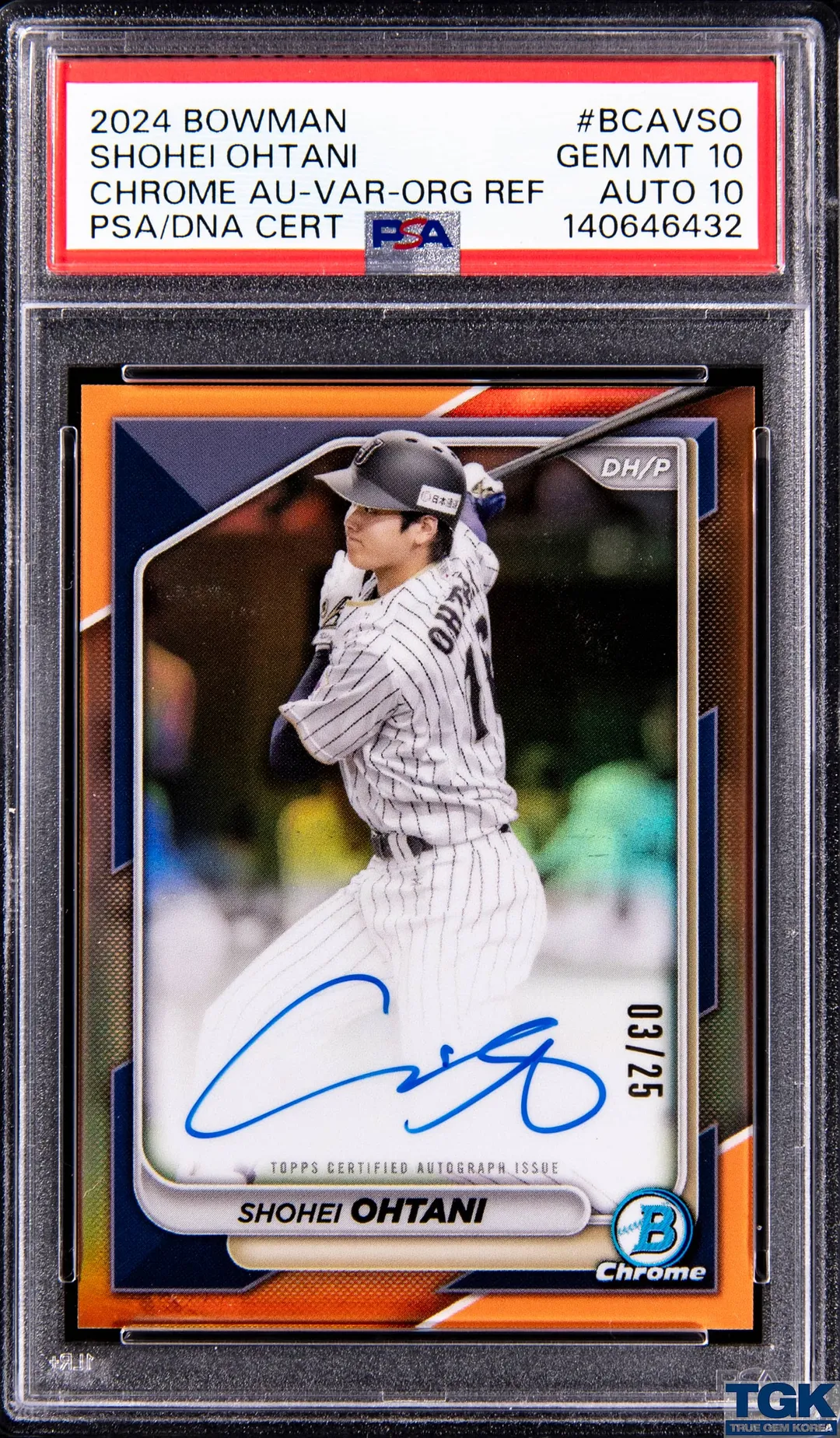
Shohei Ohtani 2024 Bowman Chrome Orange Auto Sale
Breakdown of the $43,920 sale of a 2024 Bowman Chrome Orange Refractor Shohei Ohtani auto /25 PSA 10/10 (Pop 3) at Goldin on February 8, 2026.
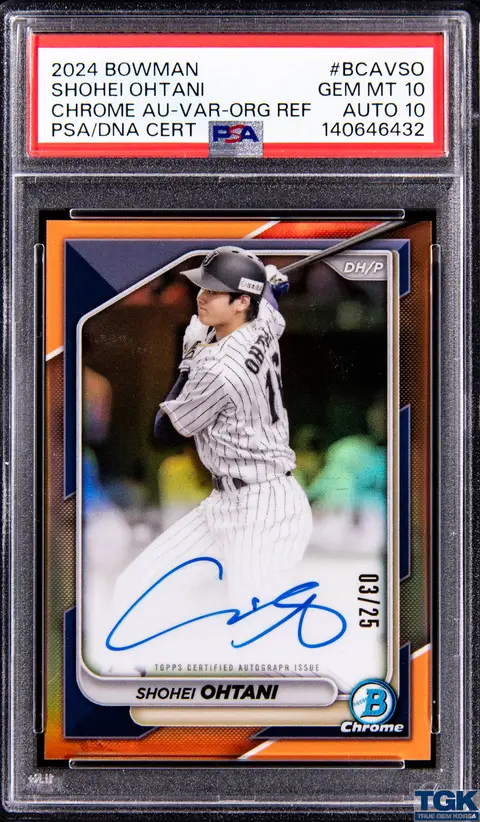
Sold Card
2024 Bowman Chrome Autographs Variation Orange Refractor #BCAV-SO Shohei Ohtani Signed Card (#03/25) - PSA GEM MT 10, PSA/DNA GEM MT 10 - Pop 3
Sale Price
Platform
Goldin2024 Bowman Chrome Autographs Variation Orange Refractor #BCAV-SO Shohei Ohtani Signed Card (#03/25) - PSA GEM MT 10, PSA/DNA GEM MT 10 - Pop 3 Sells for $43,920
On February 8, 2026, Goldin closed a key modern baseball sale that will interest anyone tracking high-end Shohei Ohtani cards and the upper tier of Bowman Chrome parallels. A 2024 Bowman Chrome Autographs Variation Orange Refractor #BCAV-SO Shohei Ohtani, serial numbered 03/25, graded PSA GEM MT 10 with a PSA/DNA GEM MT 10 autograph, and showing a population of just 3 in this grade/auto combination, sold for $43,920.
Below is a breakdown of what this card is, why it matters, and how this sale fits into the broader Ohtani and Bowman Chrome market.
Card basics: what exactly sold?
Let’s start by identifying the card clearly:
- Player: Shohei Ohtani
- Team on card: Los Angeles Dodgers (2024 Bowman Chrome reflects his move from the Angels to the Dodgers)
- Year: 2024
- Set: 2024 Bowman Chrome
- Subset: Bowman Chrome Autographs Variation
- Card number: BCAV-SO
- Parallel: Orange Refractor, serial numbered 03/25
- Autograph: On-card (signed directly on the card surface, not a sticker)
- Grading company: PSA
- Card grade: PSA GEM MT 10 (Gem Mint)
- Autograph grade: PSA/DNA GEM MT 10
- Population: Pop 3 (only three copies have achieved this exact GEM MT 10 / GEM MT 10 combo at the time of grading)
This is not a rookie card, but it is an early Dodgers-uniform autograph from a flagship chromium line. In modern baseball, Bowman Chrome Autographs and their color parallels are seen as core, long-term reference points for player markets, especially for stars and superstars.
“Variation” here indicates that the image is different from the standard Bowman Chrome autograph pose, and these variations are typically shorter-printed and more targeted toward advanced collectors.
Why collectors care about this card
1. Ohtani’s unique status
Shohei Ohtani is already one of the most significant modern players, combining elite hitting with historic two-way production. Even after his pitching-related injury and temporary shift to a hitter-only role, his hobby profile has remained near the top of the modern market.
For many collectors, Ohtani cards fall into several tiers:
- True rookies and first Bowman issues
- Key color parallels and on-card autos from major chromium sets
- Team-change and milestone cards (e.g., first Dodgers issues)
This 2024 Bowman Chrome Autographs Variation Orange Refractor sits in the second and third categories: it’s a premium on-card autograph with a low serial number, and a very early Dodgers-uniform piece from a respected chromium brand.
2. Bowman Chrome and color hierarchy
Bowman Chrome has a well-understood color ladder that collectors use as a shared language. While exact priorities can vary by person, the typical hierarchy runs something like: base refractors and numbered colors (Blue, Green), into more coveted low-numbered colors (Gold, Orange), and then into ultra-low-numbered or 1/1 tiers.
Orange (/25) is widely treated as one of the key premium colors in Bowman Chrome. It’s scarce but not so rare that it never appears at auction. For on-card autographs of elite players, Orange refractors are often short-list “target cards” for focused player collectors.
3. Variation autos and short print appeal
The Autographs Variation line usually carries:
- Distinct photography compared to the main auto
- Shorter print runs than non-variation counterparts
- A more niche but very dedicated collector base
For Ohtani, this gives the card a dual appeal: variation auto collectors chase it for set-building, and Ohtani-focused collectors want it as a distinctive Dodgers-era piece.
Grading, population, and scarcity
PSA GEM MT 10 / PSA/DNA GEM MT 10
A PSA GEM MT 10 grade means the card is in Gem Mint condition by PSA’s standards: sharp corners, strong centering, clean surfaces, and no noticeable print flaws. The PSA/DNA GEM MT 10 autograph grade indicates the signature is extremely clean and well-applied, with no smearing or noticeable issues.
For modern chromium autographs, high grades are common in absolute terms but still matter at the top of the market. When collectors are deciding which copy to pay a premium for, a PSA 10 / 10 combo tends to sit at the top of the preference list.
Pop 3 significance
“Pop” (short for population) refers to how many copies of a card have been graded at a particular grade by a grading company.
- Pop 3 here means only three copies of this exact card have received PSA GEM MT 10 with a GEM MT 10 auto.
Low population does not automatically mean extreme value, but for a premium parallel of an A-list player like Ohtani, it does matter when:
- Player collectors are competing for the very best examples
- Auction houses bring these cards to market infrequently
- Set and color-chasers target specific parallels (like Orange)
Price context: how does $43,920 fit in?
This copy sold at Goldin on February 8, 2026, for $43,920.
To understand what that means, you generally look at “comps” (recent comparable sales of the same card or close variants). For a card this specific—an Orange Variation Autograph /25, PSA 10/10, Pop 3—the comp pool is naturally thin.
Instead, collectors often triangulate using:
- Same card in lower grades (for example, PSA 9 or BGS 9.5)
- Same parallel raw (ungraded) sales
- Adjacent parallels (Gold /50, higher-numbered colors, or rarer colors like Red or Superfractor)
- Other key Ohtani Bowman Chrome or Dodgers autos from similar years/tiers
Recent ultra-modern Ohtani pricing has generally reflected:
- Continued strong demand tied to his offensive performance with the Dodgers
- Some normalization in overall modern prices compared to the most intense hobby spikes of prior years
- A clear premium for low-numbered, on-card autos with strong grades
Within that environment, a four-figure-to-low-five-figure range is common for decent Ohtani autos, and high four-figure to mid-five-figure results are seen for rarer, low-serial, top-grade pieces from respected chromium sets. A $43,920 result for a /25 PSA 10/10 Orange Variation fits into the upper slice of that band, aligning with:
- The low print run (/25)
- The PSA 10 / Auto 10 combination
- The Pop 3 scarcity
- The added interest around Ohtani’s Dodgers period cards
Given the limited population and the specific parallel, the exact same card in the exact same grade doesn’t trade frequently. So, rather than calling this sale high or low with false precision, it’s more accurate to say:
- The realized price is consistent with a premium tier modern Ohtani autograph.
- It reinforces that well-graded, low-numbered Bowman Chrome Ohtani autos remain firmly established in the higher end of the modern baseball market.
Where this card fits in an Ohtani collection
For Ohtani-focused collectors, this card checks several meaningful boxes:
- Color and scarcity: Orange /25 is a known, respected scarcity level in Bowman Chrome.
- Dodgers era: As one of his early Dodgers-uniform Bowman Chrome autos, it documents a major shift in his career narrative.
- On-card auto: Preferred by many collectors over sticker autographs for both aesthetics and perceived prestige.
- Top-grade example: PSA 10 / 10 and Pop 3 give it some “best-of-the-best” appeal.
It will likely be viewed as a trophy-level card for a focused Ohtani PC (personal collection) or a centerpiece for a modern Dodgers or color-parallel run.
What this sale might signal to collectors
Without making predictions or offering financial advice, there are a few grounded takeaways for collectors observing this result:
Low-numbered, on-card Ohtani autos remain in demand.
Even as the broader modern market has cooled from peak levels, serious collectors still compete strongly for high-end Ohtani pieces.Color and context still matter.
Being an Orange /25 from Bowman Chrome with a variation image and a Dodgers uniform adds layers of desirability that go beyond just the autograph itself.Top grades command a premium.
For modern cards, not every PSA 10 is rare, but for niche parallels like this one, the combination of low print run and low PSA 10 population can influence outcomes considerably.Auction house exposure plays a role.
A card like this running through Goldin on February 8, 2026, benefits from a focused audience of high-end modern buyers who are familiar with Bowman Chrome color hierarchies and Ohtani’s market.
Takeaways for newer and returning collectors
If you’re newer to the hobby or returning after a break, this sale offers a few practical lessons:
Learn the set and color ladders. Understanding how Bowman Chrome parallels work (and which colors are more coveted) can help you interpret prices more confidently.
Pay attention to grading and autograph labels. A PSA 10 / Auto 10 Pop 3 is a very different proposition than a lower grade or a card without an autograph grade.
Use comps carefully. For low-pop, low-serial cards, you may not find many exact matches. Look at closely related parallels and grades and treat price ranges as context, not guarantees.
Focus on what you like. Cards like this are aspirational for most collectors, but the same principles—set quality, player relevance, image variation, and condition—apply at every budget level.
The $43,920 sale of the 2024 Bowman Chrome Autographs Variation Orange Refractor #BCAV-SO Shohei Ohtani at Goldin on February 8, 2026, is another data point confirming how the hobby values premium, low-numbered, on-card autos of truly elite modern players. For Ohtani collectors, it’s a standout Dodgers-era piece; for market watchers, it’s a useful reference in understanding where high-end modern baseball currently sits.