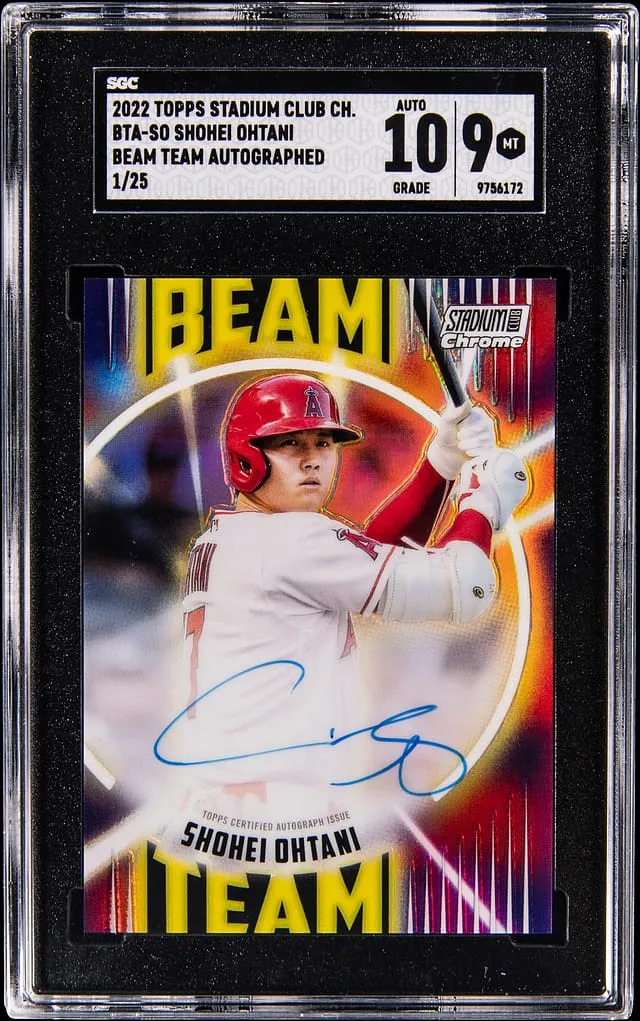
Shohei Ohtani 2022 Beam Team Auto /25 SGC 9 Sells
Goldin sold a 2022 Stadium Club Chrome Beam Team Auto /25 Shohei Ohtani SGC 9, Auto 10 for $12,200. See why this ultra-modern insert matters to collectors.
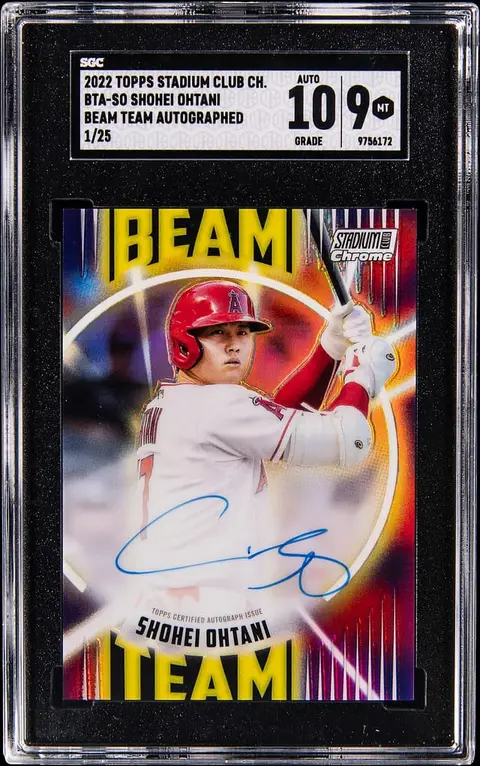
Sold Card
2022 Topps Stadium Club Chrome Beam Team Autographs #BTA-SO Shohei Ohtani Signed Card (#01/25) - SGC MT 9, Auto 10
Sale Price
Platform
Goldin2022 Topps Stadium Club Chrome Beam Team Autographs #BTA-SO Shohei Ohtani Signed Card (#01/25) - SGC MT 9, Auto 10 Sells for $12,200
On June 7, 2026, Goldin closed a notable modern baseball auction: a 2022 Topps Stadium Club Chrome Beam Team Autographs #BTA-SO Shohei Ohtani, serial‑numbered 01/25, graded SGC MT 9 with a perfect Auto 10, sold for $12,200.
For a card that sits outside Ohtani’s flagship rookie lane, this is a meaningful result. Below, we’ll unpack what this card is, why collectors care, and how this sale fits into the broader Ohtani and Stadium Club Chrome market.
Card snapshot: what exactly sold?
Here’s a clear breakdown of the card:
- Player: Shohei Ohtani
- Team on card: Los Angeles Angels
- Year: 2022
- Product: Topps Stadium Club Chrome Baseball
- Insert set: Beam Team Autographs
- Card number: #BTA-SO
- Serial numbering: 01/25 (first card in a print run of 25)
- Autograph: On‑card (signed directly on the card surface, not on a sticker)
- Grading company: SGC (Sportscard Guaranty Corporation)
- Card grade: MT 9 (Mint)
- Autograph grade: 10 (Gem, perfect signature)
- Era: Ultra‑modern (roughly 2018–present)
This is not a rookie card, but it is a low‑serial, on‑card autograph insert of one of the most collected modern players. Beam Team is a long‑running Topps insert concept (originating in early 1990s Stadium Club) that has built a quiet but steady following, especially for stars and short‑printed versions.
Why Beam Team and Stadium Club Chrome matter
Stadium Club and photography
Topps Stadium Club has a reputation for:
- High‑end photography: full‑bleed images and more creative shots than standard flagship Topps.
- Collector‑friendly design: less about base rookies as an “investment,” more about visual appeal and unique inserts.
When Topps brought Stadium Club Chrome into the fold, it created a lane where:
- You still get the standout photography.
- You also get chromium stock, refractors, and lower‑print‑run autographs.
Beam Team’s insert lineage
Beam Team originally gained attention in the 1990s as a premium Stadium Club insert. In modern releases, Beam Team and Beam Team Autographs are:
- Case‑level or tough pulls depending on the specific year and configuration.
- Often short‑printed and serial‑numbered, especially for big names like Ohtani.
For Ohtani specifically, Beam Team autos sit in the category of non‑rookie, but desirable insert autographs—cards that many player collectors look for to round out PCs (personal collections) once key rookies and main Topps Chrome autos are already in place.
Grading: SGC 9 with a 10 auto
An SGC MT 9 means the card is in mint condition: sharp corners, strong centering, clean surfaces with only minor flaws under close inspection. The Auto 10 grade indicates the signature is:
- Bold and complete,
- Free from skipping, smudging, or major pen issues.
In today’s market, PSA still tends to command a pricing premium, especially for ultra‑modern chrome autographs. However, SGC has been gaining share, particularly among:
- Vintage and pre‑modern collectors, and
- Collectors who appreciate the black insert label and strong presentation.
For low‑print‑run autographs like this /25 Ohtani, the player, serial number, and eye appeal often matter more than whether the label is PSA, BGS, or SGC—especially when the grade is a strong 9 with a 10 auto.
Market context: how does $12,200 fit in?
Understanding the sale number
The hammer price plus buyer’s premium for this card at Goldin on June 7, 2026 was $12,200.
Because ultra‑modern inserts like this one have relatively few copies—and even fewer that are graded and publicly sold—“comps” (short for comparables, or similar recent sales used as a reference) can be sparse and a bit noisy.
Based on recent public market patterns for similar Ohtani pieces, this sale appears to sit in a healthy, but not extreme, range for:
- A non‑rookie, on‑card, low‑serial Ohtani autograph from a respected product line,
- In a high grade with a perfect auto.
How it compares to related Ohtani cards
While exact public comps for this specific card, in SGC 9/10, are limited, we can look at nearby categories that have traded through major auction houses and marketplaces in the past couple of years:
Ohtani low‑/short‑printed on‑card autos from premium or semi‑premium products (Topps Chrome, Five Star, Museum, etc.) commonly command:**
- Several thousand dollars for higher‑print runs,
- Up into the low‑five‑figure range for particularly tough serials, desirable designs, or strong grades.
Beam Team and other insert autos of Ohtani generally track below his highest‑end rookie‑year autos but above more common sticker autos and mass‑produced signatures.
Rookie‑year Ohtani autos (especially from 2018 Topps Chrome and 2018 Bowman/Bowman Chrome) continue to sit at the top of his market, often well above comparable non‑rookie inserts when graded similarly.
Within that framework, $12,200 for this 01/25 SGC 9 Auto 10 result:
- Reflects the combination of scarcity (/25) and insert heritage (Beam Team).
- Sits noticeably below the biggest Ohtani rookie auto records, but
- Still positions this as a meaningful modern Ohtani signature for collectors tracking his broader autograph market.
Because public, verified sales for this exact SGC configuration are relatively thin, the card functions more as a signal of demand than a fully established price anchor.
Why collectors care about this card
Non‑rookie, but still a “want list” card
This card isn’t competing with Ohtani’s key rookies, but it checks several boxes that matter to active hobbyists:
- On‑card autograph: Many collectors prefer the feel and look of a signature directly on the card over stickers.
- Low serial numbering (25 copies total): Low print runs reduce long‑term supply; player collectors and set builders can’t simply wait forever for a cheaper copy.
- Established insert name: Beam Team’s history in the Topps ecosystem makes it more recognizable and collectible than a one‑year, forgotten insert line.
- Strong grade with Auto 10: A mint card and perfect signature can make a difference when supply is as low as 25.
Ohtani’s ongoing relevance
Ohtani continues to be:
- One of the most followed modern players in the hobby.
- A two‑way star whose performances have repeatedly reset expectations.
- A driver of both short‑term attention and longer‑term collecting interest.
Recent years have seen Ohtani:
- Regularly appear in MVP conversations,
- Break or challenge historical precedent for two‑way performance,
- Anchor entire releases and product checklists.
Those trends help explain why even non‑rookie, low‑serial autographs like this Beam Team still draw strong bidding interest.
Takeaways for collectors and small sellers
For collectors, newcomers, and small sellers looking at this Goldin sale on June 7, 2026, a few practical points stand out:
Not all non‑rookie autos are equal.
Sets with established identity (like Stadium Club and Beam Team) can carry more long‑term collecting weight than generic, one‑off inserts.Low print plus strong presentation matters.
A /25 on‑card autograph with a clean design and a 10 auto grade is often easier to place with serious player collectors than a higher‑numbered or weaker‑signed card, even from a similar year.Brand of slab isn’t everything—but it does affect liquidity.
SGC is widely respected, but PSA still tends to have broader coverage in ultra‑modern baseball. Collectors who like the card first and the label second may find SGC examples appealing, sometimes at a relative value compared to equivalent PSA grades.Use comps as a guide, not a promise.
With only 25 copies produced and even fewer graded, each sale can land at a slightly different number depending on auction timing, bidder pool, and how the broader Ohtani market is feeling.
How to think about this sale in the bigger picture
This $12,200 Goldin result doesn’t rewrite the Ohtani record books, but it does:
- Reinforce that high‑quality, low‑serial, on‑card Ohtani autos remain supported by active demand.
- Show that non‑rookie, insert‑driven cards can still draw five‑figure attention when design, scarcity, and player all line up.
- Offer another data point for collectors building or tracking Ohtani autograph runs, especially across different brands and insert types.
For figoca users and data‑minded collectors, this card is a useful reference when comparing:
- Rookie vs. non‑rookie Ohtani autos,
- Sticker vs. on‑card signatures,
- High‑volume products vs. more photography‑focused lines like Stadium Club Chrome.
Documenting these kinds of sales over time helps build a clearer picture of what collectors actually value—and how design, scarcity, and grading interact in the modern Ohtani market.