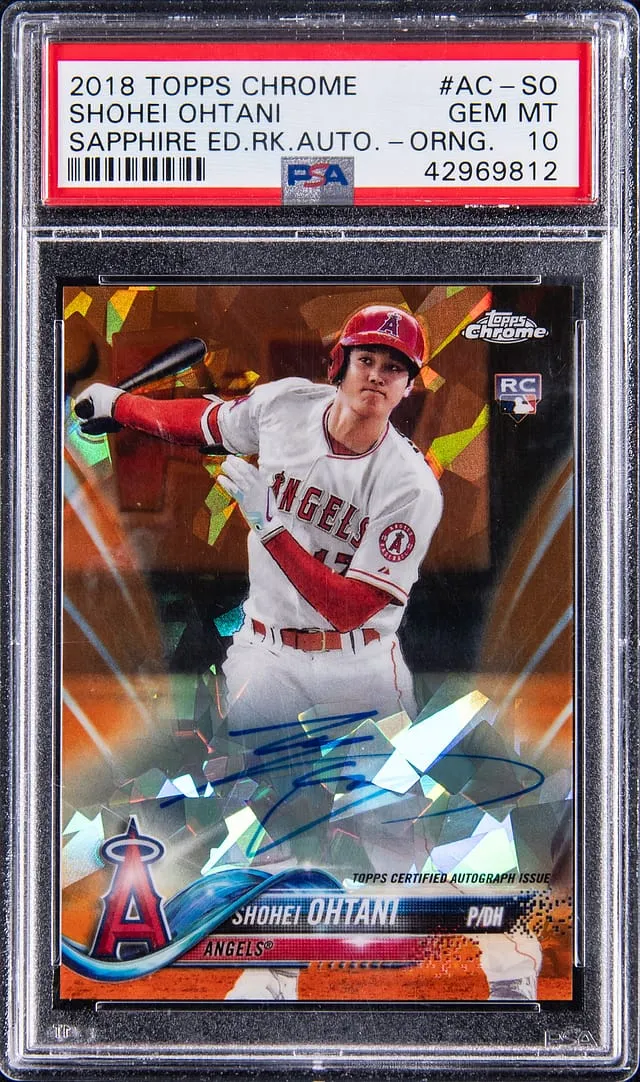
Shohei Ohtani 2018 Sapphire Orange Auto PSA 10 Sale
A calm, data-aware look at the $207,400 Goldin sale of the 2018 Topps Chrome Sapphire Orange Shohei Ohtani Rookie Autograph PSA 10.
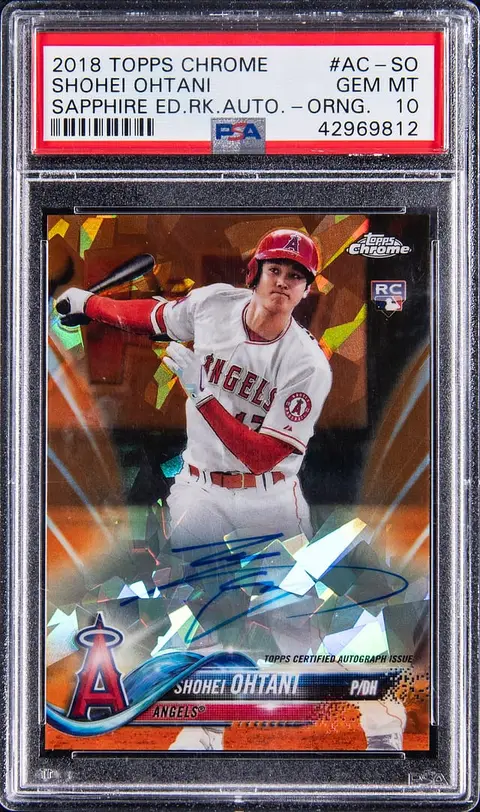
Sold Card
2018 Topps Chrome Sapphire Edition Rookie Autographs Orange #AC-SO Shohei Ohtani Signed Rookie Card (#18/25) - PSA GEM MT 10
Sale Price
Platform
Goldin2018 Topps Chrome Sapphire Shohei Ohtani Orange Auto /25 PSA 10: A Calm Look at a $207,400 Sale
On March 8, 2026, Goldin closed a major modern baseball card sale: a 2018 Topps Chrome Sapphire Edition Rookie Autographs Orange #AC-SO Shohei Ohtani, serial numbered 18/25, graded PSA GEM MT 10, selling for $207,400.
For collectors who focus on modern baseball and high-end rookies, this specific Ohtani is an important data point. It combines several pillars of demand in today’s hobby: a true rookie autograph, a premium parallel, a low serial number, and a top grade from a leading grading company.
In this post, we’ll walk through what this card is, how it fits into the broader Ohtani rookie landscape, and what this sale tells us about current market sentiment—without making predictions or promises.
- Card Breakdown: What Exactly Sold?
Let’s start by identifying the card clearly.
- Player: Shohei Ohtani
- Team: Los Angeles Angels
- Year: 2018
- Product: Topps Chrome Sapphire Edition
- Subset: Rookie Autographs
- Card Number: #AC-SO
- Parallel: Orange Sapphire
- Serial Number: 18/25 (only 25 copies of this parallel exist)
- Autograph: On-card (signed directly on the card, not on a sticker)
- Rookie Status: Rookie autograph from Ohtani’s first MLB-licensed Topps Chrome Sapphire year
- Grading Company: PSA (Professional Sports Authenticator)
- Grade: GEM MT 10 (Gem Mint)
The 2018 Topps Chrome Sapphire Edition Rookie Autographs Orange Ohtani is part of a premium, online-exclusive version of Topps Chrome. Sapphire uses a distinct cracked-ice style finish and was produced in more limited quantities than standard Topps Chrome hobby and retail products.
The Orange Sapphire Rookie Autograph is among the more desirable colored parallels in the run because:
- It is serial numbered to just 25 copies.
- It pairs color with an on-card autograph.
- It represents one of Ohtani’s key early Topps Chrome Sapphire rookie issues.
A PSA 10 grade indicates Gem Mint condition, which for modern chromium cards typically means sharp corners, strong centering, clean edges, and a clean surface free of noticeable print lines or scratches.
- Where This Card Sits in the Ohtani Rookie Hierarchy
Shohei Ohtani’s rookie year (2018) generated a deep lineup of rookie cards across multiple Topps and Bowman products. Within that ecosystem, collectors often group his key rookie issues into a few tiers.
Some of the most discussed Ohtani rookies and rookie autos include:
- 2018 Topps Chrome Rookie Autographs (and colored refractors)
- 2018 Bowman Chrome Prospect Autographs (and colors) from his pre-rookie period
- 2018 Topps Chrome Sapphire base and auto parallels
- 2018 Topps Update and related flagship paper rookies
Sapphire sits in the premium chromium lane: more scarce and visually distinct than standard Topps Chrome, but still clearly connected to the flagship Chrome design. Within Sapphire, low-numbered colored autograph parallels like Orange (/25), Red (/10), and Superfractor (1/1) tend to be among the most watched.
This specific card checks several boxes collectors often look for in a modern grail-level rookie:
- True rookie auto: It’s a rookie-year autograph, not a later insert or buyback.
- Limited print: Only 25 copies of the Orange Sapphire auto exist.
- Premium brand extension: Sapphire versions are often viewed as an upscale parallel of Topps Chrome.
- Aesthetic appeal: The Sapphire pattern plus orange color match appeals to many collectors visually, regardless of team colors.
- Market Context: How Does $207,400 Fit In?
This Goldin sale closed at $207,400 on March 8, 2026.
When collectors talk about “comps,” they’re referring to comparable recent sales of the same card, or as close as reasonably possible—for example, a similar parallel in a slightly different grade.
For this specific card (2018 Topps Chrome Sapphire Rookie Autographs Orange #AC-SO, PSA 10), the number of public sales is inherently limited because:
- Only 25 copies exist.
- Not all are graded by PSA.
- Not all PSA copies are Gem Mint 10s.
- Not every sale runs through a large public auction house.
That means each public result can have a noticeable effect on how collectors think about “market level,” but it’s still just a snapshot in time.
From what is visible in the market:
- Ohtani’s top-tier rookie autos (for example, low-numbered Bowman Chrome and Topps Chrome colored autos in PSA 10 or BGS 9.5/10) have sold in a wide range, often from the low five figures into the mid-six figures depending on rarity, brand, and grade.
- Sapphire parallels have generally been treated as premium alternatives to standard Chrome, and low-numbered colors like Orange tend to sit on the higher end of that spectrum.
- This $207,400 sale is consistent with the idea that low-pop, low-serial, Gem Mint Ohtani rookies remain firmly in high-end territory.
It’s useful to keep in mind:
- Ultra-scarce parallels like this can move significantly between results because just one or two motivated bidders can affect the final hammer price.
- Not every buyer or seller has the same preferences; some will prioritize Bowman Chrome, others Topps Chrome, others Sapphire, and so on.
Rather than treating this single result as a new “floor” or “ceiling,” it may be better viewed as a substantial, but still individual, data point in the ongoing story of Ohtani’s high-end market.
- Grade and Population: Why PSA 10 Matters
A “pop report” (population report) is a grading company’s summary of how many copies of a specific card they’ve graded at each grade level.
For this card, the population in PSA 10 is expected to be low for two reasons:
- Only 25 copies exist to begin with.
- Not every copy will grade Gem Mint 10, and not every owner chooses to grade.
In modern cards, a PSA 10 usually commands a significant premium over PSA 9 and lower grades, especially for:
- Key rookie cards
- Low-serial-numbered parallels
- On-card autographs
While exact PSA population numbers can change over time as more cards are submitted, the ceiling is capped by the print run: there will never be more than 25 of these, in any grade.
This structural scarcity is part of why each sale of a PSA 10 example attracts attention.
- Why Collectors Care About This Card
Shohei Ohtani has a unique place in modern baseball history. His ability to impact games as both an elite hitter and pitcher drew comparisons to Babe Ruth from early in his MLB career, and his MVP-level seasons created strong, sustained demand for his best rookie cards.
Collectors often highlight a few reasons this specific card matters:
- Dual-threat legacy: If Ohtani continues to build his resume as a two-way star, his earliest and scarcest rookie autos are likely to remain historically interesting, regardless of short-term hobby cycles.
- Iconic rookie year: 2018 is firmly within the ultra-modern era, but in terms of Ohtani’s story, it’s his foundational MLB season.
- Premium parallel: Sapphire has become one of the more recognizable premium chromium lines among collectors, especially for key rookies.
- Combination of attributes: Rookie, on-card auto, low serial number, and top grade all stack together.
In other words, this isn’t just another parallel; it’s a convergence of several things the market tends to reward in a player of Ohtani’s stature.
- The Role of Auction Houses and Timing
This card sold at Goldin on March 8, 2026. Auction houses like Goldin, PWCC, Heritage, and others often serve as venues for higher-end cards because:
- They provide broader visibility to serious collectors.
- They offer authentication, marketing, and established bidding structures.
- They create a public record of sale results that collectors can reference later as comps.
Timing can also matter. Factors that may influence bidding interest include:
- Where we are in the baseball calendar (preseason, mid-season, postseason).
- Recent headlines about Ohtani—awards, injuries, team changes, or milestone achievements.
- Broader hobby sentiment and liquidity at the time of auction.
Any single auction result reflects all of those factors in that moment, which is why it’s helpful to think of sales as points on a line rather than definitive long-term markers.
- Takeaways for Collectors and Small Sellers
For collectors, this sale reinforces a few key themes in the ultra-modern market:
- Quality and scarcity stack: True rookie autographs, low serial numbers, and high grades together often command the strongest attention.
- Brand and line matter: Within a player’s rookie year, different products and parallels can sit at very different levels in the market.
- Public data is limited at the top end: For ultra-rare cards like this, each sale is important, but there isn’t enough volume to draw simple, one-size-fits-all conclusions.
For small sellers or newer collectors using this sale as context:
- It can be useful to compare the attributes of your cards—rookie status, autograph, serial number, brand, and grade—even if the dollar amounts are much lower.
- Watching high-end sales can help you understand how the hobby currently values different combinations of rarity, condition, and player profile.
- Final Thoughts
The $207,400 sale of the 2018 Topps Chrome Sapphire Edition Rookie Autographs Orange #AC-SO Shohei Ohtani, numbered 18/25 and graded PSA GEM MT 10, at Goldin on March 8, 2026, is a clear reminder of how strongly the market continues to respond to Ohtani’s best and scarcest rookie cards.
It doesn’t guarantee where prices will go next, but it does provide a well-documented reference point for one of his premier ultra-modern rookie autographs—and a useful case study in how rarity, brand, and grade intersect at the very top of the modern baseball card market.