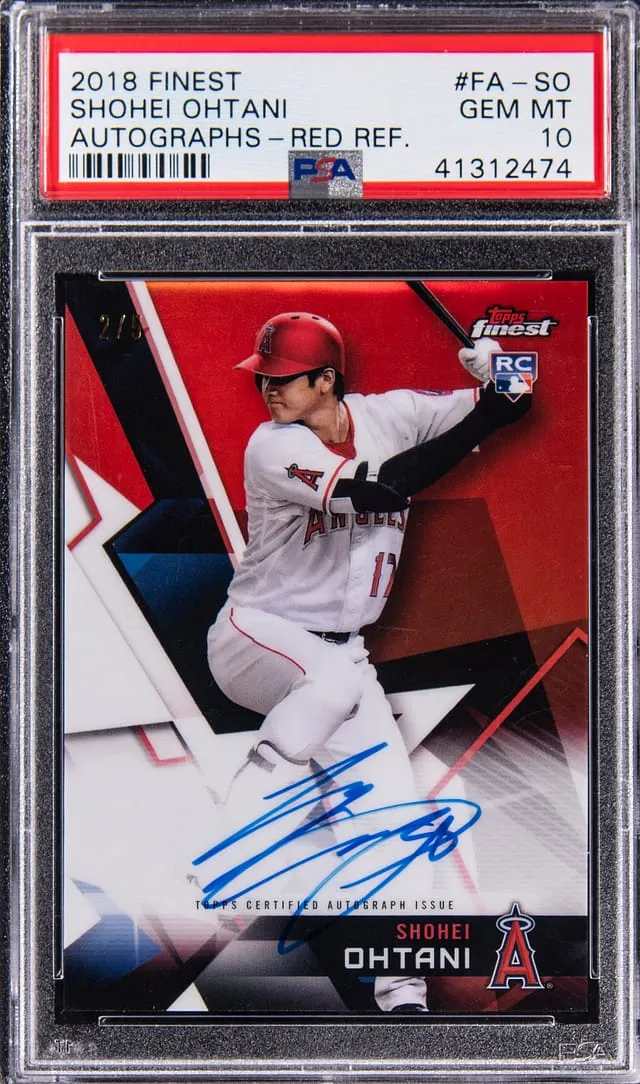
Shohei Ohtani 2018 Finest Red Auto /5 PSA 10 Sells Big
A 2018 Topps Finest Shohei Ohtani Red Refractor Auto /5 PSA 10 Pop 1 sold for $349,733 at Goldin on March 8, 2026. Here’s what it means for collectors.
Sold Card
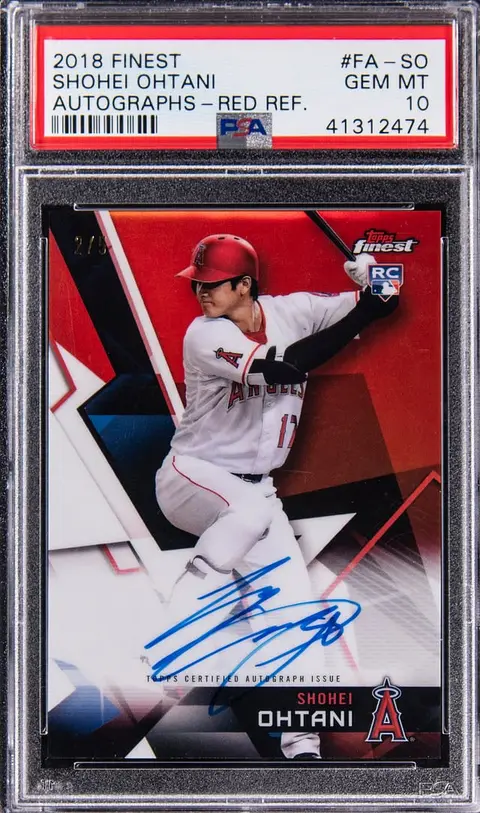
2018 Topps Finest Autographs Red Refractor #FA-SO Shohei Ohtani Signed Rookie Card (#2/5) - PSA GEM MT 10 - Pop 1
Sale Price
Platform
Goldin2018 Topps Finest Shohei Ohtani Red Refractor Auto /5 Sells for $349,733
On March 8, 2026, Goldin closed a notable modern baseball sale: a 2018 Topps Finest Autographs Red Refractor #FA-SO Shohei Ohtani signed rookie card, serial numbered 2/5, graded PSA GEM MT 10. The final price was $349,733.
For collectors tracking Ohtani’s premium rookies and ultra-low print autographs, this is a meaningful data point in a market that continues to evolve around one of the game’s most unusual stars.
The card at a glance
- Player: Shohei Ohtani
- Team: Los Angeles Angels (rookie year card)
- Year: 2018
- Set: 2018 Topps Finest
- Subset: Finest Autographs
- Card number: #FA-SO
- Parallel: Red Refractor, serial numbered 2/5
- Rookie status: 2018 is Ohtani’s true MLB rookie year
- Autograph: On-card (signed directly on the card surface)
- Grading company: PSA
- Grade: PSA GEM MT 10 (PSA’s highest standard grade)
- Population: PSA population report shows this exact version in PSA 10 as Pop 1 (one copy in this grade at the time of sale).
Topps Finest is not Ohtani’s flagship (that distinction usually belongs to Topps Series 1/2 and Topps Chrome), but it is a long-running chromium brand with a dedicated following. Autographs in Finest tend to be on-card, which many collectors prefer over sticker autos.
The Red Refractor parallel is one of the lowest-numbered color parallels in the Finest Autographs run. With just five copies produced, this card combines:
- Rookie-year timing
- On-card autograph
- Very low serial numbering (/5)
- Gem Mint grade with a one-of-one pop in PSA 10
That combination pushes it into the "true chase card" category for Ohtani Finest collectors.
Where this card fits in the Ohtani rookie landscape
In the broader Ohtani rookie ecosystem, his most watched cards tend to be:
- 2018 Topps Chrome and Chrome Update autos and color refractors
- 2018 Bowman Chrome prospect autos (pre-MLB, but treated as key issues)
- 2018 Topps flagship and Heritage for base rookies and parallels
- Select high-end brands (e.g., Dynasty, National Treasures, Flawless) for patch autos
2018 Topps Finest Autographs sits a step below absolute headliners like Bowman Chrome autos in terms of long-term hobby profile, but still clearly within the “core” modern chromium portfolio. Within Finest itself, the Red Refractor /5 is among the scarcest color autograph parallels that are still widely recognizable.
This specific Red Refractor PSA 10 Pop 1 is effectively the top of the Finest Autographs pyramid for collectors who prioritize PSA’s scale and population data.
Market context and comps
When collectors talk about “comps,” they mean comparable recent sales used as reference points. For a card this scarce (only five copies, and just one PSA 10), there are no truly perfect comps. Still, we can look at a few categories:
Same card, different parallels and grades
- Non-red Finest Autographs of Ohtani (e.g., base, Blue, Green, Gold) in BGS/PSA 9–10 have historically sold for significantly less than this result, consistent with their higher print runs and more frequent appearances at auction.
- Higher-serial-number color parallels (like /50 or /25) have changed hands in the mid four-figure to low five-figure range depending on grade and timing, illustrating the premium that ultra-low print runs command.
Similar Ohtani rookie autos in other chromium sets
- Color autographs from 2018 Topps Chrome and Bowman Chrome—especially low-numbered Gold, Orange, and Red refractors—have established that Ohtani’s best rookie autos can reach six figures and beyond when you combine:
- Low serial numbering
- On-card signatures
- Top grades
- Those flagship and Bowman issues generally sit slightly above Finest on the hobby prestige ladder, but their performance helps frame this Finest Red /5 price.
- Color autographs from 2018 Topps Chrome and Bowman Chrome—especially low-numbered Gold, Orange, and Red refractors—have established that Ohtani’s best rookie autos can reach six figures and beyond when you combine:
Gem Mint, low-pop modern Ohtani rookies
- Across marketplaces and auction houses, the pattern for Ohtani’s modern rookies is clear:
- True scarcity (low serial numbering or short prints)
- Combined with PSA/BGS top grades
- And a pop report showing very few high-grade copies available
tends to draw outsized attention when they surface.
- Across marketplaces and auction houses, the pattern for Ohtani’s modern rookies is clear:
Because this specific card is a PSA 10 Pop 1, there is no direct grade-for-grade comp. In that situation, serious collectors and bidders often triangulate from similar cards in adjacent sets and parallels. Relative to those, a $349,733 result sits in line with how the market has treated Ohtani’s elite-tier, low-numbered rookie autos, especially from chromium brands.
Why collectors care about this card
Several factors converge to make this a noteworthy piece for Ohtani and modern baseball collectors:
Two-way superstar in his prime
Ohtani remains a unique profile: a legitimate top-of-the-rotation pitcher and middle-of-the-order bat when healthy. His awards, MVP-caliber seasons, and global following all contribute to consistent demand for his key rookies.Rookie-year, on-card autograph
Rookie autographs carry particular weight because they are tied to a player’s first MLB season. On-card signatures—signed directly on the card—are prized over sticker autographs for their aesthetics and perceived authenticity.Ultra-low serial numbering (/5)
A print run of five makes this card effectively unavailable to most collectors who might want a copy. When one does hit a major auction house, it has the potential to reset expectations simply because there are so few chances to acquire one.PSA 10 Pop 1 status
A “pop report” (population report) is the grading company’s count of how many copies of a specific card exist in each grade. A Pop 1 in PSA 10 means there is just one example at the top grade on PSA’s books at the time of the sale.Even among the five printed copies, condition, centering, and surface quality can vary. The Gem Mint grade confirms that this particular example hit PSA’s highest standards.
Established chromium brand
Topps Finest has been part of the hobby since the 1990s. While it may sit slightly behind Topps Chrome or Bowman Chrome in overall visibility, it remains a well-known, long-running chromium line. Its autograph checklist and refractor structure are familiar territory for modern baseball collectors.
How this fits into current hobby trends
From a broader market perspective, this sale aligns with several ongoing trends in the ultra-modern segment:
- Concentration at the top: The largest realized prices continue to center on a small set of players and cards: foundational rookies, true low-numbered parallels, and key autograph issues.
- Emphasis on condition and pop: For modern cards, where many examples start in strong condition straight out of packs, small differences in surface, centering, and edges can be the only thing separating a PSA 9 from a PSA 10. As a result, Pop 1 or Pop Very Low Gem Mint examples draw disproportionate attention.
- Selective strength in modern: Even in periods where broader modern prices fluctuate, genuinely scarce, high-grade cards of top-tier players often track differently than higher-pop base rookies.
The $349,733 price at Goldin doesn’t set an all-time record for an Ohtani card, but it reinforces the idea that his best, truly limited rookies remain a focus for advanced collectors.
What this sale might mean for collectors and small sellers
This result is one data point, not a promise of where prices will go next. It does, however, offer some practical takeaways.
For Ohtani-focused collectors
- Rarity matters: There’s a clear separation between mass-produced rookies and low-numbered, on-card autograph parallels. If you’re building an Ohtani portfolio, understanding where a card sits on that spectrum is essential.
- Brand hierarchy isn’t everything: While Chrome and Bowman Chrome often lead the conversation, this Finest Red /5 shows that strong results are possible across several chromium brands when the card checks enough boxes (rookie, auto, low serial, top grade).
For broader modern baseball collectors
- Know your parallels: Two cards from the same set with the same design can have drastically different populations and values depending on the color parallel and serial numbering. Learning each product’s color and numbering structure helps you interpret pricing more accurately.
- Grading and timing both matter: Condition is an obvious driver, but timing within a player’s career—awards, team changes, and performance cycles—also influences realized prices.
For small sellers
- Use sales like this as context, not a template: A Pop 1 PSA 10 Red Refractor /5 is an extreme outlier. Most copies of most cards will not track anywhere near this price tier.
- Comp carefully: When looking up comps for your own listings, match as many variables as possible: set, year, parallel, serial number, grade, and grading company. If your card differs meaningfully from a headlining sale like this one, expect a very different price range.
Final thoughts
The 2018 Topps Finest Autographs Red Refractor #FA-SO Shohei Ohtani rookie autograph, numbered 2/5 and graded PSA GEM MT 10 (Pop 1), selling for $349,733 at Goldin on March 8, 2026, is a clear reminder of how the market treats truly rare, high-grade Ohtani rookies.
It doesn’t redefine the entire Ohtani market on its own, but it does provide a clean, well-documented benchmark for one of his scarcest Finest autographs. For collectors who track modern baseball’s top-tier cards, it’s a sale worth bookmarking and comparing against future appearances of similarly scarce Ohtani rookies across Chrome, Bowman, and other premium brands.
As always, this information is best used as context rather than prediction. The hobby moves in cycles, but genuinely rare, high-quality examples like this tend to remain touchstones in any serious discussion of modern baseball cards.