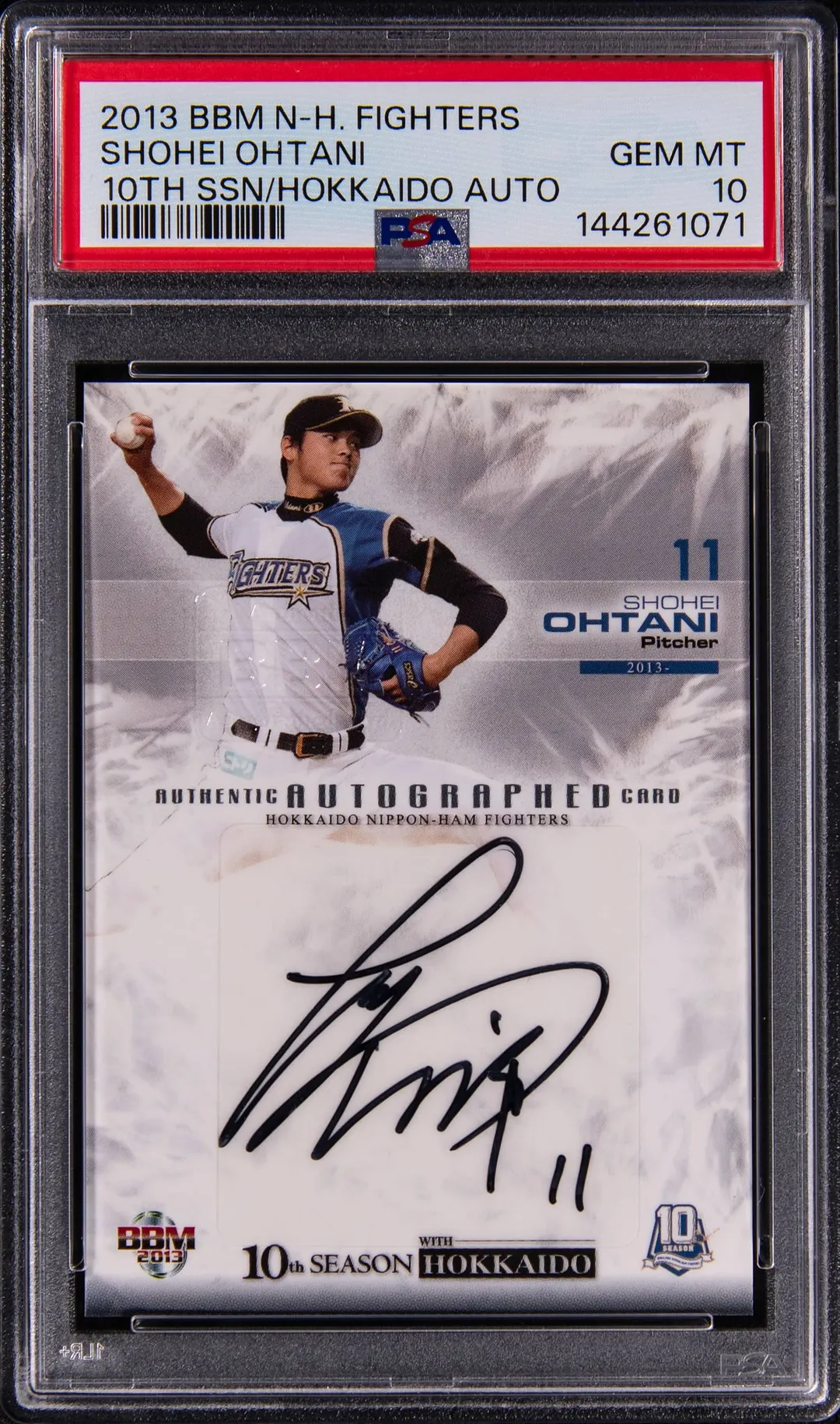
Shohei Ohtani 2013 BBM Auto /10 PSA 10 Sells for $430K
Goldin sold a 2013 BBM Nippon Ham Fighters Shohei Ohtani rookie auto /10 PSA 10 pop 1 for $430,050. Here’s what this sale means for collectors.
Sold Card
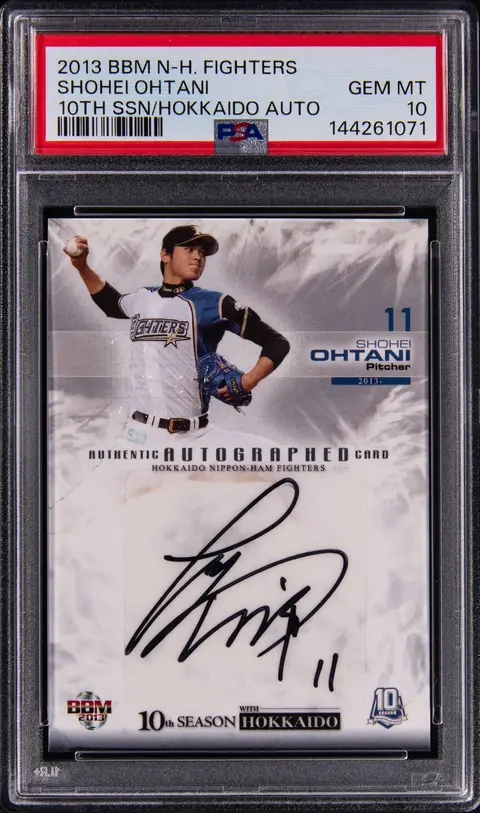
2013 BBM Nippon Ham Fighters 10th Season with Hokkaido Autographs Shohei Ohtani Signed Rookie Card (#07/10) - PSA GEM MT 10 - Pop 1
Sale Price
Platform
GoldinShohei Ohtani’s earliest licensed cards from Japan have quietly become some of the most studied pieces in the modern baseball market, and the latest data point comes from Goldin.
On February 8, 2026 (UTC), Goldin sold a 2013 BBM Nippon Ham Fighters 10th Season with Hokkaido Autographs Shohei Ohtani Signed Rookie Card, serial‑numbered #07/10, graded PSA GEM MT 10, for $430,050. This copy is currently a population 1 (“pop 1”) at PSA in this grade.
Below, we break down what this card is, why it matters, and how this sale fits into the broader Ohtani and Japanese‑issue market.
The card at a glance
- Player: Shohei Ohtani
- Team: Hokkaido Nippon-Ham Fighters (NPB)
- Year: 2013
- Set: BBM Nippon Ham Fighters – 10th Season with Hokkaido (team issue)
- Subset: Autographs
- Type: Signed rookie card from his first fully licensed Japanese pro issue
- Serial numbering: Hand-numbered 07/10
- Autograph: On-card autograph (signed directly on the card)
- Grading company: PSA (Professional Sports Authenticator)
- Grade: GEM MT 10
- Population: Pop 1 in PSA 10 at the time of sale
This card sits in the lane of “true early Ohtani,” produced in Japan during his rookie NPB season, well before his MLB debut with the Los Angeles Angels. For collectors who focus on first-appearance and rookie-year issues, these 2013 Japanese cards function similarly to pre-MLB or international rookies in other sports.
What makes this issue significant
1. A low-serial, on-card auto from Ohtani’s first pro year
The combination here is what collectors usually look for in a cornerstone modern piece:
- Rookie-year: 2013 was Ohtani’s first NPB season with the Nippon-Ham Fighters.
- Autograph: The signature is directly on the card (not on a sticker).
- Scarcity: Only 10 copies were produced, each individually numbered.
- Grade: A PSA GEM MT 10 is the highest standard grade on PSA’s scale.
In the modern/ultra-modern era (roughly mid‑2000s to present), manufactured scarcity is common. However, a /10 autograph from a player of Ohtani’s profile, tied specifically to his NPB rookie season, is still meaningfully rare—especially in gem-mint condition.
2. Part of a key Japanese team set
BBM (Baseball Magazine) is the primary licensed card producer for Nippon Professional Baseball (NPB). The Nippon Ham Fighters 10th Season with Hokkaido set is a team-specific release commemorating the franchise’s decade in Hokkaido.
Within that context, the Autographs subset carrying Ohtani’s on‑card signature and low print run is widely viewed as one of the more important early Ohtani chases from Japanese releases, sitting alongside his 2013 BBM base and other autograph variations.
3. PSA pop report context
“Pop report” refers to the population report—how many copies of a specific card have been graded at each grade level by a grading company.
As of this sale:
- This card is listed as Pop 1 in PSA 10.
Low pop numbers matter more when:
- The card itself is already scarce (only /10), and
- The card is condition-sensitive (surfaces, edges, or autographs that are easily flawed).
In that scenario, a pop 1 gem can plausibly be the single best-graded copy of one of the scarcest signed rookie cards for a player.
Market context and recent sales
The Goldin sale closed at $430,050 on February 8, 2026 (UTC).
When looking at a result like this, collectors usually compare:
- Exact-card comps – same card, same grade.
- Parallel/grade neighbors – same card in lower grades or raw (ungraded), or similar autographed Ohtani rookies from 2013 BBM/other Japanese sets.
- Cross-market parallels – U.S.-issued Ohtani rookie autographs from 2018 (Topps, Bowman, etc.) in similar scarcity and grade.
Because this is a /10, pop 1, PSA 10 Japanese-issue auto, exact comps are naturally thin. Sales of this exact BBM Nippon Ham Fighters 10th Season with Hokkaido auto /10 in PSA 10 are extremely infrequent, and public auction records show very limited appearances of the same card in any top grade.
What we can say from broader context:
- High-end Ohtani rookies (both NPB and MLB issues) have produced multiple six- and seven-figure results across major auction houses when they combine low serial numbering, on-card autographs, and top grades.
- Within that ecosystem, a rookie-year Japanese autograph /10, pop 1 in PSA 10, naturally falls into the upper tier of Ohtani’s card market.
Given the lack of frequent, like-for-like sales, this $430,050 result appears toward the strong side of the known range for high-end early Ohtani autographs, aligning with the broader premium that collectors have shown for his earliest licensed cards, especially in gem condition.
Why collectors care about this card
1. Ohtani’s historical profile
Shohei Ohtani’s value in the hobby is driven by a combination of factors:
- Two-way excellence: a rare impact hitter and pitcher in modern baseball.
- MVP awards and historic seasons at the MLB level.
- Strong global following, bridging Japanese NPB history and MLB superstardom.
Cards that trace his journey back to Japan, and especially his rookie NPB season, have become focal points for collectors who want to build a full narrative of his career.
2. Pre-MLB and international emphasis
In recent years, hobby attention has widened beyond just “Topps flagship rookie” cards. Collectors increasingly seek:
- First licensed cards from international leagues.
- Team-issued or league-issued early autos that predate the standard MLB rookie card era.
This BBM Nippon Ham Fighters signed rookie sits squarely in that lane. It’s one of the cleanest, scarcest ways to collect Ohtani’s rookie-year signature in an official NPB product.
3. Modern ultra-rare structure
Modern and ultra-modern cards are often defined by:
- Tight serial numbering (/10, /5, 1/1, etc.).
- Premium attributes (on-card autos, patches, special foils).
- Strong grading outcomes (PSA 10, BGS 9.5/10, etc.).
This card checks those boxes, but with the added layer that it’s not just a low-serial chase parallel from the middle of his career—it is from his rookie NPB year, making its scarcity more structurally meaningful.
How this sale fits into the Ohtani and Japanese card market
Reinforcing early Japanese-issue importance
This result from Goldin on February 8, 2026 reinforces a consistent pattern: the market continues to recognize and price Ohtani’s earliest Japanese issues on par with, and sometimes above, many of his MLB rookie autographs.
For collectors, that supports a few ongoing themes:
- Early, authentic, licensed issues from a player’s home league can maintain strong long-term interest.
- Population data and scarcity still matter, even in an era of many different sets and parallels.
- High-end bidders are willing to differentiate between mass-produced rookie autos and truly low-serial, early-career anchors.
A reference point, not a guarantee
It’s important to treat this $430,050 sale as a single, high-confidence data point, not a guaranteed benchmark for the future. Ultra-rare, pop 1 cards can vary meaningfully depending on:
- Which auction house is involved.
- Timing (seasonal interest, news cycles, awards).
- Who happens to be bidding in that specific auction.
Goldin is one of the major venues for high-end sports cards, and this sale date—February 8, 2026 (UTC)—will likely be referenced in future discussions about top-tier Ohtani rookies from Japan. But as always, any future sale could land higher or lower depending on conditions at that time.
Takeaways for collectors and small sellers
For those looking to understand or navigate this corner of the market, a few practical observations:
- Know your issue: Not all Ohtani “rookies” are equal. Early BBM and other Japanese licensed sets from 2013 occupy a different tier than later commemorative or retrospective issues.
- Autograph quality and grade matter: On-card signatures, clear ink, and high grades (especially PSA 10) have shown consistent premiums over raw or lower grades.
- Rarity plus story: The strongest results tend to combine real scarcity (/10 or better) with a strong narrative (rookie year, first league, commemorative set).
- Use comps carefully: For ultra-rare, pop 1 cards, there may be little to no direct sales history. In those cases, collectors often look at comparable scarcity and grade across different, but related, Ohtani cards rather than a perfect one-to-one comp.
Where this card sits in the Ohtani hierarchy
Within the broad landscape of Ohtani cards, this 2013 BBM Nippon Ham Fighters 10th Season with Hokkaido Autographs rookie /10 in PSA GEM MT 10, pop 1, can reasonably be viewed as:
- A top-tier early-career piece, emphasizing his NPB roots.
- One of the more significant signed rookie-year Ohtani cards produced outside of MLB-licensed products.
- A leading comp for how the market values low-serial, gem-mint Japanese-issue autos of global stars.
For figoca users tracking important sales, the Goldin auction on February 8, 2026 offers a clear reference: high-end collectors continue to place substantial weight on Ohtani’s earliest licensed signed cards from Japan, not just his MLB-licensed rookies.
As always, this isn’t a prediction of where prices will go next; it’s a snapshot of where the market stood on that particular day—and a reminder that the story of Ohtani’s cards is being written on both sides of the Pacific.