Shining Magikarp PSA 10 Neo Revelation Sale Data
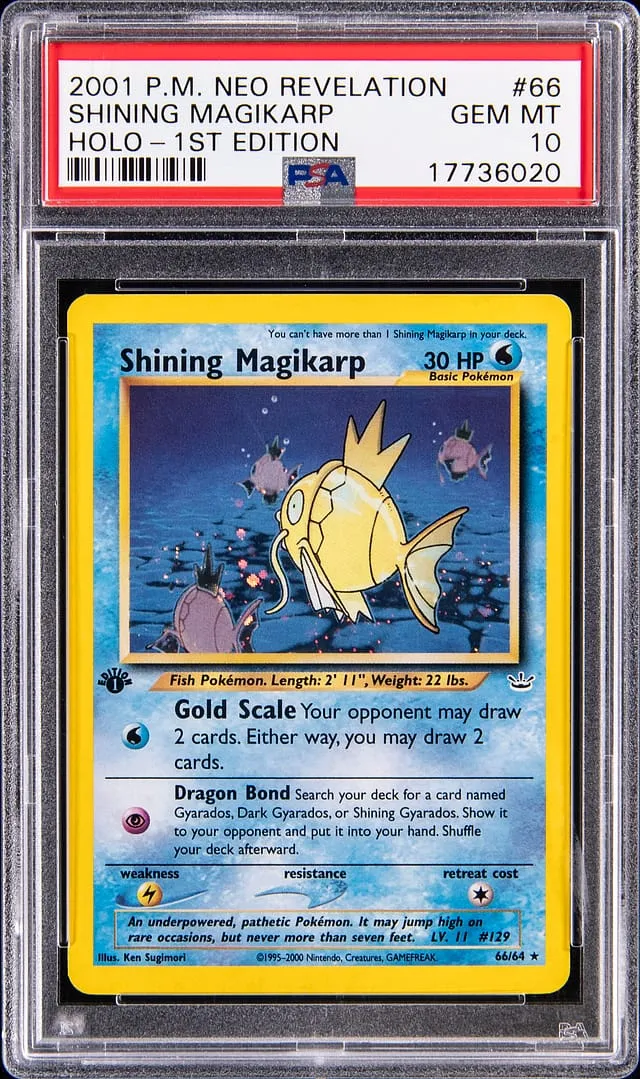
Breakdown of a 2001 Neo Revelation 1st Edition Shining Magikarp PSA 10 that sold for $27,378 at Goldin on April 13, 2026.
Sold Card
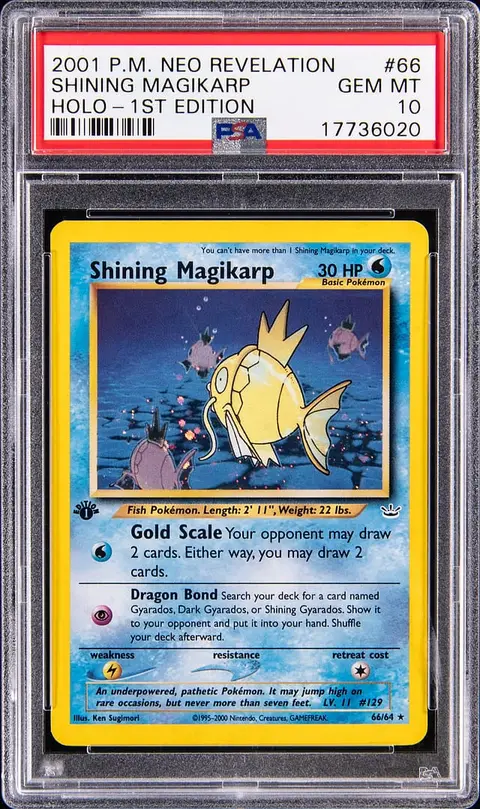
2001 Pokemon Neo Revelation 1st Edition Holo #66 Shining Magikarp - PSA GEM MT 10
Sale Price
Platform
GoldinA first-edition Shining Magikarp in gem mint condition quietly made waves at Goldin on April 13, 2026, reminding collectors how deep the early Pokémon well still runs.
On that date, a 2001 Pokémon Neo Revelation 1st Edition Holo #66 Shining Magikarp graded PSA GEM MT 10 sold for $27,378. For a card that began life as an oddball secret rare of an often-mocked Pokémon, this result underlines just how far the hobby has come in treating early Wizards of the Coast (WotC) era chase cards as true blue-chip collectibles.
Card snapshot: what exactly sold?
Let’s break down the card itself:
- Year: 2001
- Set: Pokémon Neo Revelation (WotC era)
- Card: Shining Magikarp
- Card number: #66 (secret rare, above the set’s listed count)
- Edition: 1st Edition
- Finish: Holofoil with Shining treatment (alternate color art)
- Grading company: PSA
- Grade: GEM MT 10 (PSA’s highest standard grade)
- Attributes: No autograph or patch – value is driven by era, rarity, condition, and character
This is not a rookie card in the sports sense, but in Pokémon terms it is a key issue: one of the earliest “Shining” cards and part of a short-run secret rare subset that helped define high-end Pokémon collecting in the early 2000s.
Why Shining Magikarp matters to collectors
To understand this sale, it helps to understand the context of the Neo-era Shining cards.
A secret rare from a pivotal set
Neo Revelation followed the original Base–Jungle–Fossil run and came out at a time when Pokémon’s initial craze was cooling. Print runs were generally lower than the earliest sets, and kids were shifting attention to other games and interests. The result: fewer sealed boxes opened, fewer cards preserved in top condition, and relatively limited supply of clean copies today.
Within Neo Revelation, Shining Magikarp stands out because:
- It was a secret rare: card #66 in a set listed to 64, making it one of the chase pulls of the product.
- It introduced the concept of a differently colored, high-rarity version of a familiar Pokémon – a concept that later evolved into Shiny Pokémon across the franchise.
- It features a famously weak Pokémon showcased in a premium, almost regal treatment. That contrast has aged very well with collectors.
From a timeline perspective, this card sits firmly in the vintage / early WotC window for Pokémon, where scarcity is driven more by era and survival rate than by modern-style serial numbering.
PSA GEM MT 10 and population context
PSA’s GEM MT 10 grade means the card is, by their standards, essentially flawless: centering, edges, corners, and surface all meet the top tier requirement.
For older holo cards like Shining Magikarp, this is not trivial. Neo-era holos are prone to print lines, edge chipping, and surface wear from childhood play. That means the number of PSA 10s (often called the pop or population) tends to be much lower than lower grades.
Population reports (PSA’s public counts of how many copies exist in each grade) show that Shining Magikarp 1st Edition has a significantly smaller PSA 10 population than more common modern chase cards. While exact numbers fluctuate with new submissions, this GEM MT 10 example lives in a relatively small club compared to the total number of raw copies that once existed.
Market context: where does $27,378 sit?
In hobby conversations, you’ll often hear people refer to “comps” – short for comparable sales. These are recent sales of the same (or very similar) card and grade, used to get a feel for current market sentiment.
For Shining Magikarp 1st Edition in PSA 10, recent public auction activity from major marketplaces and auction houses has generally clustered in the tens of thousands of dollars, not hundreds or thousands. Directly comparable results show that:
- PSA 10 copies have consistently achieved five-figure prices in strong venues.
- Lower grades (such as PSA 9) typically come in at a substantial discount to PSA 10, sometimes less than half, reflecting how sharply collectors differentiate perfect from near-perfect in this card.
At $27,378, this April 13, 2026 Goldin result sits well within the established high-end range for this card in top grade. It does not represent an outlier record that radically resets expectations, but rather a solid, data-supported confirmation of where serious buyers and sellers are meeting for PSA 10 Shining Magikarps in a strong auction environment.
Because Pokémon prices can move with broader hobby cycles, it’s more useful to look at this sale as one more point in an ongoing trend line than as a standalone headline number.
How this sale fits into Shining Magikarp’s history
Historically, notable Shining Magikarp sales have often tracked alongside renewed interest in:
- Early WotC-era Pokémon more broadly
- Cross-collectors moving from sports to Pokémon and seeking iconic, clearly defined key cards
- Nostalgia cycles driven by anniversaries and franchise milestones
Shining Magikarp has gradually graduated from “cult favorite” to “recognized pillar” of early Pokémon rarity. When key copies like a PSA 10 1st Edition surface at major houses such as Goldin, the results help:
- Set practical expectations for private seller transactions.
- Provide a reference point for graded copies just below 10 (PSA 9s and strong 8s).
- Anchor the perceived value of raw (ungraded) Shining Magikarps.
The April 13, 2026 sale doesn’t need to be a record to matter. By confirming healthy demand at $27,378 in a transparent auction, it supports the idea that the market for high-grade Neo-era Shining cards remains active and selective rather than speculative.
Takeaways for collectors and small sellers
Whether you own this card or are considering it, here are a few grounded observations:
Condition still rules. The spread between PSA 10 and lower grades is meaningful. For a card with known condition challenges, investing in proper storage and protection can be the difference between a mid-grade collectible and a premium asset.
Auction venue matters. This copy selling at Goldin on April 13, 2026 shows how major platforms can attract the right buyers for rare, high-end pieces. Smaller venues may see less competition and different pricing outcomes.
Neo Revelation remains a focused chase. It doesn’t have the sheer cultural footprint of Base Set, but within serious Pokémon circles, Neo Revelation’s key cards – especially Shining Magikarp – are firmly established as long-term targets.
Comps are a tool, not a guarantee. Using sales like this one as a reference is helpful for understanding the current landscape, but they are data points, not promises. Market conditions, timing, and card-specific factors (subgrade eye appeal, centering) all influence final results.
How figoca can help you track cards like this
For collectors, returning hobbyists, and small sellers, keeping up with individual high-end sales is time-consuming. That’s where figoca comes in:
- We surface sales histories for specific cards and grades so you can see not just one headline number, but the broader trajectory.
- We help you compare comps across platforms – from fixed-price marketplaces to auction houses like Goldin – so you can understand how venue and timing influence results.
- We emphasize data in plain language, making it easier to translate auction results into practical context for your own collection.
The 2001 Pokémon Neo Revelation 1st Edition Holo #66 Shining Magikarp PSA GEM MT 10 that sold for $27,378 at Goldin on April 13, 2026 is another clear signpost: early WotC-era secret rares, in true top-tier condition, continue to command respect from serious collectors.
As more of these cards settle into long-term collections, each public sale becomes that much more informative for anyone trying to understand where the vintage Pokémon market really stands today.