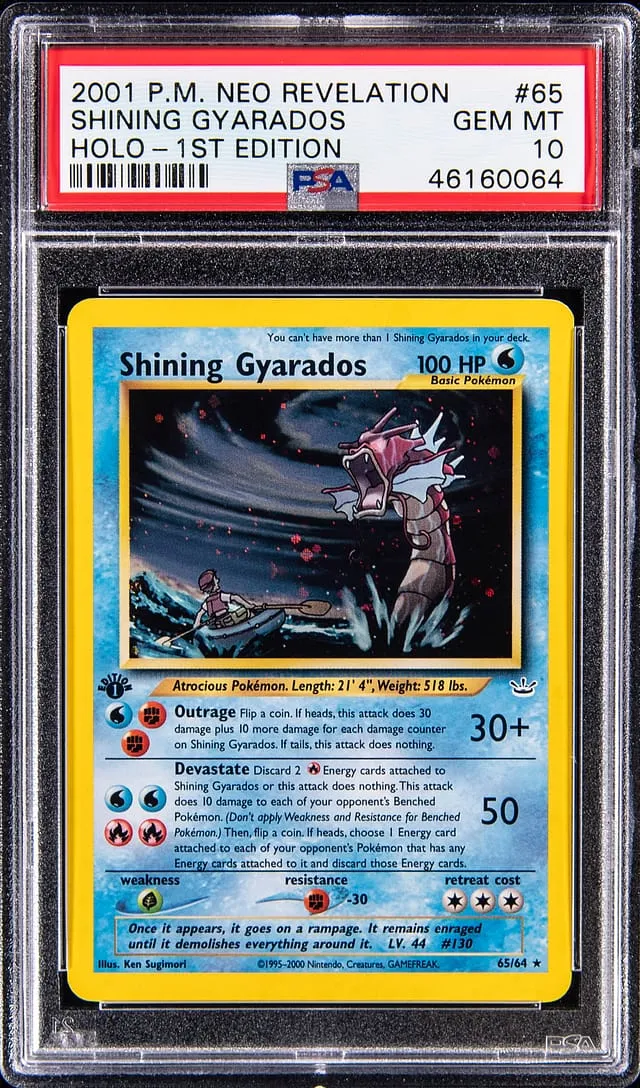
Shining Gyarados PSA 10 Neo Revelation Sale Analysis
A $69,540 Goldin sale of a 2001 Neo Revelation 1st Edition Shining Gyarados PSA 10 shows how WOTC-era Pokémon grails are holding up.
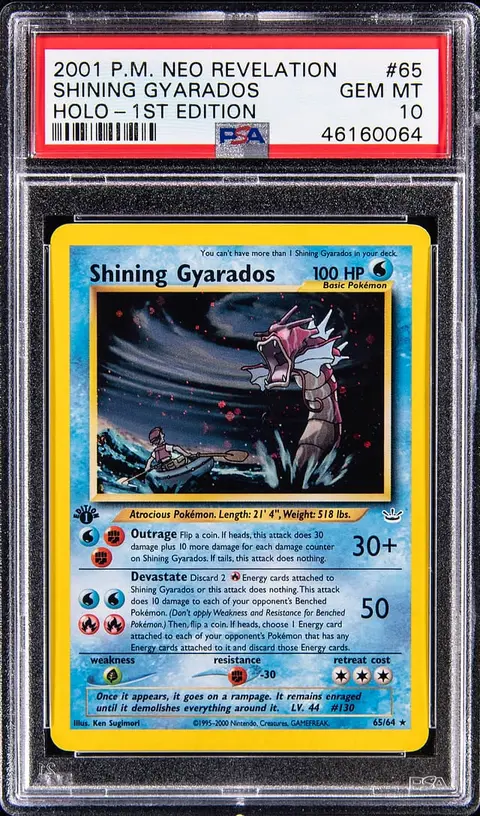
Sold Card
2001 Pokemon Neo Revelation 1st Edition Holo #65 Shining Gyarados - PSA GEM MT 10
Sale Price
Platform
Goldin2001 Neo Revelation Shining Gyarados PSA 10: Why This $69,540 Sale Matters
On April 13, 2026, a 2001 Pokémon Neo Revelation 1st Edition Holo #65 Shining Gyarados graded PSA GEM MT 10 sold for $69,540 via Goldin. For a card that’s been on collectors’ radar for more than two decades, this sale is another clear data point in how the hobby continues to treat Shining Gyarados as a true blue-chip from the WOTC era.
In this breakdown, we’ll look at what makes this card important, how this sale fits into recent market data, and why PSA 10 copies remain so closely watched.
Card Snapshot
- Card: Shining Gyarados
- Character: Gyarados
- Year: 2001
- Set: Pokémon Neo Revelation (English, Wizards of the Coast)
- Card number: #65
- Edition: 1st Edition
- Finish: Holo (Shining)
- Rarity: Secret rare-style Shining card
- Grading company: PSA (Professional Sports Authenticator)
- Grade: GEM MT 10 (PSA’s highest standard grade)
- Key issue: Yes – one of the anchor Shining cards of the Neo era
This is not a rookie card in the sports sense, but within Pokémon it functions like a key issue: a first-era Shining treatment of a fan-favorite evolution line, released during the original WOTC run.
Why Shining Gyarados Matters to Collectors
Shining Gyarados sits at the intersection of several collecting themes:
WOTC-era importance Neo Revelation is a 2001 Wizards of the Coast set, part of the original English Pokémon run. WOTC sets carry built-in nostalgia and finite supply, since they’re long out of print and heavily opened.
Shining card design and rarity The Shining subset in Neo Revelation (and Neo Destiny) introduced a different visual style: the Pokémon is printed in a different, often off-color foil with a unique texture and a lower pull rate than regular holos. In plain terms, these were some of the hardest and most unusual cards to pull from packs at the time.
An iconic artwork The Shining Gyarados art by Ken Sugimori and the team is unusually narrative: a red Gyarados emerging from a storm, looming over a tiny boat. For many collectors, it feels more like a scene from an animated movie than a typical TCG illustration. That storytelling quality is a big part of why the card is frequently singled out in “best Pokémon art” lists.
Condition difficulty Neo-era holos are known for printing lines, edge chipping, and surface scratches straight out of the pack. High grades, especially PSA 10, are relatively tough compared to modern ultra-modern releases, where print quality and centering have generally improved.
Putting all of that together, the card checks several boxes: early-era, visually distinctive, condition-sensitive, and fan-beloved.
Understanding PSA 10 and Population
PSA’s GEM MT 10 grade indicates a card that is, by their standards, virtually flawless: sharp corners, strong centering, and clean surfaces.
Population report (often shortened to “pop report”) refers to how many copies of a specific card have received each grade from a grading company. While exact numbers move over time as new submissions are graded, Shining Gyarados in PSA 10 has historically had a meaningfully lower population than more common WOTC holos.
Two things matter to collectors here:
- Total PSA 10 count: How many perfect copies exist.
- Ratio of PSA 10 to total graded: How hard it is to achieve that 10 relative to the number of cards submitted.
For Shining Gyarados, the ratio skews toward being relatively tough in 10, reinforcing its premium over PSA 9 and lower.
Recent Market Context for Shining Gyarados
When we look at “comps” (short for comparables—recent sales of the same or very similar items), a few patterns have been consistent over the last few years:
- PSA 10 1st Edition Shining Gyarados has tended to transact in the mid five-figure range in stable market periods.
- PSA 9 copies often sell for a substantial discount to 10s, sometimes less than half of the 10’s price depending on timing and venue.
- Unlimited (non–1st Edition) versions, even in high grade, usually sit at a much lower price tier than 1st Edition.
The $69,540 result at Goldin on April 13, 2026, fits within the upper band of recent observed ranges for PSA 10 copies in a mature, post-peak market. It doesn’t read as an outlier “record-smashing” spike, but it does lean toward the strong side of the curve, particularly given a more measured Pokémon market compared with the 2020–2021 surge.
Comparing Grades and Versions
To understand this sale, it’s useful to think in terms of a ladder of demand:
1st Edition PSA 10
- The premium tier for this card.
- Low population, high demand from set builders and character collectors.
- Sales like this Goldin result help anchor expectations for the top of the market.
1st Edition PSA 9
- More accessible while still very high grade.
- Historically, these have traded at a steep but logical discount to 10s.
- Price movement in 10s tends to influence how buyers and sellers price 9s.
Unlimited PSA 10
- Scarcer than many might assume but far more available than 1st Edition.
- Often targeted by collectors who want the art and nostalgia without paying 1st Edition premiums.
Raw and lower grades
- Popular with set builders and collectors who prioritize owning the card over grade.
- Prices here provide a floor for the card’s overall demand.
This $69,540 sale effectively reaffirms the gap between PSA 10 and everything below it. For those watching the market, it suggests that the “true gem” copies remain firmly in a different price conversation than PSA 9s and unlimited versions.
Role of Auction House and Timing
Auction venue matters. Goldin has developed a strong audience for high-end graded cards, and that can influence realized prices at the top end. A well-promoted auction with strong bidder participation often produces more robust results than a quiet fixed-price listing.
The sale date—April 13, 2026—comes in a period where the broader Pokémon market has largely normalized after the sharp swings of the early 2020s. In that context, a nearly $70K closing price reinforces that:
- The card’s appeal is not purely driven by short-term hype.
- There is still organized demand for top WOTC-era keys.
Collector Takeaways
For newcomers, returning collectors, and smaller sellers, here are some grounded observations based on this sale:
Shining Gyarados is a long-established key This card has been on “top WOTC card” lists for years. The Goldin result doesn’t create that status—it confirms it.
Grade matters more than ever at the high end The spread between PSA 10 and PSA 9 continues to be significant. If you’re buying or selling, it’s worth understanding:
- Surface quality: print lines, scratches.
- Centering: front and back.
- Edges and corners.
1st Edition vs. Unlimited is a structural price divider The 1st Edition stamp and lower print run have consistently commanded a premium. Unlimited copies offer a way to enjoy the same artwork at a fraction of the price.
Think in terms of ranges, not targets Rather than treating $69,540 as a “new rule” for the card, it’s more useful to see it as a data point in a range. Different auction houses, listing formats, and timing can all move the final number within that band.
Nostalgia plus scarcity continues to hold Shining Gyarados isn’t driven by current TV shows, games, or short-lived hype cycles. It’s anchored in:
- Early 2000s collecting memories.
- A distinct art style and story-driven scene.
- Proven, long-term interest across multiple hobby cycles.
How This Sale Fits the Bigger Picture
Looking across the broader WOTC landscape, several patterns seem consistent:
- Top-tier iconic cards (Charizard, key Shining cards, notable Neo holos) continue to attract strong bidding when they appear in true gem condition.
- Population data and grading standards matter more as supply has largely surfaced and raw copies have dried up compared with several years ago.
- The market for mid-tier graded copies (PSA 7–8) is more sensitive to overall hobby sentiment, while the absolute top grades show more resilience.
For Shining Gyarados specifically, this Goldin sale underscores that it belongs in the conversation with other premier WOTC-era chase cards, not just as a cult favorite but as a consistently supported market piece.
Final Thoughts
The 2001 Pokémon Neo Revelation 1st Edition Holo #65 Shining Gyarados in PSA GEM MT 10 selling for $69,540 at Goldin on April 13, 2026, is a measured but meaningful signal. It reinforces several long-standing themes:
- WOTC-era Shining cards still command serious attention.
- PSA 10 examples remain tightly held and highly contested when they surface.
- Market participants are treating this card as a long-term cornerstone, not a passing trend.
For anyone tracking high-end Pokémon, this result is less about sudden change and more about confirmation: Shining Gyarados continues to hold its place near the top of the Neo-era hierarchy, especially in the rarefied air of PSA GEM MT 10.