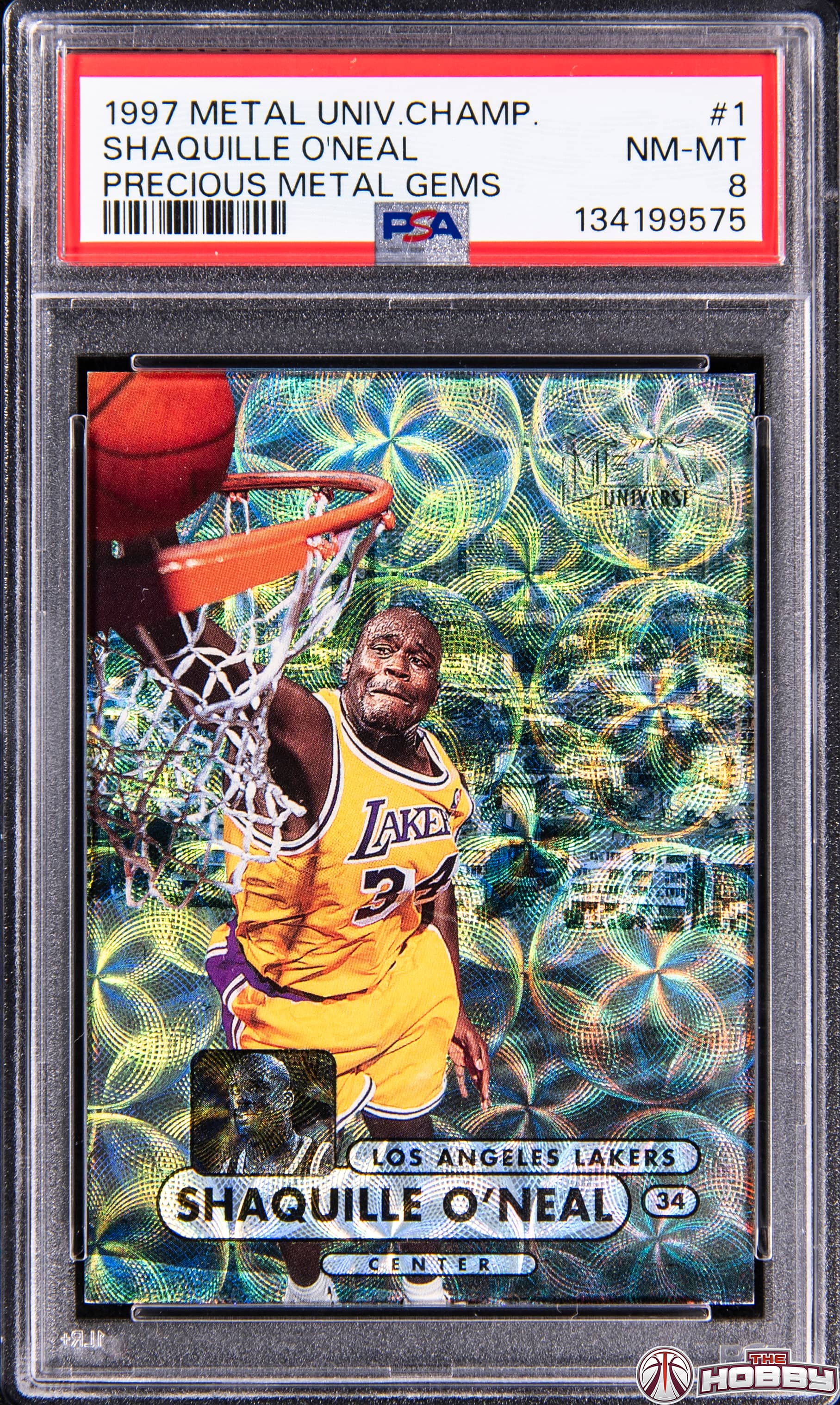
Shaq 1997-98 PMG Championship PSA 8 sells for $62K
Goldin sold a 1997-98 SkyBox Metal Universe Championship PMG Shaquille O’Neal #1 PSA 8 (#001/50) for $62,232. A key data point for 1990s insert collectors.
Sold Card
1997-98 SkyBox Metal Universe Championship Precious Metal Gems (PMG) #1 Shaquille O'Neal (#001/50) - PSA NM-MT 8
Sale Price
Platform
Goldin1997-98 SkyBox Metal Universe Championship Precious Metal Gems (PMG) #1 Shaquille O'Neal (#001/50) - PSA NM-MT 8 Sold for $62,232 at Goldin (01/04/26)
The 1997-98 Metal Universe Championship Precious Metal Gems (PMG) Shaquille O’Neal is one of the key Shaq cards from the 1990s, and this specific copy checks nearly every box serious collectors care about.
- Player: Shaquille O’Neal
- Team: Los Angeles Lakers
- Year: 1997-98
- Set: SkyBox Metal Universe Championship
- Parallel: Precious Metal Gems (PMG)
- Card number: #1
- Serial number: 001/50 (first in the run)
- Grading company: PSA
- Grade: PSA 8 (NM-MT – Near Mint-Mint)
- Attributes: low-serial, metal/foil PMG, non-rookie but a premium key issue
On January 4, 2026 (UTC), Goldin sold this card for $62,232. For Shaq collectors and PMG specialists, this sale offers a useful snapshot of where high-end 1990s inserts are settling in the current market.
What exactly is this Shaq PMG?
The 1997-98 SkyBox Metal Universe Championship set was a parallel product to the base 1997-98 Metal Universe release. Within it, Precious Metal Gems (PMGs) are the premium, low-serial parallels that have become some of the most chased 1990s basketball inserts.
This Shaquille O’Neal is:
- From the Championship subset, not the standard Metal Universe base product.
- A PMG parallel, serial numbered to just 50 copies.
- The first serial in the run: 001/50, which many collectors see as a desirable “eye appeal” bonus.
It is not a rookie card (Shaq’s rookies are 1992-93), but it is widely treated as a key 1990s insert for him—especially for collectors who focus on rare, condition-sensitive, serial-numbered parallels rather than base rookies.
Why PMGs matter so much in the hobby
“Precious Metal Gems” have become a kind of shorthand in the hobby for high-end 1990s inserts that combine scarcity, strong design, and real difficulty in high grade:
- Era: Late-1990s, a transitional period between true vintage and modern. Production was much lower than the later “ultra modern” boom, but still above early 1980s levels.
- Scarcity: Serial numbering (like /50 on this Shaq) means we know exactly how many were printed, and that supply is permanently capped.
- Condition sensitivity: PMGs are notorious for chipping, edge wear, and surface issues. High grades like PSA 8, 9, or 10 are comparatively rare.
Within PMGs, the original 1997-98 runs (across various sports and the Championship variant) have taken on almost a “foundational” status for modern insert collecting. They’re often grouped in the same conversation as key 1986-87 Fleer rookies or early Exquisite patches when people discuss important modern-era basketball issues.
Grading and population context
PSA’s grading scale runs from 1 (Poor) to 10 (Gem Mint). A PSA 8 (NM-MT) means the card is:
- Nicely centered to slightly off.
- With only minor corner or edge wear.
- Free of major creases or dents.
For PMGs, even PSA 8s are respected grades because of how easily these cards show damage. While exact population ("pop report") counts can change as new cards are submitted, the basic pattern tends to look like this for 1990s PMGs:
- Very few total graded examples compared with more common inserts or base cards.
- A small number in PSA 8 and above.
- A long tail of lower grades due to surface and edge issues.
In short, a PSA 8 on a 1997-98 Championship PMG is not a “mid-tier” grade the way it might be for a base card from a mass-produced modern set—it’s closer to a sweet spot between condition, aesthetics, and affordability (relative to higher grades).
Market context and recent sales
This particular copy sold via Goldin on January 4, 2026 for $62,232.
When collectors talk about “comps” (comparable sales), they usually look at:
- The same card in the same grade.
- The same card in nearby grades (PSA 7, PSA 9, BGS equivalents).
- Closely related versions (for PMGs, that might include other colors or the non-Championship version in the same year).
For 1997-98 Championship PMG Shaq cards, the available public sales are relatively thin compared with more liquid, modern issues. That low volume makes exact comparisons tricky, but we can still outline the broader pattern seen across Shaq PMGs and similar 1990s metal-era inserts:
- Lower grades (PSA 5–7 or equivalent) typically trade at a noticeable discount to PSA 8+. For PMGs, eye appeal (centering, color, chipping) often matters as much as the number on the label.
- Higher grades (PSA 9, BGS 9.5, etc.) can command significant premiums when they appear, especially for star players like Shaq, Kobe, and Jordan.
- Serial nuances like a jersey number or first/last in the print run (001/50 or 050/50) can add a subjective premium for some buyers, especially in private or auction settings.
Given that context, a $62,232 result for a PSA 8, serial 001/50 Championship PMG of a top-tier Hall of Famer sits firmly in the high-end 1990s insert lane, but not in the record-challenging territory reserved for PSA 10s, jersey number copies, or Jordan PMGs. It’s a strong but contextually believable outcome for a scarce, culturally important insert.
How this sale fits into Shaq’s broader card market
Shaquille O’Neal’s card market is anchored by:
- 1992-93 rookies in sets like Topps, Stadium Club, and Upper Deck.
- Early 1990s inserts and parallels (Beam Team, N-Tense, etc.).
- Late 1990s rare inserts, PMGs, and numbered parallels like this one.
Over the last few years, the hobby has seen:
- A renewed focus on 1990s inserts as many collectors who grew up in that era return to the hobby with more disposable income.
- Distinct strength in metal-themed brands and serial-numbered parallels, as newer collectors seek cards that feel scarce and visually unique.
- Stable demand for Hall of Fame-level big men, with Shaq often at the top of that group due to his on-court dominance and ongoing media presence.
This sale aligns with that picture. Rather than a speculative spike tied to short-lived hype, it fits into a multi-year trend of collectors valuing:
- Scarce, serial-numbered 1990s inserts.
- Established Hall of Fame players.
- Condition-sensitive cards in strong but not necessarily “perfect” grades.
Key takeaways for collectors
For collectors and small sellers trying to make sense of this result, a few practical observations:
True scarcity matters more than buzz. A serial-numbered /50 PMG from a foundational 1990s set will almost always behave differently in the market than a modern, high-print-run parallel, even if both are technically numbered.
Grade bands behave differently for PMGs. A PSA 8 on a PMG is a high-confidence condition result, not a mid-tier outcome. Comparing prices to standard base rookies or modern chrome parallels can be misleading.
Serial number premiums are real but situational. The 001/50 label likely helped this copy stand out in bidding. Some collectors will pay extra for first or last in the run; others focus strictly on grade and eye appeal.
Low transaction volume means wide ranges. With few public sales, realized prices can vary more from auction to auction. A single result—high or low—does not necessarily reset the entire market for the card.
Context beats headlines. A $62,232 sale is notable, but it fits a broader narrative: key 1990s inserts of iconic Hall of Famers in solid grades continue to command meaningful attention.
Where this leaves the 1997-98 Championship PMG Shaq
This Goldin sale confirms a few things about where the hobby currently stands on this card:
- The 1997-98 Metal Universe Championship PMG Shaq is established as a premium, non-rookie key for high-end Shaq and PMG collectors.
- PSA 8 remains a highly respected grade given the card’s condition challenges.
- Serial 001/50 copies can find strong demand in a competitive auction setting.
For collectors tracking the long-term story of 1990s inserts, this sale is another data point that the era’s true scarce parallels—especially PMGs—have settled into a mature part of the market. Not every result will look like this, and prices can move both up and down over time, but the underlying interest in these cards continues to be driven by their combination of history, design, and real scarcity.
As always, it’s helpful to treat any single auction result as one piece of a larger puzzle. For those building a focused Shaq PC (personal collection) or exploring 1990s metal inserts for the first time, this $62,232 Goldin sale on January 4, 2026 offers a clear, data-backed reminder of how highly collectors value the best examples of this iconic era.