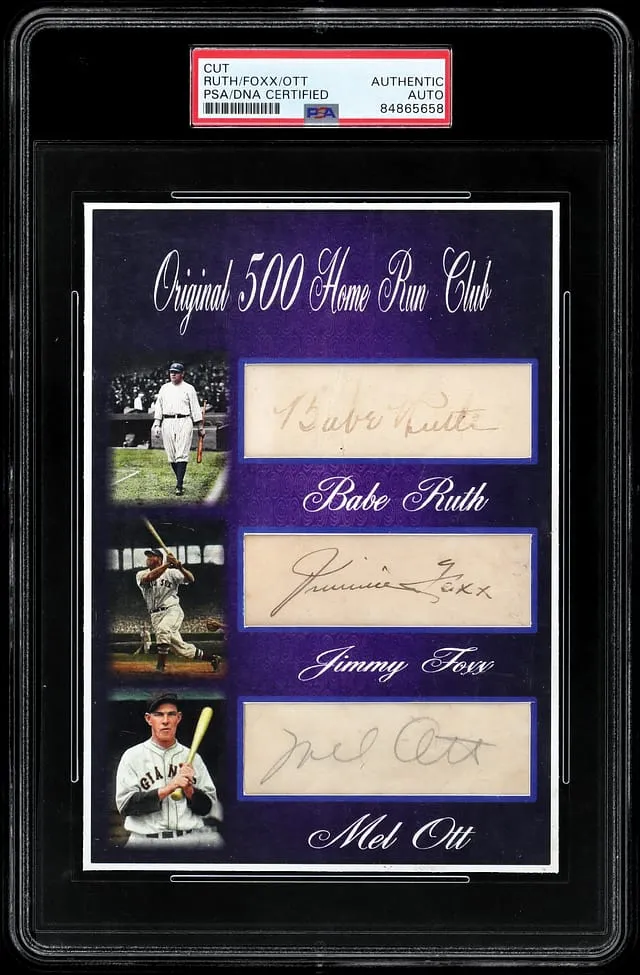
Ruth, Foxx & Ott 500-HR Cut Display Sells for $19K
Goldin sold a PSA/DNA 500-Home Run Club cut display signed by Babe Ruth, Jimmie Foxx, and Mel Ott for $19,519. Here’s what the result means for collectors.
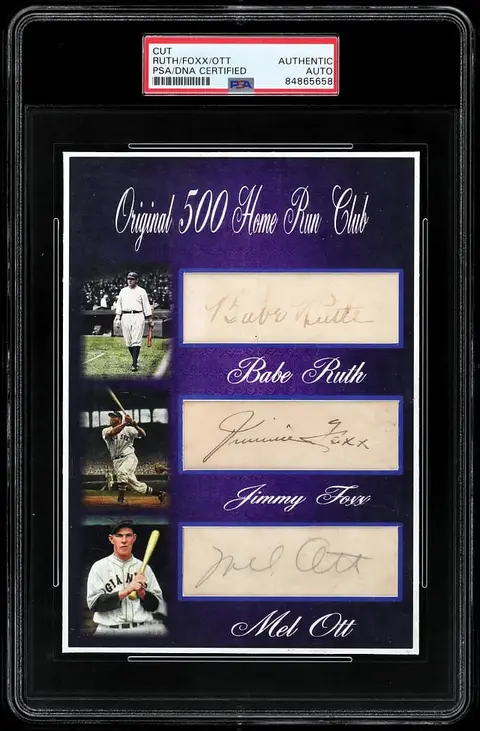
Sold Card
Babe Ruth, Jimmie Foxx, Mel Ott Original 500-Home Run Club Multi-Signed Cut Display - PSA/DNA Authentic
Sale Price
Platform
GoldinBabe Ruth, Jimmie Foxx, Mel Ott: A 500-HR Club Cut That Just Cleared $19K
On February 22, 2026, Goldin closed the sale of a uniquely focused piece of baseball history: a Babe Ruth, Jimmie Foxx, and Mel Ott Original 500-Home Run Club multi-signed cut display, authenticated by PSA/DNA, at a final price of $19,519.
For collectors who mostly think in terms of traditional slabs and set checklists, this is an important reminder that some of the most meaningful pieces in the hobby live outside standard issues. Multi-signed cuts—especially when they combine multiple pre-war Hall of Famers—sit in a niche where rarity, eye appeal, and provenance matter as much as any population report.
What Exactly Sold?
This piece is not a conventional card from a specific Topps, Goudey, or Bowman set. It’s a custom display featuring original cut signatures from three of the earliest members of Major League Baseball’s 500-home-run club:
- Babe Ruth – New York Yankees icon and still the defining name of pre-war collecting.
- Jimmie Foxx – Power-hitting first baseman, primarily known for his years with the Philadelphia Athletics and Boston Red Sox.
- Mel Ott – New York Giants slugger and National League legend.
Key details:
- Item type: Original multi-signed cut display (not a pack-issued trading card)
- Signers: Babe Ruth, Jimmie Foxx, Mel Ott
- Theme: Early members of the 500-Home Run Club
- Authentication: PSA/DNA Authentic
- Grading: The signatures are authenticated rather than given a numerical grade in the listing context
- Attributes: Multi-signature piece, spanning three all-time greats whose true-period autographs are each challenging in their own ways
Because this is a custom display built around original cuts, there is no set name, card number, or parallel designation the way there would be with a modern issue. Instead, the hobby views it more like a unique, high-end autograph piece.
Why This Combination Matters to Collectors
The 500-Home Run Club is one of the most recognized milestone groups in baseball history. For much of the 20th century, the list was small and exclusive. Ruth, Foxx, and Ott were foundational to that narrative:
- Babe Ruth became the first player to reach 500 home runs in 1929, transforming offensive expectations for the sport.
- Jimmie Foxx joined Ruth in 1940, building his reputation as one of the most dangerous right-handed hitters of the era.
- Mel Ott reached 500 in 1945 and held the National League home-run record for decades.
Collectors often use terms like “iconic,” “pillar,” or “foundational” for Ruth; Foxx and Ott are more quietly revered, especially among pre-war and early post-war specialists. A piece that unites all three on one display gives collectors a way to represent an entire narrative—early power hitting and the birth of the 500-HR Club—within a single item.
Market Context: How Does $19,519 Fit In?
Because this is a custom multi-signed cut, there is no perfect one-to-one comparison in recent auction records. Instead, collectors and consignors usually look at a cluster of related data points—often called “comps,” short for comparable sales—to understand whether a realized price is low, typical, or strong.
Useful categories of comps for context include:
Single-Signer Ruth Cuts and Slabbed Autos
- Authentic Babe Ruth cut signatures, authenticated by PSA/DNA or similar services, often sell in the several-thousand to mid–five-figure range depending on:
- Signature quality and boldness
- Medium (checks, album pages, cuts, photos)
- Presentation (basic encapsulation vs. premium-framed display)
- High-end, well-centered Ruth cuts with strong ink can push well above typical ranges, especially when paired with quality display work or significant inscription content.
- Authentic Babe Ruth cut signatures, authenticated by PSA/DNA or similar services, often sell in the several-thousand to mid–five-figure range depending on:
Jimmie Foxx and Mel Ott Autographs
- Authentic Jimmie Foxx and Mel Ott signatures are scarcer in the market compared with many post-war stars, in part because both died relatively young.
- Their prices tend to trail Ruth substantially but are still meaningful within pre-war collecting, especially for clean, legible, and well-placed cuts.
Multi-Signed Displays and Team-Signed Pieces
- Pre-war multi-signed pieces—whether team-signed balls, photos, or cuts—often scale in value with:
- The headliner (here, Ruth)
- Number and quality of additional Hall of Famers
- Thematic coherence (for example, all members of a specific milestone group or championship team)
- Pieces that bring a clear theme (like the 500-HR Club) generally command stronger interest than random assortments of players.
- Pre-war multi-signed pieces—whether team-signed balls, photos, or cuts—often scale in value with:
Within that framework, a realized price of $19,519 for a three-signature, authenticated 500-HR Club display featuring Ruth as the anchor lands in a range that makes sense for serious vintage autograph collectors. It reflects:
- The premium for Ruth’s signature
- The relative scarcity and importance of Foxx and Ott
- The appeal of a unified theme rather than an incidental multi-signature piece
The absence of a numerical autograph grade here (for example “PSA/DNA 9”) can matter in some corners of the hobby, where top-graded autos can carry an additional premium. In this case, the PSA/DNA Authentic designation emphasizes legitimacy and period-correct signing, while leaving the final judgment of pen quality and aesthetics to buyers.
How Era and Format Affect Demand
This piece is rooted firmly in the vintage era—Ruth died in 1948, Ott in 1958, and Foxx in 1967. For modern and ultra-modern cards, collectors usually obsess over serial numbers, parallels, and gem-mint grades. For pre-war autographs, the hierarchy looks different:
- Authenticity is non-negotiable. A major third-party authenticator like PSA/DNA is almost a prerequisite at this level.
- Signature quality (pen pressure, completeness of the name, smudging, fading) can outweigh things like centering or corners that dominate card grading.
- Context—who signed, when, and on what—adds significant value. Items known or believed to be signed during a player’s active career, or tied to an event or theme, often draw additional interest.
Cut displays like this one appeal to a specific slice of collectors:
- Vintage autograph specialists
- Hall of Fame and milestone collectors (500 HR, 3,000 hits, Triple Crown, etc.)
- Deep baseball historians who prioritize era and narrative over pack-issued card structure
Recent Hobby Environment
While there has been plenty of attention on modern prospects, new parallels, and grading trends, high-quality vintage autographs have generally held a steady place in the upper tiers of the market. They are less affected by short-term performance swings and more by:
- Long-term collector preference for certain eras
- The supply of authentic examples coming to auction
- The role of museum-level or institutional buyers occasionally stepping in
A multi-signed 500-HR Club display anchored by Ruth sits at the crossroads of several stable collecting themes: Hall of Famers, milestones, and early power-hitting history.
What This Sale Suggests for Collectors
For collectors watching the market, the $19,519 Goldin result on February 22, 2026, suggests a few practical takeaways:
Theme Matters The fact that the signatures are Ruth, Foxx, and Ott specifically—as early 500-HR Club members—gives the piece structure and coherence. Multi-signed items that tell a clear story tend to attract more focused bidding than random groupings.
Presentation and Authentication Are Central Even though this is not a numbered, pack-issued card, the way the cuts are assembled and the presence of PSA/DNA authentication clearly support the final result. For sellers, investing in trustworthy authentication and thoughtful display can be a meaningful value-add.
Vintage Autographs Behave Differently than Modern Parallels You will not see pop report data or serial numbering for a custom piece like this. Instead, the market is guided by how often similar-quality examples show up and by the depth of collector demand for these signatures.
Comps Are a Range, Not a Script In a niche segment like multi-signed vintage displays, exact comps are rare. Collectors generally work with a spectrum of related Ruth, Foxx, and Ott autograph sales, then overlay factors like theme, layout, and visual strength. That context frames a sale like this as a data point rather than a universal reference price.
How Figoca Users Might Think About Pieces Like This
If your collecting has been mostly modern slabs and you are considering a move into vintage autographs:
- Start by studying authentication standards from PSA/DNA and similar firms.
- Look at multiple examples of each signer’s autograph across different years to get a feel for authentic handwriting styles.
- Pay close attention to how theme and presentation influence realized prices. Two items with the same signers can sell very differently if one tells a clearer story.
If you already collect Ruth, Foxx, Ott, or other early power hitters, this Goldin sale is a useful benchmark for what the market is currently willing to pay for a tightly themed, PSA/DNA-authenticated, multi-signature display featuring Hall of Fame power bats.
In any case, this $19,519 result underlines a steady truth in the hobby: when era-defining names are brought together thoughtfully, the market will usually show up—even when the piece doesn’t fit neatly into a traditional set checklist.