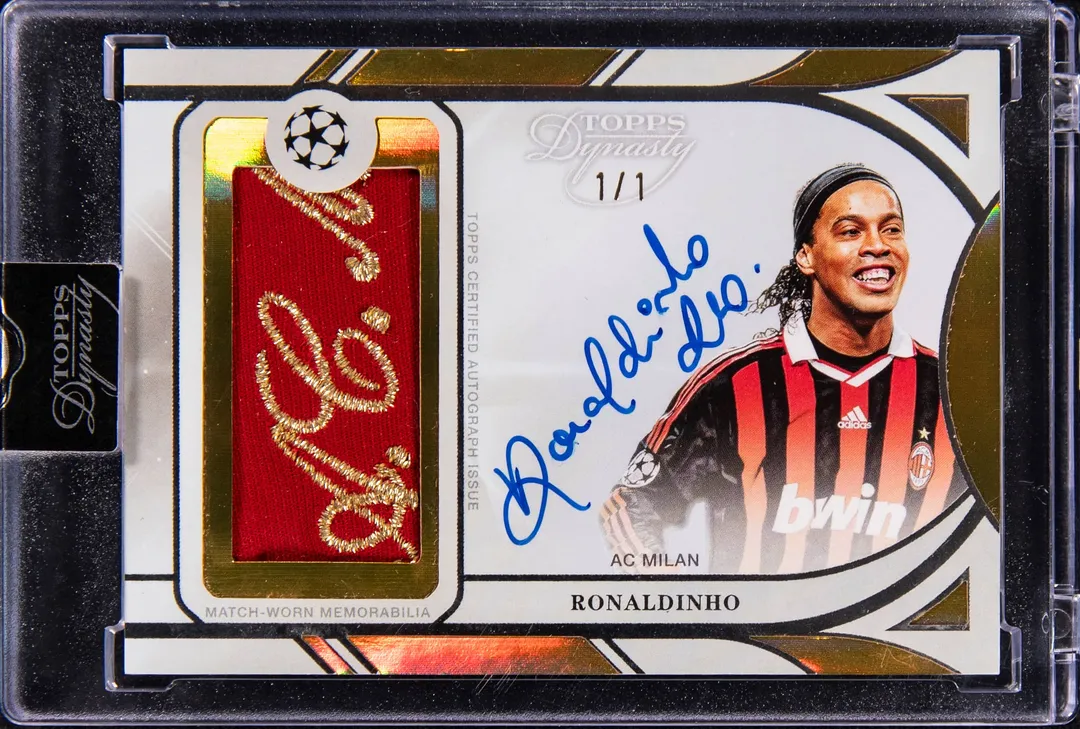
Ronaldinho 2024-25 Topps Dynasty Gold 1/1 Sale
Goldin sold a 2024-25 Topps Dynasty UCC Ronaldinho Gold 1/1 auto patch for $41,480. See what this means for high-end soccer card collectors.
Sold Card
2024-25 Topps Dynasty UCC Autograph Patch Gold #APL-RI2 Ronaldinho Signed Patch Card (#1/1) - Topps Encased
Sale Price
Platform
GoldinFor collectors who enjoy the intersection of modern luxury soccer cards and all-time legends, a recent Goldin sale is worth a closer look.
On February 8, 2026 (UTC), Goldin sold a 2024-25 Topps Dynasty UCC Autograph Patch Gold #APL-RI2 Ronaldinho card for $41,480. This particular copy is a one-of-one (#1/1) gold parallel, features a signed patch, and comes Topps-encased from the factory.
In this breakdown, we’ll walk through what this card is, why it matters to the market, where this sale sits in the broader Ronaldinho landscape, and what collectors might take away from the result.
The card at a glance
Full card details
- Player: Ronaldinho
- Year: 2024-25
- Product: Topps Dynasty UCC (likely tied to UEFA club competition licensing)
- Card: Autograph Patch Gold #APL-RI2
- Parallel: Gold, serial-numbered 1/1
- Autograph: Certified Ronaldinho signature
- Memorabilia: Multi-color patch window
- Encapsulation: Topps factory-encased
- Rookie or key issue? Not a rookie, but a high-end, ultra-modern premium issue of a global icon
There is no third-party grading label mentioned with this card. Instead, it is in Topps’ own tamper-evident case, which has become common for premium releases. In the high-end soccer space, many collectors are comfortable buying these cards in original manufacturer encasement, especially when the card is a 1/1.
Why Dynasty UCC matters to soccer collectors
Topps Dynasty has long been positioned as a high-end, low-print-run brand in baseball. Its soccer (UCC) counterpart follows a similar formula:
- Ultra-low print runs: Boxes and cases contain very few cards, each intended to be premium.
- On-card or high-quality autographs: Dynasty-style releases are built around signatures and patches, not base cards.
- Patch focus: Multi-color patches and club-related memorabilia pieces are core to the appeal.
For soccer collectors, the big draw is that legendary names—like Ronaldinho—are presented in a format that feels more like high-end basketball or baseball: thick card stock, bold autos, and impactful patches.
This sits firmly in the ultra-modern era of cards (roughly mid-2010s to present), where rarity is built into the product design via serial numbering and intentionally small print runs.
Ronaldinho in the hobby: not a rookie, but a legend
This card is not a Ronaldinho rookie. His early-2000s issues (such as 2002 and 2003 releases tied to his PSG and Barcelona eras) are generally considered his key early cards. However, for many collectors, Ronaldinho’s appeal goes beyond strict rookie-chasing:
- Global icon: He’s widely regarded as one of the most entertaining and influential playmakers of his generation.
- Cross-club appeal: Barcelona, AC Milan, and Brazil national team collectors all intersect on his cards.
- Autograph demand: Legitimate, licensed, pack-issued Ronaldinho autos are consistently sought after, especially when combined with quality patches.
High-end modern autograph patch cards like this Dynasty Gold 1/1 are effectively “centerpiece” items rather than volume plays. A collector who wants a single, major Ronaldinho card for a display, PC (personal collection), or long-term hold tends to look at cards in this tier.
Market context and price positioning
The Goldin sale closed at $41,480. To understand this in context, it helps to compare it with:
- Other modern Ronaldinho autos – including on-card autos from Topps and Panini high-end products.
- Other Ronaldinho patch autos – especially low-numbered or 1/1 cards.
- High-end 1/1s of comparable soccer legends – cards from players like Zidane, Henry, or Kaka, in similar premium patch-auto formats.
Across recent public sales data for Ronaldinho:
- Standard modern autograph cards (no patch, higher numbering) typically sell in a much lower band, reflecting higher supply and less premium presentation.
- Low-numbered patch autos (for example, serial-numbered out of 10 or 5) tend to sit significantly higher than his basic autos, especially when the patch is visually strong and club-branded.
- True 1/1 patch autos from recent premium releases often form their own tier, with realized prices varying widely depending on design, timing, and where they are sold.
Within that landscape, $41,480 places this sale in the upper band of modern Ronaldinho card prices, which is consistent with:
- A one-of-one designation
- A premium brand (Dynasty-style product)
- A combined auto + patch format
- Being offered via a major auction house (Goldin), which typically aggregates serious high-end bidders
Because this is a new 2024-25 release, there is not yet a deep history of exact-card comparisons—especially not for another copy of the same 1/1, which by definition does not exist. Instead, collectors tend to compare this to:
- Other Ronaldinho 1/1s from previous premium products
- 1/1s of similarly respected legends in the same or closely related soccer products
From that angle, the realized price aligns with the broader trend of high-end soccer legend 1/1s establishing themselves as long-term “pillar” pieces in advanced collections.
What this sale suggests about the high-end soccer market
While one sale does not set the entire market, it does offer some useful signals for collectors and small sellers.
1. Legends remain a steady anchor
Even as younger players and prospects can see large swings in value based on form, injuries, or transfers, all-time greats like Ronaldinho tend to show more stable demand at the high end. A sale above $40,000 for an ultra-modern issue underlines that collectors are comfortable allocating serious budget to established legends, not just current stars.
2. Premium design and presentation matter
The combination of:
- Premium brand (Topps Dynasty/UCC)
- Autograph + patch
- 1/1 Gold parallel
- Factory encasement
is exactly what many high-end soccer buyers look for. The card is immediately recognizable as a “showcase” piece, and that translates into serious bidding when it surfaces on a large auction platform.
3. Auction house visibility can shape outcomes
This card selling at Goldin on February 8, 2026 (UTC) gives it broad hobby visibility. Major auction houses often generate:
- Larger, more engaged bidder pools
- Historical record-keeping that collectors can reference for future comps
That doesn’t mean every card should or must go to auction, but it does highlight the role of visibility, marketing, and bidder competition in realizing strong results for unique pieces.
How newer collectors can read a sale like this
If you’re newer or returning to the hobby, a $41,480 sale can feel distant from everyday collecting. It’s still useful, though, as a reference point.
A few practical takeaways:
Use high-end results as directional markers, not targets. This kind of sale shows how the very top of a player’s market can behave. It doesn’t mean every Ronaldinho auto will be expensive, but it does confirm that there is strong appetite at the top for his best cards.
Understand what drives scarcity.
- Serial numbering (1/1 vs /10 vs /99)
- Brand (high-end vs mass-market releases)
- Design (patch, on-card auto, unique artwork) All of these work together to create tiers of demand.
Look at comps, but with context. “Comps” refers to comparable recent sales. For a 1/1, exact comps don’t exist, so collectors use close substitutes: same player, similar product, comparable serial number. This is more art than science, but it’s a key skill in navigating modern sports cards.
Separate player fandom from card attributes. Many people love Ronaldinho. Not all Ronaldinho cards are worth the same. The market clearly distinguishes between:
- Basic inserts or stickers
- Standard autographs
- Premium patch autos and 1/1s
Where this card sits in a Ronaldinho-focused collection
For a Ronaldinho collector, this 2024-25 Topps Dynasty UCC Autograph Patch Gold #APL-RI2 1/1 is the type of card that can:
- Serve as a central display piece
- Complement early-career or rookie-era cards by adding a modern, luxury-style counterpart
- Represent Ronaldinho in a multi-player, high-end legends collection alongside icons like Zidane, Ronaldo Nazário, and Henry
Because it’s a one-of-one, it also carries an inherent finality: there is no second copy to chase. For some collectors, that’s the entire appeal.
Final thoughts
The February 8, 2026 Goldin sale of the 2024-25 Topps Dynasty UCC Autograph Patch Gold #APL-RI2 Ronaldinho (#1/1) at $41,480 is a clear marker of where the top of the Ronaldinho market—and a slice of the high-end soccer market more broadly—currently sits.
For active hobbyists, it reinforces a few themes:
- Ultra-modern, low-print-run legend cards have carved out a durable space.
- Brand, design, and serial numbering combine to create sharp value tiers.
- Unique, high-visibility auctions help define the upper edges of what collectors are willing to pay.
You don’t need to chase five-figure cards to learn from them. Watching results like this can sharpen your sense of what truly rare, well-presented pieces look like—and help you evaluate everything from entry-level inserts to your own next big purchase or sale with clearer eyes.
If you track or collect Ronaldinho, patch autos, or 1/1s and want to better understand how recent auction results fit into your own strategy, keep an eye on upcoming Goldin and other major auction house catalogs. Each new sale adds another data point to the evolving picture of the high-end soccer card market.