Roger Federer 2003 NetPro Auto Relic Rookie Sells for $95K
Breakdown of the 2003 NetPro Roger Federer Bonus 25 auto relic rookie that sold for $95,770 at goldin on 02/08/26, and what it means for collectors.
Sold Card
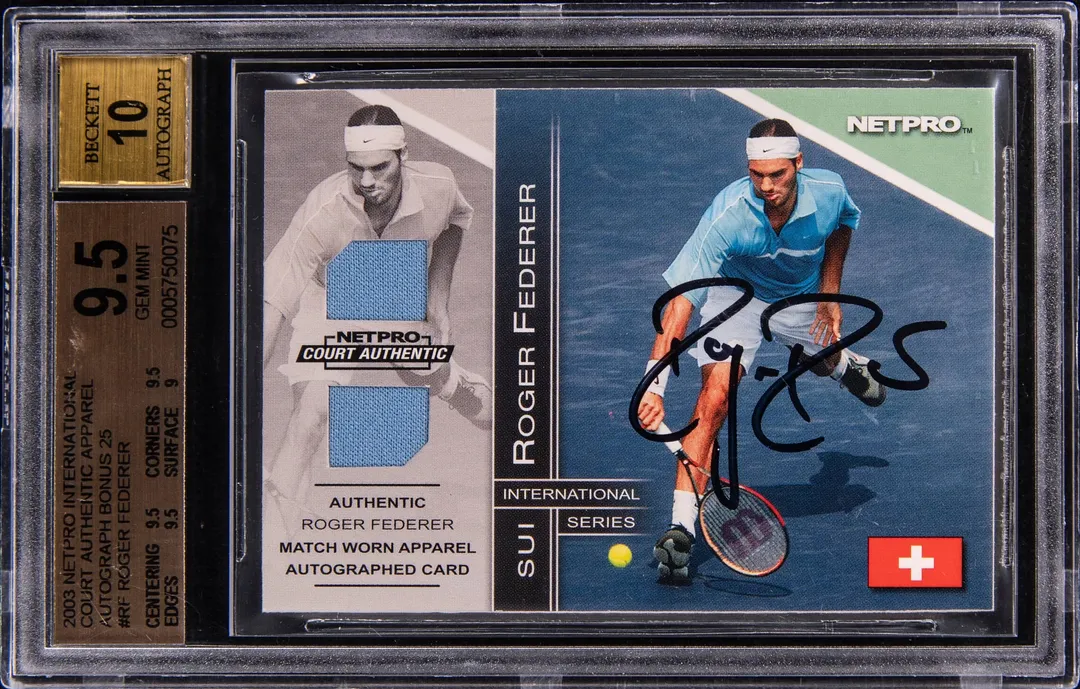
2003 NetPro International Series Court Authentic Apparel Autograph Bonus 25 #RF Roger Federer Signed Match-Worn Relic Rookie Card (#12/25) - BGS GEM MINT 9.5, Beckett 10
Sale Price
Platform
Goldin2003 NetPro International Series Court Authentic Apparel Autograph Bonus 25 #RF Roger Federer Signed Match-Worn Relic Rookie Card (#12/25) - BGS GEM MINT 9.5, Beckett 10
Sale price: $95,770 (goldin, 02/08/26 UTC)
Roger Federer’s early-2000s NetPro cards have quietly become the foundational pieces of modern tennis collecting. Among them, the Court Authentic Apparel Autograph “Bonus 25” cards sit in a very small, very important tier: low-serial, on-card autograph, match-worn relic rookies from the sport’s defining player of his era.
This article walks through what exactly this card is, why it matters, and how this $95,770 result at goldin on 02/08/26 fits into the broader market for Federer and tennis cards.
- Card breakdown: what exactly sold?
Let’s unpack the full title:
- Year & brand: 2003 NetPro
- Subset: International Series – Court Authentic Apparel Autograph “Bonus 25”
- Player: Roger Federer
- Card number: #RF
- Serial number: #12/25 (only 25 copies produced)
- Rookie status: 2003 is Federer’s true mainstream rookie year, and this is a premium rookie issue.
- Autograph: On-card autograph (Federer signed directly on the card, not on a sticker).
- Relic: Match-worn apparel piece (a small swatch of clothing worn by Federer in actual match play).
- Grading:
- Beckett Grading Services (BGS) overall GEM MINT 9.5
- Beckett 10 autograph grade (their highest standard auto grade)
This specific sub-series, often called “Bonus 25”, is one of the rarest configurations in the 2003 NetPro tennis run. A serial number of 25 means only 25 total copies exist, and high-end BGS 9.5 examples with a 10 auto represent only a fraction of that already-small population.
In hobby terms, this is:
- A rookie-year, on-card auto, match-worn relic, low-serial Federer
- Graded at a gem mint level, with a perfect autograph
For tennis collectors, that’s close to the ideal combination of attributes.
- Why 2003 NetPro matters for tennis collectors
To understand the significance of this sale, it helps to understand the set.
2003 NetPro is widely treated as the modern “flagship” tennis release — similar to how 1986 Fleer functions in basketball or 1952 Topps in baseball. The set captured the early prime of several all-time greats:
- Roger Federer
- Rafael Nadal (in some later associated issues)
- Serena Williams
- Maria Sharapova
Key reasons 2003 NetPro is important:
- It re-established tennis cards as a serious, widely collected category after a long quiet period.
- It featured multiple hall-of-fame-level talents in the same general era.
- It included both mass-printed base rookies and very limited premium autographs and relics.
Within that structure, the Court Authentic Apparel Autograph cards sit at the top of the hierarchy: they combine match-worn material and a certified autograph into one rookie-year card.
The “Bonus 25” run narrows that even further. Instead of a larger serial print run, you have just 25 copies, making them some of the most condition-sensitive and supply-constrained Federer rookies available in a mainstream, recognized product.
- Attributes that drive this card’s appeal
Collectors often think in terms of a few key questions:
Is this a true rookie or rookie-year card?
Yes. 2003 is Federer’s mainstream rookie year. While different collectors debate which specific NetPro card is “the” rookie, this is clearly a rookie-year premium issue.Is the autograph on-card and well-graded?
Yes. Federer signed directly on the surface. Beckett has assigned the auto a 10, signaling a clean, bold signature with no visible streaking or flaws against their criteria.Is the relic actually match-worn?
Yes. The card includes a match-worn apparel piece. In plain English: this is a piece of clothing Federer wore in a real match, not just a generic or event-worn item.How rare is it?
- Serial number: 25 total copies. That’s low even by modern high-end standards.
- Effective supply is even lower because some copies are:
- Ungraded
- In weaker condition
- Locked away in long-term collections
Condition: how strong is a BGS 9.5?
BGS GEM MINT 9.5 is one of the highest standard grades in the Beckett scale and is widely accepted as a premium condition tier. Very few low-serial, relic-autograph cards from 2003 survive in gem mint condition due to sensitive edges, corners, and surfaces.
When you combine all of these factors — rookie year, on-card auto, match-worn relic, out-of-25, gem mint — you get a card that comfortably sits in the top tier of Federer rookies available to collectors.
- Market context and price comparison
The card closed at $95,770 via goldin on 02/08/26 (UTC).
When collectors talk about price context, they usually look at “comps” (short for comparables) — recent sales of the same or similar cards. For a piece this scarce and condition-sensitive, direct comps are naturally limited, but we can frame the market in a few ways:
Exact-card comps:
Public sales data for this precise card (2003 NetPro International Series Court Authentic Apparel Autograph Bonus 25 #RF, BGS 9.5/10, serial out of 25) are sparse because only 25 exist and many likely sit in long-term collections.Close-proxy comps:
Collectors often look at:- Other grades of the same Bonus 25 card (BGS 9, BGS 8.5, PSA equivalents).
- Other Federer 2003 NetPro autos and relics, especially limited-number issues.
- High-end Federer rookies from alternative products where they exist.
From the available data across major auction houses and marketplaces over the past few years, high-grade, low-serial Federer NetPro autograph relic rookies have consistently traded at the top of the tennis card market, often landing in the upper five- and low six-figure range depending on card, grade, and timing.
Against that backdrop, a $95,770 result for a gem mint Bonus 25 with a perfect autograph grade fits comfortably within the upper echelon of Federer sales that have surfaced publicly. It reflects:
- Ongoing recognition of Federer’s status as an all-time great
- The ongoing scarcity of high-end, rookie-year tennis issues versus more mature sports
Because data for this exact card and grade level is limited, it’s more accurate to describe this sale as consistent with recent top-tier Federer pricing rather than calling it definitively low, high, or a record without a full verified log of every private and public transaction.
- Why Federer’s market holds collector interest
Roger Federer checks nearly every box collectors look for in a long-term PC (personal collection) player:
- Career résumé: 20 Grand Slam singles titles, extended runs at world No. 1, and a major role in the sport’s global growth.
- Aesthetics and style: Visually memorable play style and on-court presence that translate well into cardboard.
- Global fan base: Demand is not limited to one country or region.
- Crossover appeal: Federer attracts interest from both core tennis fans and broader sports or culture collectors.
As of early 2026, Federer is firmly retired, which typically stabilizes the storyline: there are no more active-career swings in performance, just gradual shifts driven by:
- Long-term legacy narratives
- Anniversary moments (retirement, iconic matches)
- Media projects, exhibitions, and appearances
This tends to favor high-end, low-serial, rookie-year pieces like the card covered here. While outcomes always vary and nothing is guaranteed, the market has repeatedly shown that when supply is this thin and the player is this significant, any top-grade example can be a centerpiece for years in a serious collection.
- Grading, population, and condition scarcity
For premium cards, collectors often check the “pop report” (short for population report). This is a grading company’s public record of how many copies of a card they’ve graded at each grade level.
NetPro Federer autos and relics, especially the out-of-25 variants, naturally show low population counts for high grades like BGS 9.5 with a 10 auto. The combination of:
- Thin stock and sensitive surfaces
- Autograph areas that can smudge or streak
- Relic windows that can introduce edge and surface wear
means gem mint copies are rare even before you consider that only 25 were printed.
For this card, the takeaway is straightforward: even if all 25 copies eventually get graded, the number that land in BGS 9.5/10 (or equivalent) will always be very small.
- What this sale means for tennis and niche-sport collectors
A sale like this at goldin on 02/08/26 does more than set a number for one card; it contributes to a broader picture of how the market values tennis cards and niche sports overall.
Key signals for collectors:
Tennis as a serious category:
High five-figure sales of Federer rookie autos with relics underline that tennis is no longer a side-note segment. It has enough depth and committed collectors to support significant results.Concentration at the top:
The biggest prices remain heavily concentrated in:- All-time legends (Federer, Nadal, Serena, etc.)
- True rookie or rookie-year issues
- Low-serial, on-card autos and genuine match-worn pieces
Quality and provenance matter:
The combination of a respected auction house (goldin), a clear card pedigree (NetPro 2003), and a Gem Mint 9.5/10 grade gives buyers confidence in what they’re bidding on.
For collectors who like to track the market but are not necessarily aiming at this price tier, this sale acts as a reference point: it shows how the very top of the tennis pyramid is being valued and how scarcity, condition, and player stature work together.
- Takeaways for different types of collectors
New or returning collectors
- Use this card as a case study in how attributes stack: rookie year + on-card auto + match-worn relic + low serial + top grade.
- When you explore more accessible Federer or tennis cards, look for the same principles at scaled-down price points.
Active hobbyists and small sellers
- This result helps anchor the upper range for Federer’s rookie-era autos and relics.
- When evaluating mid-tier cards, consider how they compare on: player, year, scarcity, and grade.
Long-term PC collectors
- For those who already hold Federer NetPro autos or other early-2000s tennis pieces, this sale is a reminder of how thin the true high-end supply is.
- Upgrading condition or consolidating into fewer, higher-quality pieces is a common strategy some collectors use in mature player markets.
- Final thoughts
The $95,770 sale of the 2003 NetPro International Series Court Authentic Apparel Autograph Bonus 25 #RF Roger Federer (#12/25), BGS GEM MINT 9.5 with a Beckett 10 autograph, at goldin on 02/08/26, is a clear marker for where the very top of the Federer rookie market currently sits.
It reinforces a few simple ideas:
- Scarcity matters, especially when it’s hard-capped by a low serial number.
- Condition matters, especially on early-2000s relic-autos that rarely survive in gem mint shape.
- Player legacy matters, especially when the player helped define an era.
For collectors, this card is less about chasing a quick move and more about understanding what a true cornerstone Federer rookie looks like when all the attributes line up.
As always, treat sales data as reference points, not guarantees. The best starting place is deciding what you genuinely enjoy collecting, then using information like this to navigate condition, scarcity, and timing with clear eyes.