Rodman 1997-98 Autographics Century Marks Sells Strong
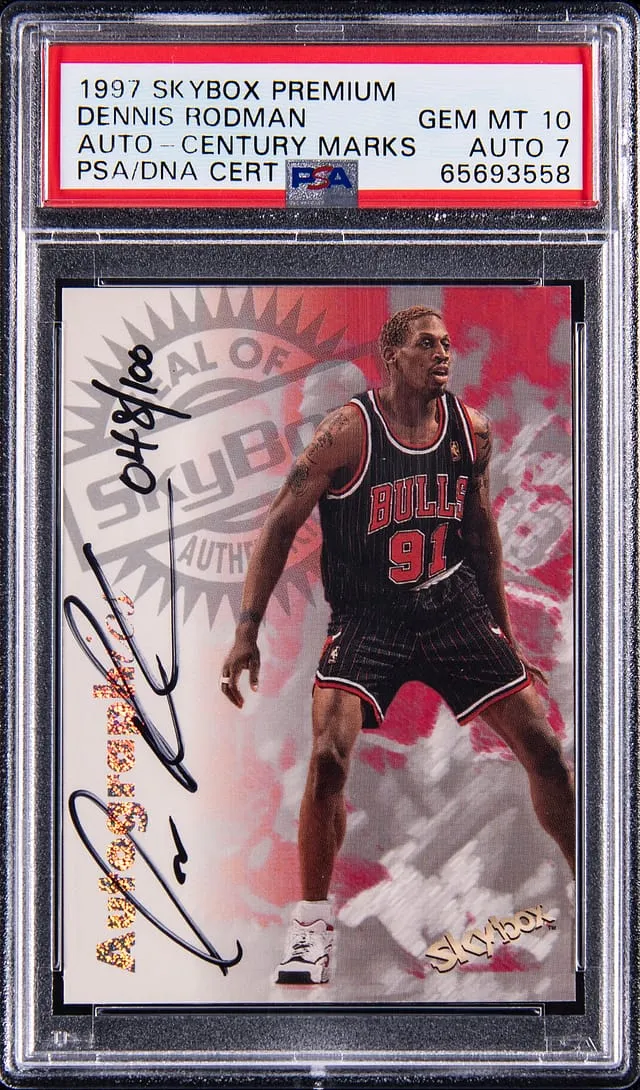
Goldin sold a PSA 10 1997-98 SkyBox Autographics Century Marks Dennis Rodman auto /100 for $18,300. Here’s what it means for 90s basketball collectors.
Sold Card
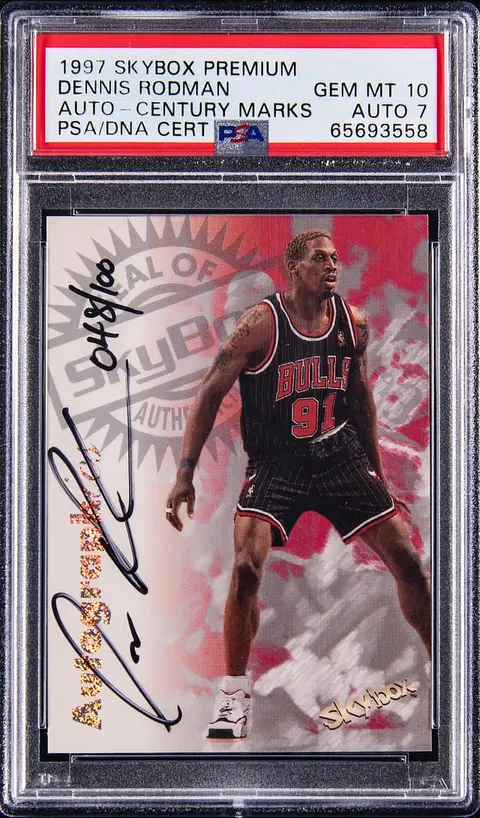
1997-98 SkyBox Premium Autographics Century Marks Dennis Rodman Signed Card (#048/100) - PSA GEM MT 10, PSA/DNA NM 7 - Pop 2
Sale Price
Platform
Goldin1997-98 SkyBox Premium Autographics Century Marks Dennis Rodman Signed Card (#048/100) – PSA GEM MT 10, PSA/DNA NM 7 – Pop 2
On March 15, 2026, Goldin sold a 1997-98 SkyBox Premium Autographics Century Marks Dennis Rodman signed card, serial numbered 048/100, for $18,300. The card received a PSA GEM MT 10 grade for the card itself and a PSA/DNA NM 7 grade for the autograph, with a population (or “pop”) of just 2 in this grade configuration.
For collectors who track 1990s basketball inserts and autos closely, this sale is a useful data point for understanding where high-end Dennis Rodman cards are settling in today’s market.
What exactly is this card?
Let’s break down the key identifiers:
- Player: Dennis Rodman
- Team era: Chicago Bulls (late-1990s championship run)
- Year: 1997-98
- Set: SkyBox Premium Autographics – Century Marks parallel
- Serial numbering: Hand-numbered 048/100
- Type: On-card autograph (Rodman signed directly on the card)
- Grading:
- Card: PSA GEM MT 10 (Gem Mint)
- Autograph: PSA/DNA NM 7
- Population: Pop 2 (only two copies in this exact PSA 10/auto-7 configuration in PSA’s population report as of the sale)
- Key issue or rookie?: Not a rookie card, but a premium 1990s on-card autograph from an important insert line.
The Autographics line is one of the foundational 1990s basketball autograph issues. The Century Marks versions are the tougher, serial-numbered parallel, limited to 100 copies. For many player collectors, a Century Marks auto is one of the top-tier 90s pieces they chase.
Why collectors care about 1997-98 Autographics Century Marks
To understand this sale, it helps to understand the context of the set itself.
Autographics as a 1990s cornerstone
SkyBox Autographics cards are often viewed as:
- Among the earliest widely recognized, pack-inserted, on-card autographs.
- A bridge between early-90s experimental autos and the modern autograph era.
- A consistent run across multiple years and products, which built collector familiarity.
Within that run, Century Marks stands out because it is serial-numbered to 100, a meaningful number in the 1990s when true limited print runs were still relatively new and not nearly as saturated as in the 2000s and 2010s.
For 90s-focused collectors, a Century Marks card is usually seen as:
- Short-printed and meaningfully scarce.
- A cleaner, more traditional on-card autograph design, without patches or multiple stickers.
- A snapshot of the late-90s insert era, where scarcity, design, and player selection all mattered.
Why Dennis Rodman specifically
Dennis Rodman occupies a unique lane in the hobby:
- Iconic role player: Not a traditional scorer, but arguably the defining defensive and rebounding specialist of the 1990s.
- Championship pedigree: Multiple NBA titles with the Pistons and Bulls.
- Cultural impact: A global figure beyond basketball—style, personality, media presence—creating broader appeal than many role players from the same era.
Because of this, his premium 1990s autograph and insert cards can attract interest not just from Bulls collectors, but also from:
- 90s nostalgia collectors.
- Fans who discovered Rodman through later media (e.g., documentaries, features on the Bulls’ dynasty years).
- Set builders focused on Autographics or 90s autos.
This specific card combines:
- A historically important 1990s autograph line.
- A low serial number (out of 100).
- A Gem Mint card grade.
That mix is what makes it a target for higher-end Rodman and 90s insert collectors.
Grading details: PSA GEM MT 10 and PSA/DNA NM 7
This copy carries a PSA GEM MT 10 grade for the card, which means PSA considers the card essentially Gem Mint: sharp corners, clean edges, excellent surface, and strong centering by their standards. For a 1990s, pack-issued, on-card autograph card, achieving a PSA 10 can be challenging because:
- Autographed cards often show handling or surface wear from signing and packing.
- The card stock and finish of 90s autos can be susceptible to chipping or minor defects.
The autograph is graded separately by PSA/DNA as NM 7, which typically means:
- The auto is clearly legible.
- There may be minor issues like slight streaking, fading, or uneven ink flow that keep it from higher auto grades (9 or 10).
While some buyers strongly prioritize a 9 or 10 autograph grade, others focus first on the card grade and the overall eye appeal. In this case, the combination of PSA 10 card and on-card signature still places it among the strongest examples of this issue available.
The pop 2 note indicates that PSA’s population report lists only two copies in this exact card-grade configuration (PSA 10) with this autograph grade at the time of sale. For scarcity-minded collectors, that population data is part of how they gauge relative rarity among graded examples.
Market context: how does $18,300 fit in?
The final price on Goldin was $18,300 on March 15, 2026.
When collectors talk about “comps,” they mean comparable recent sales of the same card or something very close (same set, parallel, player, and a similar grade). For a niche but important card like this, comps can be limited because:
- Only 100 copies were produced.
- Not many have surfaced in PSA 10.
- Some are locked away in long-term collections.
Recent public sales data for this exact configuration (PSA 10 card with PSA/DNA graded auto) is very thin. Instead, collectors generally look at:
- Lower-graded Century Marks Rodman cards.
- Non-Century Marks Rodman Autographics from similar years.
- Other high-end 1990s Rodman inserts and autos in top grades.
Across those categories, trends in 2024–2026 for 90s superstar and star-level inserts/autos have been:
- Selective strength: Iconic sets and truly scarce parallels have held up better than more common issues.
- Grade sensitivity: High grades (particularly true Gem-level cards like PSA 10) often show a sharper price gap over mid-grade examples than they did several years ago.
This Goldin result at $18,300 reinforces a few points:
- Premium for PSA 10: The card grade carries clear weight in the final price, especially within a limited run of 100.
- Century Marks has staying power: Even as the market has matured, short-printed 90s autos like this still command strong interest.
- Rodman’s lane is defined but real: He is not priced like the absolute top-tier headline names of the era, but his best cards sit comfortably in an established, collector-driven segment of the market.
Because confirmed public comps for the exact same PSA 10 Rodman Century Marks are limited, it’s more accurate to treat this sale as one of the key reference points rather than as an outlier in a long data series.
Scarcity and 1990s era context
The 1997-98 season sits in the heart of the Bulls’ second three-peat and the broader 1990s hobby boom. A few factors matter here:
- Print runs vs. today: Overall production of 1990s products was high in many sets, but genuinely low-numbered inserts and autos like this were still relatively rare compared to modern, parallel-heavy releases.
- Condition scarcity: Gem Mint copies of 90s insert and auto cards remain hard to find. Many were opened and handled casually years before grading became standard.
- Design and nostalgia: Collectors who grew up with these sets often prefer the more restrained 90s design language and on-card autos over modern multi-color patch cards.
The combination of:
- A run of just 100 copies,
- A PSA 10 card grade, and
- A historically important autograph line,
helps explain why this card draws strong interest and can sustain a five-figure price.
What this sale means for collectors
For hobbyists tracking 90s basketball and Dennis Rodman specifically, this Goldin sale offers several takeaways:
Top-tier 90s autos remain a focused, collector-driven segment. Even as broader market trends ebb and flow, well-known, well-documented autograph runs like Autographics continue to be reference points.
Population reports matter, but context is key. A pop 2 in PSA 10 is meaningful, especially given the total print run of 100. However, many ungraded or differently graded copies exist. Population data is best used to compare graded examples, not to estimate total surviving supply.
Card grade vs. autograph grade: Collectors and sellers should be aware that a strong card grade with a mid-level auto grade can still achieve a robust result if the card itself is rare and desirable. The importance of the autograph grade varies by buyer.
Rodman’s long-term appeal is tied to narrative as much as stats. His role in the Bulls dynasty and his overall cultural footprint help support demand for his best 1990s cards.
For newcomers and small sellers
If you’re newer to the hobby or returning after a long break, here are a few practical notes drawn from this sale:
- Know your set: Autographics and Century Marks carry more weight than many other 90s autographs because they sit at the intersection of low print run, on-card signatures, and historical importance.
- Check pop reports: PSA and other grading companies publish population reports that show how many copies of a card exist in each grade. This can help you understand grading scarcity, even though it doesn’t capture every raw (ungraded) card.
- Use comps carefully: When very few exact comps exist, it’s more accurate to look at a range of related sales (different grades, similar inserts, same player) rather than treating any one sale as a universal benchmark.
- Avoid assumptions about the future: A strong sale like this shows current demand, not a guarantee of what the card—or any card—will do later.
Summary
The 1997-98 SkyBox Premium Autographics Century Marks Dennis Rodman signed card (#048/100), graded PSA GEM MT 10 with a PSA/DNA NM 7 autograph and listed as pop 2, realized $18,300 at Goldin on March 15, 2026.
It stands out as:
- A premium, low-numbered 1990s on-card autograph from a landmark insert line.
- A high-grade example in a small graded population.
- A strong reference point for the upper end of the Dennis Rodman 90s autograph and insert market.
For collectors, it reinforces how targeted demand for key 90s inserts and autos continues to shape prices—especially when true scarcity and top grades come together.