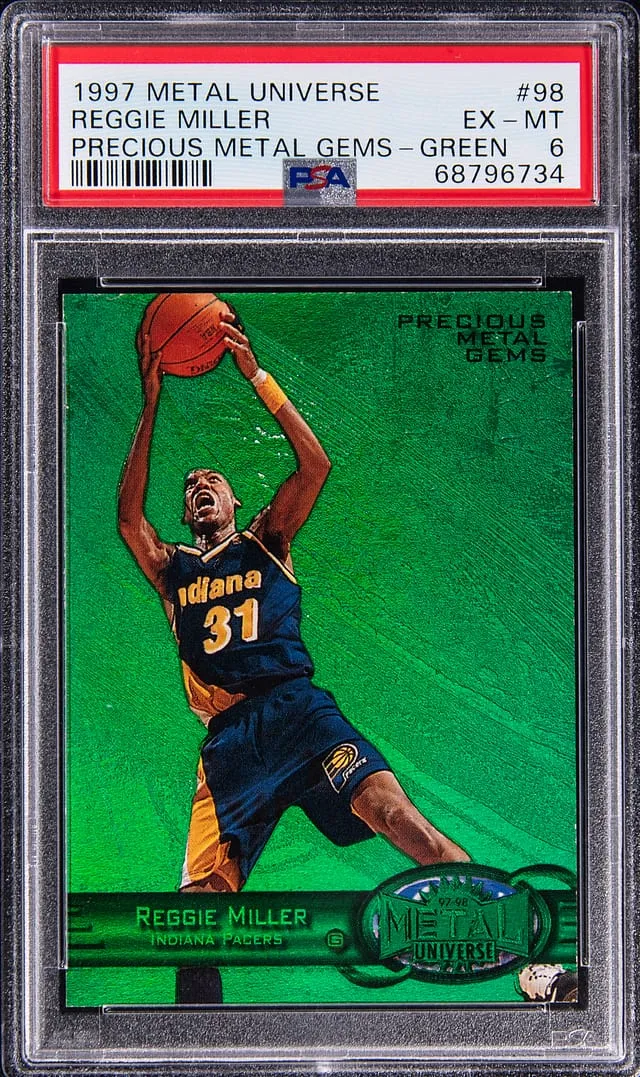
Reggie Miller 1997-98 PMG Green PSA 6 sells for $57K
Goldin sold a 1997-98 SkyBox Metal Universe PMG Green Reggie Miller PSA 6 for $57,340. See what this means for 90s inserts and PMG collectors.
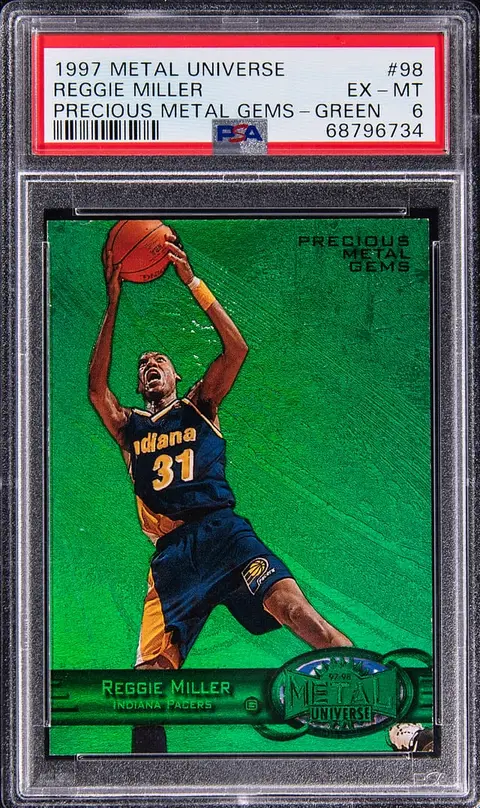
Sold Card
1997-98 SkyBox Metal Universe Precious Metal Gems (PMG) Green #98 Reggie Miller (#007/100) - PSA EX-MT 6
Sale Price
Platform
Goldin1997-98 SkyBox Metal Universe Precious Metal Gems (PMG) Green #98 Reggie Miller (#007/100) - PSA EX-MT 6 just changed hands at Goldin on March 8, 2026 for $57,340. For Reggie collectors and 90s insert fans, this is one of those sales that quietly helps re-draw the long-term map of the basketball PMG market.
In this post, we’ll break down what the card is, why it matters, and how this result fits into the wider Precious Metal Gems landscape.
The card at a glance
- Player: Reggie Miller, Indiana Pacers
- Year: 1997-98
- Set: SkyBox Metal Universe
- Insert / parallel: Precious Metal Gems Green
- Card number: #98
- Serial number: #007/100
- Print run structure: 100 total copies (1–10 Green, 11–100 Red)
- Grade: PSA EX-MT 6 (PSA)
- Type: Premium 90s insert / key parallel, not a rookie card
This is Reggie’s second-year Metal Universe PMG (his rookie is 1987-88 Fleer). The 1997-98 PMG run is famous for its two-tier structure: the first 10 copies of each card are Green, and the remaining 90 are Red. That makes every Green a true out-of-10, even though the card is serial-numbered to 100.
The copy Goldin just sold is serial #007/100, falling within the Green run. With only ten Reggie Greens existing on paper and some likely gone or damaged, any example that surfaces in a PSA holder—especially from a major auction house—is notable.
Why 1997-98 PMG Green cards matter
For newer collectors, it helps to understand why PMGs are treated differently than most 90s inserts.
A short PMG overview
- Era: 1997-98 is squarely in the late-90s “inserts and parallels” boom, not the overproduced late-80s/early-90s junk wax era.
- Design: Foil-heavy with bold color overlays and a futuristic Metal Universe background. Great-looking in hand, but fragile.
- Condition sensitivity: Edges and surfaces chip and scratch easily. High grades are genuinely hard to find.
- Print run: For most players, PMG Green is /10 and PMG Red is /90. That structure is part of what built the mystique.
Because of the combination of low print runs, tough condition, and distinctive design, PMGs have become one of the core brands of 90s basketball collecting—often mentioned alongside credentials, credentials future, and essential credentials.
Why Reggie Miller specifically
Reggie Miller doesn’t get the same universal hobby love as Jordan or Kobe, but he checks several important boxes:
- Hall of Famer and franchise icon for the Indiana Pacers
- Central figure of 90s NBA storylines (Knicks rivalries, clutch shooting, the 8 points in 9 seconds game)
- One of the defining 3-point shooters before the modern pace-and-space era
For player collectors who chase “top-tier” cards of their favorite star, a PMG Green is usually at or near the top of the list. It’s effectively a grail parallel—the kind of card a serious Reggie collector might chase once in a lifetime.
Grading and scarcity: PSA EX-MT 6
PSA’s EX-MT 6 grade generally indicates:
- Noticeable edge or corner wear
- Some surface issues, often visible without magnification
- Still presentable, but clearly not near-mint
For most modern cards, a 6 would be a big negative. For 1997-98 PMG Greens, the conversation is a bit different:
- Many surviving copies are raw or heavily worn.
- The cardstock and full-foil design make chipping almost unavoidable.
- Collectors often prioritize survival and eye appeal over the number on the label.
Population reports (“pop reports”)—the census counts that grading companies release—tend to show very low numbers for 1997-98 PMG Greens of almost every player. Even without specific pop data for this Reggie Miller, the combination of:
- Only 10 possible copies
- 1990s foil condition issues
- Fragmented grading across PSA, BGS, and SGC
…means that any slabbed example entering the market is a relatively rare event.
Price context: where does $57,340 sit?
The Goldin sale closed at $57,340. To understand that number, it helps to look at three layers of context:
- Other Reggie Miller PMGs and key 90s parallels
- PMG Green prices for similar-tier Hall of Famers
- The broader 1997-98 PMG Green market
1. Reggie Miller specific context
Recent public sales data for this exact card—1997-98 PMG Green Reggie Miller in PSA 6—is extremely thin. With only ten copies in total and a mix of grades, these don’t change hands often. Most prior activity has involved:
- Raw or ungraded copies
- Other grades (PSA/BGS 5s and 7s, occasional crossovers)
- PMG Reds /90 at significantly lower prices
Over the past few years, Reggie PMG Reds from 1997-98 have tended to sell in the low-to-mid four-figure range depending on grade and eye appeal. Greens, when they appear, sit in a completely different tier.
The $57,340 result therefore reflects the premium that:
- PMG Green commands over PMG Red
- True scarcity (/10) carries for a Hall of Fame-level player
2. Comparing to other non-superstar Greens
While detailed, card-by-card PMG Green data can be spotty, the pattern for non-Jordan, non-Kobe, non-LeBron Greens over the last few years has been relatively consistent:
- Second-tier Hall of Famers (Ray Allen, Iverson, etc.) can land from mid-five figures up, depending on grade and timing.
- Third-tier stars and cult favorites can range from high four figures to mid-five figures.
Reggie’s standing in hobby perception sits somewhere between “team icon” and “second-tier Hall of Famer.” In that context, a mid–five-figure sale for his PMG Green aligns with how the hobby has been valuing similar-level players.
3. Within the 1997-98 PMG Green ecosystem
For context, 1997-98 PMG Green cards of hobby icons like Michael Jordan and Kobe Bryant have posted:
- Six-figure and, in some cases, higher landmark results
- Highly publicized record sales that helped define the 90s insert boom
By comparison, $57,340 for Reggie sits well below those superstar peaks but meaningfully above:
- Common players
- Many modern /10 parallels from newer sets
In short, this sale looks strong but not outlandish for a Hall of Fame guard’s PMG Green in mid-grade. It reinforces the idea that true 90s scarcity maintains a premium even outside the very top tier of hobby names.
Why this particular sale matters
Several factors make this Goldin result worth bookmarking for collectors and small sellers:
Scarcity meets a global audience
When a low-population card runs through a major auction house like Goldin, it often becomes a reference point for future negotiations. Collectors will point to this price when discussing private deals.Evidence of depth beyond the top three names
A healthy vintage or 90s insert market needs more than just Jordan, Kobe, and LeBron carrying the load. Strong results for names like Reggie Miller suggest there is depth in demand for the era’s second-tier stars.Mid-grade PMGs holding their place
High grades understandably grab headlines, but this sale supports the idea that collectors are still willing to pay for true scarcity and brand strength, even when the grade is a 6 instead of an 8 or 9.Useful comp for future Reggie PMGs
“Comps” are comparable sales that collectors use as a starting point to estimate value. For a card as thinly traded as a Reggie PMG Green, this $57,340 figure becomes a key benchmark for:- Other grades of the same card
- PMG Reds
- Other high-end Reggie inserts from the late 90s
Takeaways for different types of collectors
For Reggie Miller player collectors
- This confirms that your top 90s inserts—especially true low-serial parallels—have a serious collector base.
- If you own a PMG Red or other Reggie grails, this sale strengthens the data behind premium pricing.
For 90s insert and PMG collectors
- The sale reinforces that PMG Green still occupies a unique lane. Modern serial-numbered cards may be cleaner and higher grade, but the market continues to treat 1997-98 PMGs as historically significant.
- Mid-grade examples remain viable targets if you prioritize owning a copy over chasing the highest possible grade.
For small sellers and part-time dealers
- If you’re sitting on 90s inserts or parallels of Hall of Fame-level players, this is a reminder to check modern comps and not assume 2010s pricing still applies.
- Even if you don’t have a PMG Green, this type of sale can lift related cards—PMG Reds, other Metal Universe inserts, and comparable-era parallels.
Final thoughts
The 1997-98 SkyBox Metal Universe Precious Metal Gems (PMG) Green #98 Reggie Miller (#007/100) - PSA EX-MT 6 selling for $57,340 at Goldin on March 8, 2026 (UTC) is not just a headline number. It’s another data point in the slow, long-term story of how the hobby values:
- True 1990s scarcity
- Iconic insert brands
- Hall of Fame players just outside the absolute top hobby tier
For Reggie collectors, this is one of the key public benchmarks for his highest-end 90s parallel. For the broader market, it’s a quiet confirmation that demand for cornerstone 1990s inserts remains deep, even in mid-grade and even for players who lived in Michael Jordan’s shadow.
As always, treat this as price context, not a prediction. Markets evolve, players move in and out of hobby focus, and individual card eye appeal can swing results. But if you care about the 90s insert era, this Goldin sale is worth remembering—and worth adding to your personal PMG Green price log.