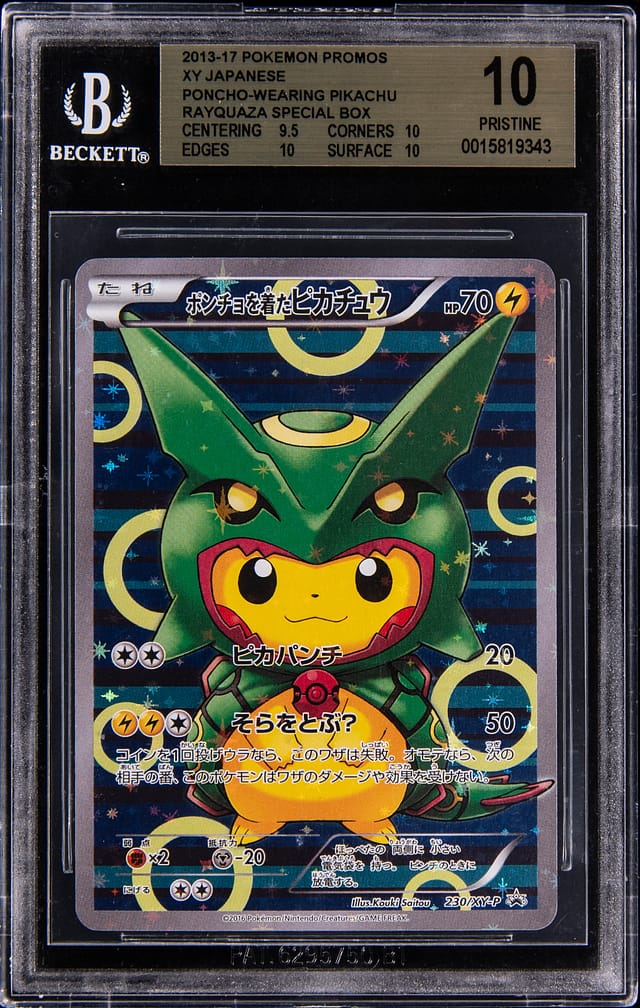
Rayquaza Poncho Pikachu BGS 10 sells for $14,104
Goldin sold a BGS Pristine 10 Rayquaza Poncho-Wearing Pikachu promo for $14,104. Here’s what it means for Pokémon collectors and the market.
Sold Card
2013-17 Pokemon Japanese XY Promo Rayquaza Poncho-Wearing Pikachu Box #230 Poncho-Wearing Pikachu - BGS PRISTINE 10
Sale Price
Platform
GoldinA Poncho, a Pikachu, and a Pristine 10: Breaking Down the Rayquaza Poncho-Wearing Pikachu Sale
On February 23, 2026, Goldin closed a notable Pokémon sale: a 2013–17 Pokémon Japanese XY Promo Rayquaza Poncho-Wearing Pikachu Box #230 Poncho-Wearing Pikachu, graded BGS PRISTINE 10, sold for $14,104.
For a character-based promo in the modern/ultra‑modern era, that’s a meaningful number. Let’s unpack what this card is, why collectors care, and how this price fits into the broader market.
Card at a glance
- Character: Pikachu (wearing a Rayquaza poncho)
- Year / Era: 2013–2017 Pokémon XY era (modern / early ultra‑modern)
- Region / Language: Japanese
- Set / Release: XY Promo – Rayquaza Poncho-Wearing Pikachu Box
- Card number: #230 (Japanese XY-P promo numbering)
- Type: Premium Japanese promo, character costume card (not a rookie, but a key character promo)
- Grade: Beckett Grading Services (BGS PRISTINE 10)
- Pristine 10 is BGS’s second-highest label, just under Black Label
- Attributes: Non-serial numbered; prized for artwork, theme, and condition rarity
This card sits in the popular “Poncho-Wearing Pikachu” line of Japanese promos. These cards feature Pikachu in costumes themed after other Pokémon—here, Rayquaza—often released in limited, box-style products.
Why this card matters to collectors
Even among Pikachu cards, poncho promos have become a sub-collection of their own. Key reasons:
Character stacking: Pikachu + Rayquaza
Pikachu is the face of the Pokémon brand. Rayquaza is one of the most popular legendary Pokémon. Combining both on a single card, in a whimsical costume design, hits multiple collector bases at once.Japanese promo culture
Japanese promos, especially box or campaign exclusives, often have smaller print runs than main set cards and can be harder to find in clean, gradable condition years later. That relative scarcity, paired with distinct artwork, drives long-term demand.Condition rarity: BGS PRISTINE 10
“Pop report” is hobby shorthand for population report: how many copies of a card have earned a specific grade with a grading company. For poncho Pikachu promos, the total graded population has grown, but top-end grades remain thin. BGS Pristine 10 is significantly harder to achieve than a PSA 10.While exact, up-to-the-day population data can move as new submissions are graded, this card is generally understood to have:
- A modest total graded population, and
- A very small number of copies in BGS Pristine 10 (with BGS Black Labels even rarer).
That condition scarcity is a major driver behind this sale price.
Iconic sub-set within the XY era
The XY era (2013–2017) sits in a sweet spot: modern enough that collectors remember the releases, but far enough in the rearview that sealed boxes are not readily available at retail and high-grade promos are meaningfully harder to source.
Market context and recent sales
When collectors talk about “comps” (comparable sales), they’re usually referring to recent public auction or marketplace results for the same card in the same or similar grade.
For the Rayquaza Poncho-Wearing Pikachu #230, public data for this exact BGS Pristine 10 grade is thin—this grade level does not trade frequently. However, we can get context by looking at:
- Historical sales of this card in PSA 10 and BGS 9.5
- Sales of closely related poncho Pikachu promos
- The broader pattern of price separation between gem mint and pristine/black label grades
PSA 10 / BGS 9.5 context
Recent years have seen:
- PSA 10 copies of Rayquaza Poncho-Wearing Pikachu #230 trading in the low-to-mid four-figure range, depending on auction house, timing, and condition details within the grade (strong vs. weak 10s, centering, etc.).
- BGS 9.5 copies typically slotting below that PSA 10 level or roughly in line, depending on subgrades and eye appeal.
Compared to that tier, a $14,104 result for a BGS Pristine 10 reflects a substantial premium for condition rarity.
How strong is $14,104?
Relative to:
- Modern promo cards in PSA 10
- Other poncho Pikachu cards in equivalent or slightly lower grades
- And character promos from similar XY-era releases
…this realized price sits on the high end of the observed range, which is consistent with the scarcity of BGS Pristine 10 examples.
While we don’t have a long history of public BGS Pristine 10 comps for this exact card, the sale fits the broader pattern where:
- PSA 10 defines the main market band, and
- BGS Pristine 10 and Black Label results form a thinner, higher-priced layer of condition-sensitive demand.
Put simply: this price is strong but not out of line for a scarce top-pop Pokémon promo that checks both character and aesthetics boxes.
What might be driving demand now?
A few wider hobby dynamics help explain interest in this kind of card:
Shift toward character collecting
Many collectors are organizing their collections around favorite Pokémon rather than specific sets. Pikachu and Rayquaza are both top-tier characters, so cross-appeal matters.Growing respect for Japanese promos
As more collectors learn the stories behind Japanese-exclusive and box/campaign promos, cards like the poncho Pikachu line have moved from niche interest to widely recognized targets.Condition-focused collecting
A subset of collectors is increasingly focused on the absolute highest grades—PSA 10, BGS 10, BGS Black Label, and occasionally CGC Perfect. For them, population scarcity at the top matters more than the raw print run of the card itself.Maturing XY-era nostalgia
XY isn’t vintage, but it has shifted into a “nostalgia zone” for people who were younger during 2013–2017. As these collectors gain purchasing power, demand for XY-era grails and promos continues to solidify.
What this sale means for collectors and small sellers
From a collector-to-collector perspective, here’s how to think about a result like this.
For collectors
Signal, not a guarantee
One strong auction in BGS Pristine 10 doesn’t automatically re-price every other copy of the card. It does, however, signal that high-end buyers are comfortable paying a strong premium where condition rarity and character appeal intersect.PSA 10 and BGS 9.5 remain the reference points
If you’re trying to understand where your copy might sit, PSA 10 and BGS 9.5 comps are usually the most liquid and visible reference band. A pristine result like this is more of a specialty market.Eye appeal still matters inside the grade
Even at BGS 10, centering and subgrades influence how collectors perceive a card. Two Pristine 10s with different subgrades or visual appeal can sell for different prices.
For small sellers
High grades justify the effort
This sale underlines why condition screening and careful grading submissions matter, especially with Japanese promos that often come well-centered but can have subtle edge or surface issues.Don’t over-extend from a single comp
When pricing raw or lower-grade copies, anchor your expectations to repeatable PSA 9/10 and BGS 9.5 sales, not a one-off pristine result.Present the story clearly
When listing a poncho Pikachu card, especially Rayquaza, it helps to:- Name the promo box or release
- Note that it’s a Japanese promo
- Emphasize condition (with clear photos)
- Reference publicly verifiable auction results where appropriate
Final thoughts
The February 23, 2026 Goldin sale of the 2013–17 Pokémon Japanese XY Promo Rayquaza Poncho-Wearing Pikachu #230 in BGS PRISTINE 10 for $14,104 highlights how character-driven Japanese promos have matured into a core part of the Pokémon market.
For many collectors, the card is appealing not because it’s the rarest item in the XY era, but because it blends:
- A beloved character (Pikachu),
- A fan-favorite legendary (Rayquaza),
- Distinctive, memorable artwork, and
- True condition scarcity at the very top of the grading scale.
As always, individual sales are data points, not destiny. But for anyone who has been quietly building a poncho Pikachu or Japanese promo collection, this sale is a useful reference for how the hobby currently values peak-condition examples of one of the line’s most recognizable cards.