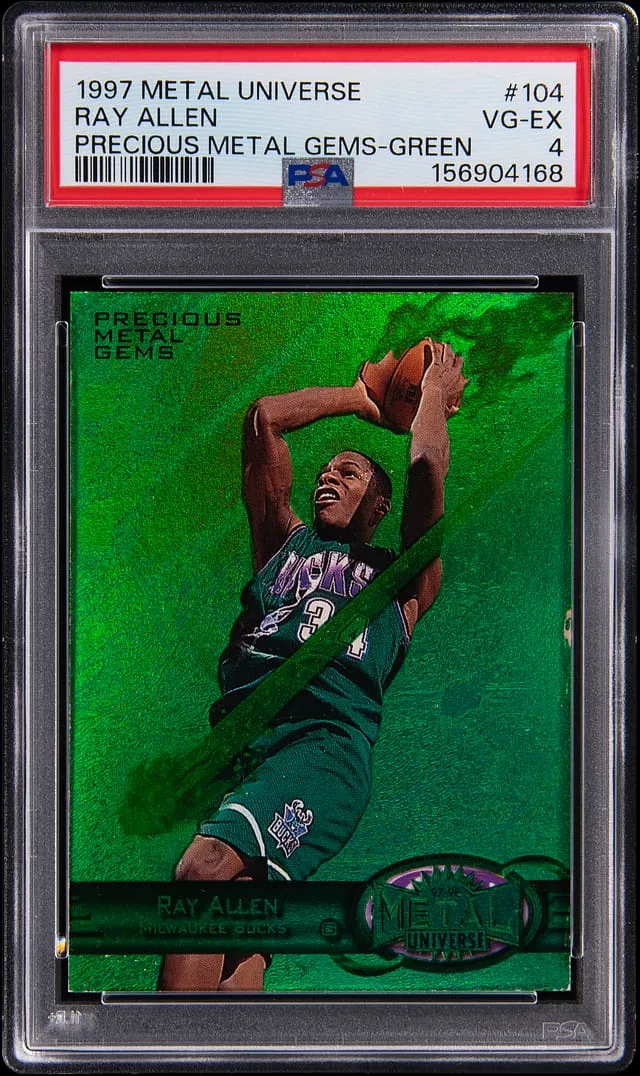
Ray Allen 1997-98 PMG Green PSA 4 Sells for $79K
A PSA 4 Ray Allen 1997-98 Metal Universe PMG Green #104 sold for $79,363 at Goldin. See why this rare 90s parallel still drives strong prices.
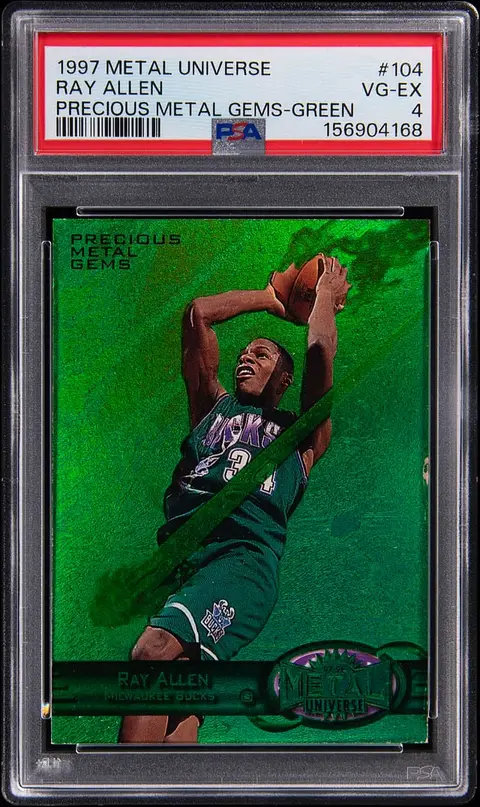
Sold Card
1997-98 SkyBox Metal Universe Precious Metal Gems (PMG) Green #104 Ray Allen (#007/100) - PSA VG-EX 4
Sale Price
Platform
Goldin1997-98 SkyBox Metal Universe Precious Metal Gems (PMG) Green #104 Ray Allen (#007/100) - PSA VG-EX 4 Sold for $79,363 at Goldin on May 10, 2026
The 1997-98 SkyBox Metal Universe Precious Metal Gems Green Ray Allen is one of those cards that quietly sits at the intersection of 90s nostalgia, true rarity, and modern hobby respect. A copy numbered 007/100, graded PSA VG-EX 4, just sold at Goldin on May 10, 2026 for $79,363.
For a mid-grade copy of a non-rookie Hall of Famer, that number can feel surprising at first glance. Let’s unpack why it makes sense to a lot of serious collectors.
The card: a quick rundown
- Player: Ray Allen (Milwaukee Bucks)
- Year: 1997-98
- Set: SkyBox Metal Universe
- Parallel: Precious Metal Gems (PMG) Green
- Card number: #104
- Serial numbering: 007/100
- Grading company: PSA (Professional Sports Authenticator)
- Grade: VG-EX 4 (Very Good–Excellent)
- Rookie card? No – Ray Allen’s key rookies are from 1996-97, but this is still a central 1990s card for him.
1997-98 Metal Universe PMGs are widely viewed as one of the foundational 90s “grail” parallels in basketball. While this card is not his rookie, many collectors consider it a centerpiece for any serious Ray Allen or 90s PMG collection.
Why PMG Green matters
In the 1997-98 Metal Universe run, Precious Metal Gems Green cards are extremely limited and notoriously condition-sensitive:
- Print run structure: 100 total copies were made per player.
- The hobby-standard understanding is that 10 of those 100 are Green and the other 90 are Red.
- Foil and chipping: Full-foil surfaces, colored edges, and era-typical handling mean high grades are rare. Even pack-fresh copies often had edge chipping right away.
So when you see a PMG Green at a PSA 4, that doesn’t read like a “weak copy” to seasoned collectors. Instead, it usually reads as: “It survived the late 90s, and it’s real.”
Market context: how does $79,363 fit in?
When collectors talk about “comps” (short for comparables), they mean recent sales of the same card or similar versions. For a card as thinly traded as a Ray Allen PMG Green, there are only a few meaningful data points to work with, and they’re often spread across different grades and auction houses.
Based on publicly tracked auction results and marketplace archives up to this point, some broad patterns emerge:
- PMG Green vs PMG Red:
- Greens (out of 10) typically sit well above Reds (out of 90) for the same player.
- In many players’ markets, Green can be several multiples of equivalent-grade Red.
- Hall of Fame, but not a top-tier hobby name:
- Ray Allen is a Hall of Famer, two-time NBA champion, and all-time elite shooter.
- He doesn’t command the same global pricing tier as Michael Jordan, Kobe Bryant, or LeBron James, but within the 90s Hall of Fame shooting guard lane, his premiums are strong.
- Grade vs. price behavior:
- For ultra-rare 90s inserts and parallels like PMGs, authenticity and survival often matter more than numerical grade.
- It’s common to see mid-grade PMGs (PSA 3–5) realize prices that are closer to higher grades than you’d expect if you’re used to modern chromium cards.
Within that context, a sale at $79,363 for a PSA 4 Ray Allen PMG Green is:
- Solidly in “serious grail” territory for a non-Jordan, non-Kobe 90s PMG.
- In line with the broader trend of strong pricing for Green copies across different players, even when the slab says 3, 4, or 5.
Because these surface so infrequently, there’s no dense grid of recent sales to map out exact “fair value.” Instead, each auction becomes a fresh reference point and can reset expectations for the next one.
Serial number 007/100 – does it matter?
This copy is serial numbered 007/100. While there isn’t a direct Ray Allen connection to the number 7 in the way that 34 might be more associated with him, low numbers and visually memorable serials do attract extra attention from some collectors.
In particular:
- Two- or three-digit palindromes, repeating numbers, jersey numbers, and iconic pop-culture numbers like “007” can all add a small, subjective premium.
- That premium isn’t as quantifiable as grade or scarcity, but it can show up in strong bidding when multiple collectors want the same copy.
It’s better to think of this as a story and desirability enhancer rather than a firm pricing rule.
Condition, grading, and why a 4 still works
PSA’s VG-EX 4 grade generally implies:
- Noticeable edge and corner wear
- Surface flaws or light creasing that keep it clearly out of EX-MT territory
On modern chromium cards, a 4 would be a major red flag. On a 1997-98 PMG Green, it’s much more normal, and in many collectors’ eyes, acceptable or even expected for a card that:
- Has a fragile foil construction
- Survived years before grading was common for this kind of insert
- Comes from a time when kids still actually played with and traded cards
The PSA label functions less as a chase for a 9 or 10 here and more as:
- Authentication: confirming the card is genuine, not a reprint or counterfeit.
- Baseline condition description: enough to compare roughly against other copies.
For ultra-rare 90s inserts and parallels, many collectors prioritize “owning a real one” over chasing the last possible grade bump.
Why collectors care about this specific Ray Allen
Ray Allen checks several meaningful boxes for PMG and 90s-focused collectors:
- Hall of Fame shooting legend who helped define perimeter play in the pre-Steph era.
- Key figure in NBA history with:
- Two championships (Boston 2008, Miami 2013)
- One of the most iconic Finals shots ever in Game 6 of the 2013 Finals.
- Part of the 90s insert and parallel boom that today’s hobby still celebrates.
The 1997-98 PMG Green taps directly into that era. It carries:
- The Metal Universe aesthetic – busy backgrounds, metallic finish, and an unmistakable 90s look.
- The mythology around early PMGs, where the crossover between sports cards, design, and art collecting really began to take shape.
For Ray Allen-specific player collectors, this card often ranks near the top of the ladder, sometimes only behind core rookie parallels or autographs depending on personal preference.
Era context: 1990s inserts vs. modern parallels
This card comes from what many consider the golden age of basketball inserts:
- Production runs were far lower than modern flagship and rainbow-parallel products.
- Many cards were not sleeved, top-loaded, or graded on release — especially non-rookie stars.
- The PMG brand has since become shorthand for “true 90s rarity”, especially when talking about high-end Hall of Fame players.
Compared to modern releases with dozens of parallels and high overall print volumes, a 1997-98 PMG Green feels fundamentally different:
- Rarity is built in at the print level, not created through a long checklist of colors.
- Surviving population is low, especially in higher grades.
For newcomers who are used to modern Prizm, Select, or Optic: think of PMG Green as an early, much more limited forebear of today’s colored parallels — only with far fewer copies in existence and a deeper hobby backstory.
Recent hobby and player sentiment
Ray Allen’s career is long since complete, and he’s already in the Hall of Fame. There isn’t the same speculative energy around his name that you’d see with an active star.
Instead, interest around a card like this typically comes from:
- Long-term respect for Ray Allen’s place in NBA history.
- Ongoing demand for 90s grail cards as more collectors return to the hobby.
- A slow, steady reevaluation of just how scarce these PMGs really are in the wild.
Because of that, pricing tends to reflect collector demand and rarity more than short-term buzz.
What this sale tells us
This $79,363 result at Goldin on May 10, 2026 suggests a few things about where the market sits for 90s PMG Greens and Ray Allen in particular:
- Green is still king for 90s parallels. Even for a non-rookie Hall of Famer, a mid-grade Green can command a deep five-figure result.
- Grade is secondary to survival. A PSA 4 still carries significant weight because of the card’s inherent scarcity and condition challenges.
- Thin supply shapes pricing. When only a handful of copies trade publicly over several years, each sale can become the new reference point for future buyers and sellers.
As always, this doesn’t guarantee where the next one will land. It simply gives the hobby another real, documented data point for one of Ray Allen’s most coveted 90s cards.
Takeaways for collectors and small sellers
If you’re new to PMGs or 90s inserts and watching this sale from the sidelines, a few practical notes:
- Use sales like this as context, not a roadmap. One auction is a signal, not a full pricing model.
- Focus on understanding the set. Knowing the difference between 1990s PMGs and modern parallels helps you evaluate whether a price is driven by scarcity, hype, or both.
- Condition expectations should match the era. A PSA 4 PMG Green is nothing like a PSA 4 modern chrome rookie.
For small sellers and returning collectors:
- If you uncover 1990s Metal Universe, PMGs, or other numbered inserts, consider grading key cards primarily for authentication and preservation, not just chasing high numbers.
- When researching value, look across multiple auction houses and marketplaces and pay attention to:
- Grade
- Serial number
- Player tier (superstar vs Hall of Very Good vs role player)
This Ray Allen PMG Green sale at Goldin is another reminder that the 90s are still central to the modern basketball card conversation — especially when it comes to true low-serial, historically important parallels like Precious Metal Gems.
figoca will continue tracking these high-impact 90s sales so collectors can see where the market is actually moving, one auction at a time.