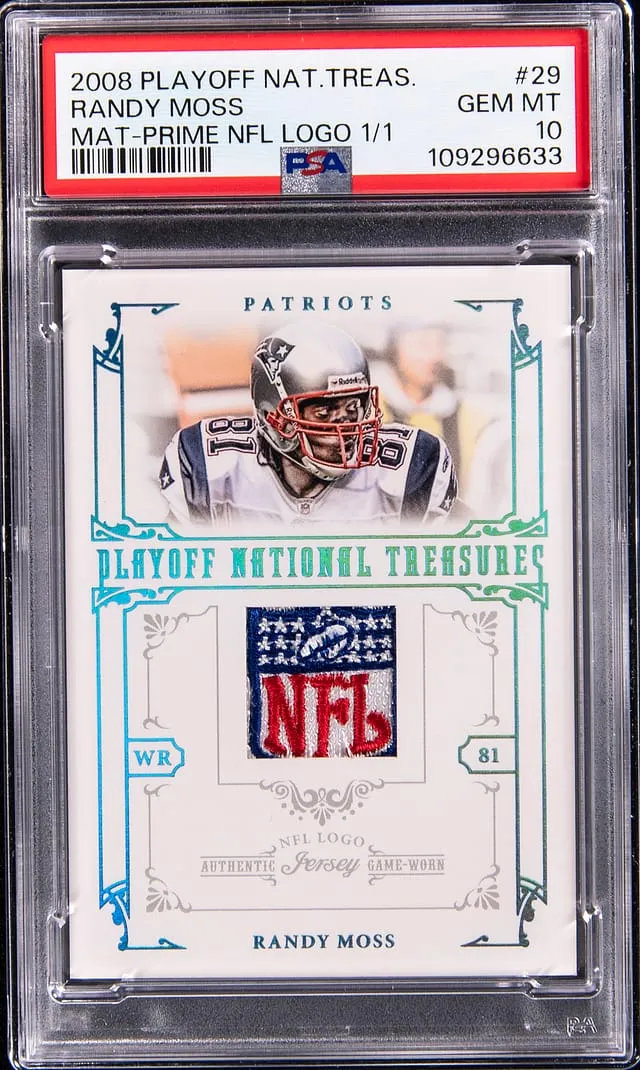
Randy Moss 2008 NT NFL Shield 1/1 PSA 10 Sells for $12K
Goldin sells a 2008 National Treasures Randy Moss NFL Shield 1/1 PSA 10 for $12,505. We break down why this high-end patch matters to collectors.
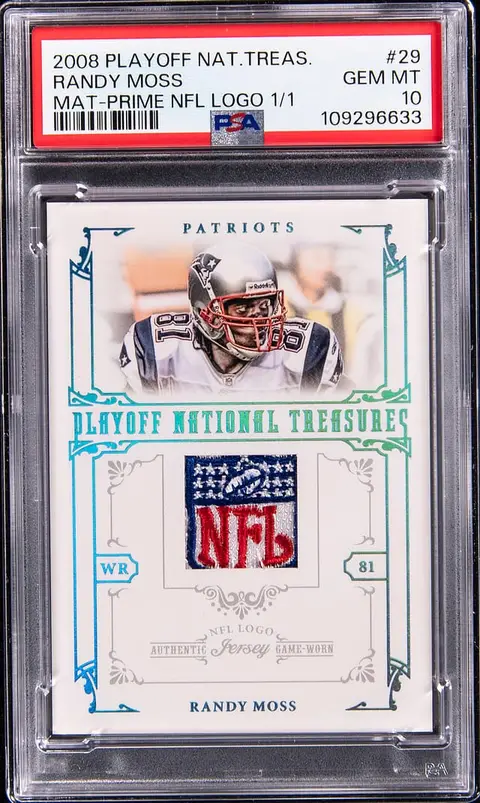
Sold Card
2008 Playoff National Treasures Materials Prime NFL Logo #29 Randy Moss NFL Shield Patch Card (#1/1) - PSA GEM MT 10
Sale Price
Platform
GoldinA one-of-one Randy Moss shield patch just crossed the auction block, and it offers a useful snapshot of where high-end 2000s football cards sit today.
On May 10, 2026, Goldin sold a 2008 Playoff National Treasures Materials Prime NFL Logo #29 Randy Moss NFL Shield Patch Card (#1/1), graded PSA GEM MT 10, for $12,505.
In this post, we’ll walk through what this card is, why collectors care, and how this price fits into the broader market for Moss and mid‑2000s National Treasures.
The card at a glance
Card details
- Player: Randy Moss
- Team: New England Patriots
- Year: 2008
- Set: Playoff National Treasures
- Insert/Subset: Materials Prime – NFL Logo
- Card number: #29
- Serial numbering: 1/1 (one of one)
- Key features: Oversized NFL Shield patch, game-used patch theme, premium thick-stock card
- Rookie card?: No – Moss’s rookies are from 1998 products
- Era: Modern (post‑2000)
Grading details
- Grading company: PSA (Professional Sports Authenticator)
- Grade: GEM MT 10
- Population context: For true 1/1 cards, “pop report” (the grading company’s census of how many copies exist in each grade) is less about total copies and more about how rare a perfect 10 is on a thick, patch-based card. National Treasures shield cards are notoriously tough in high grade because of chipping and edges.
Put simply: this is the only copy of this specific Moss NFL Shield, and it has received the top grade from a major grading company.
Why the 2008 National Treasures Moss shield matters
A key window in Moss’s career
2008 falls in the late‑prime phase of Randy Moss’s career, following his record‑setting 2007 season with Tom Brady and the Patriots. While it’s not a rookie card, high‑end patches from this period highlight Moss at the height of his dominance on a major contender.
Collectors often divide Moss cards into a few main buckets:
- 1998 rookies and parallels – the core rookie card chase.
- Early‑2000s game-used and autographs – establishing his hobby presence.
- Patriots era, especially 2007–2009 – premium patches, logos, and autos capturing his all-time great seasons.
This shield lands squarely in that last bucket, combining an instantly recognizable NFL logo patch with one of the hobby’s flagship high-end brands.
Why National Treasures matters
Playoff National Treasures (eventually just called Panini National Treasures) is widely treated as a premier “ultra‑premium” football product. For many collectors, it’s one of the core brands for:
- True rookie patch autographs (RPAs)
- Low‑serial parallels
- Game-used logo and shield cards
A few reasons National Treasures matters in the hobby:
- Brand history: National Treasures helped define the modern high‑end, thick‑stock, multi‑color patch aesthetic.
- Checklists: Star veterans like Moss share space with key rookies, making the product relevant to multiple collecting lanes.
- Design: NFL shield patches and team logo patches from NT are viewed as centerpiece cards, often becoming a collector’s “main display” item.
Within that context, a game-used NFL Shield 1/1 of a first-ballot Hall of Famer is one of the more desirable non‑rookie cards you can find for that player.
Market context: how $12,505 fits in
The Goldin sale closed at $12,505. To understand that number, it helps to look at a few reference points, even if exact one-to-one comparisons are limited:
1. Exact card comps
Because this is a 1/1, there are no truly identical copies to compare. When looking across public auction archives and major marketplaces, it’s common to find:
- Other Moss NFL shield or logo patch cards from different years and sets, usually also 1/1 or very low‑serial.
- Non‑shield Moss patches (multi‑color game-used pieces) that bring in noticeably less, reflecting the hobby premium on shield patches.
Recent public sales of this exact 2008 National Treasures Moss NFL Logo 1/1 in PSA 10 are limited or absent, which is normal for a one-of-one. Instead, price context has to be built from parallel categories below.
2. Comparable Moss high-end patches
Looking across high‑end Moss sales over the last few years, a general pattern emerges:
- Rookie‑year (1998) Moss cards – especially key parallels and rare inserts in strong grades – can reach into the mid‑four-figure and sometimes higher range, depending on scarcity and brand.
- Premium non‑rookie Moss shields and logo patches – especially from strong brands like National Treasures and Exquisite – can land in roughly the same tier or higher than many of his rookies, particularly when they feature on-card autographs or iconic patches.
In that landscape, $12,505 positions this Moss as a serious center‑piece card, in line with other high‑end non‑rookie shields of Hall of Famers, though exact numbers vary by player, brand, and whether the card is autographed.
3. Grading premium
For thick, patch-based cards, PSA GEM MT 10 is not common. Even without a full population breakdown, hobby behavior suggests:
- Raw (ungraded) or lower‑grade shield cards often sell at a discount to high‑grade examples, especially when centering and edges show visible wear.
- A PSA 10 on a one-of-one tends to serve more as a confidence signal than a direct price anchor, since there’s no competing copy in another grade. It can still add a premium by reducing condition uncertainty.
In practical terms, this $12,505 result reflects the intersection of:
- Player quality (Randy Moss as a top‑tier all‑time receiver)
- Brand strength (National Treasures)
- Patch type (NFL Shield)
- Absolute rarity (1/1)
- Condition reassurance (PSA 10)
Rather than being an outlier or a bargain, the sale fits reasonably into what collectors have been willing to pay for similar ultra‑premium Moss pieces and other Hall of Fame receivers.
Why collectors care about this specific card
Not a rookie, but a “grail-level” non‑rookie
For many player collectors, the hierarchy looks something like this:
- Key rookie cards and rookie patch autos (RPAs)
- True 1/1s with premium patches (like shields or team logos)
- Low‑serial autographs, multi‑patches, and important inserts
This card clearly falls into category 2. It’s not competing with Moss’s rookies; instead, it’s competing with his other best possible single cards, especially those featuring Patriots patches and iconic logos.
NFL Shield appeal
The NFL Shield patch carries specific weight:
- It’s a central emblem of the league, recognized even by casual fans.
- Shields usually come from the neckline or collar, meaning the patch comes from a small, specific area of a game-used or event‑worn jersey.
- Many shield cards are 1/1 by design, which gives them a built‑in grail status.
For a player like Moss, whose career includes record-breaking seasons and a memorable Patriots run, owning the NFL Shield patch in a premier brand feels like owning a visual “summary” of his status in the league.
The 2000s high-end era
2008 sits in what many collectors now see as the formative era of ultra‑premium football cards:
- Products like Exquisite Collection and National Treasures were refining the template for what high-end football looked like.
- Print runs were lower than late‑2010s and 2020s mass print eras, but still produced enough variety to support deep player collecting.
- Many of today’s collectors were introduced to the concept of logo patches, shields, and 1/1s through sets like this.
As nostalgia for 2000s products continues to build, cards from this period have gained more attention—not just among Moss collectors, but also among hobbyists who focus on the evolution of high‑end design.
Sale timing and broader hobby signals
The Goldin sale on May 10, 2026 (UTC) comes at a time when:
- Randy Moss’s legacy is fully established. He’s in the Hall of Fame, frequently visible in media, and consistently included in “best ever” conversations at his position.
- Collector interest in established legends has stayed relatively steady, even as speculative attention moves between different active players.
- High-end, low‑population cards have generally shown more resilience than widely available base or mid‑tier inserts.
While hobby conditions can change, this result is a good data point for how collectors currently value:
- A Hall of Fame non‑rookie shield,
- From a major brand,
- In a top grade,
- Sold through a leading auction house.
Takeaways for collectors and small sellers
Whether you’re new to football cards or already deep into the 2000s rabbit hole, this sale offers a few practical lessons:
Know your tiers of rarity. A 1/1 shield from National Treasures sits at the very top of the rarity ladder for a player like Moss. When you evaluate or price cards, recognizing where a card sits on that ladder matters more than just checking the year.
Brand and patch type matter. Not all game-used patches are equal. NFL Shields from respected high-end products are in a different category than common jersey swatches from lower‑tier sets.
Grading is a confidence layer for thick cards. For thick, patch‑heavy cards that are prone to edge and corner wear, a high grade from a major grader gives buyers more certainty, which can influence auction outcomes.
Compare across player lanes, not just within one player. Looking at how similar cards of other Hall of Famers perform can help frame what’s realistic for a star like Moss.
Use sales like this as context, not a promise. Auction results are a snapshot in time. They’re useful for understanding current demand and relative positioning, but they’re not guarantees of future prices.
Final thoughts
The $12,505 sale of the 2008 Playoff National Treasures Materials Prime NFL Logo #29 Randy Moss NFL Shield Patch 1/1, PSA GEM MT 10 at Goldin on May 10, 2026, underscores how strongly the hobby still values:
- True one-of-ones,
- NFL Shield patches,
- Established legends from the 2000s high-end era.
For Moss collectors and 2000s football enthusiasts, it’s a reminder that some of the hobby’s most important non‑rookie cards live in that intersection of brand, patch, and grade—often quietly, until a result like this brings them back into the spotlight.