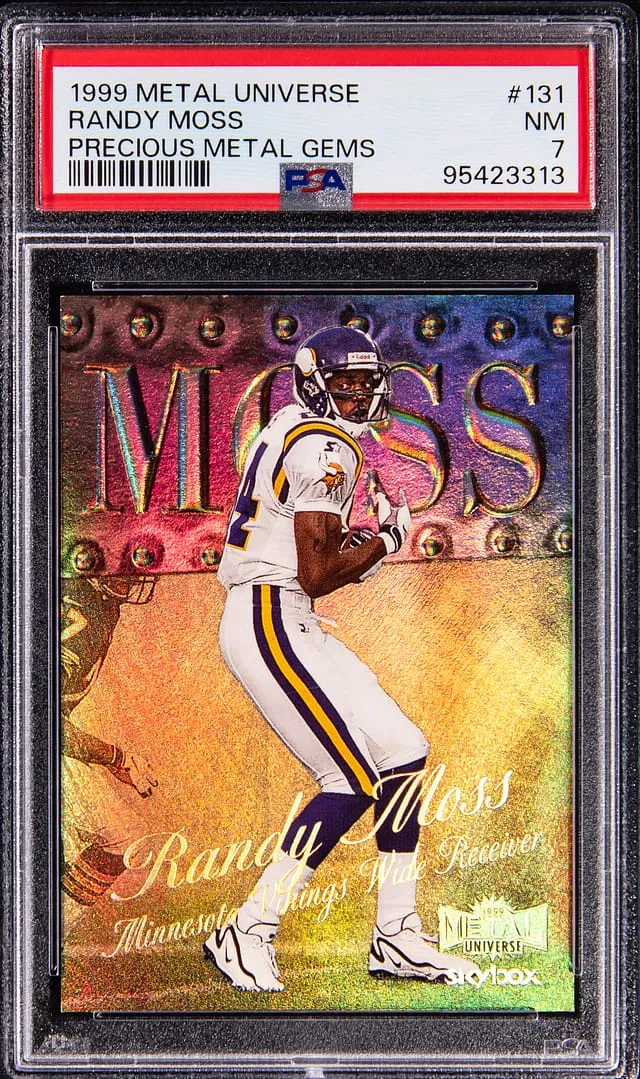
Randy Moss 1999 PMG #131 PSA 7 sells for $12.5K
Breakdown of the 1999 SkyBox Metal Universe PMG #131 Randy Moss PSA 7 sale for $12,538 at Goldin on March 15, 2026.
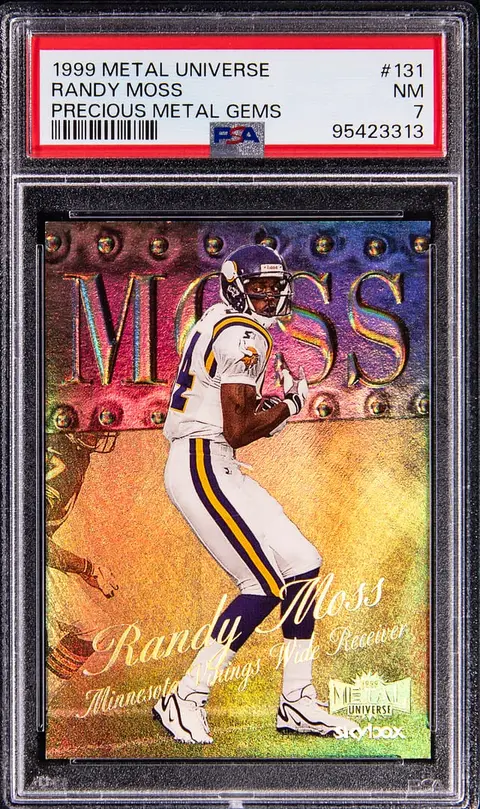
Sold Card
1999 SkyBox Metal Universe Precious Metal Gems (PMG) #131 Randy Moss (#28/50) - PSA NM 7
Sale Price
Platform
Goldin1999 SkyBox Metal Universe Precious Metal Gems (PMG) #131 Randy Moss (#28/50) in a PSA NM 7 just hammered at Goldin on March 15, 2026 for $12,538.
For 90s football collectors, that sentence packs a lot of meaning. Let’s unpack what this sale tells us about the card, the set, and where Randy Moss PMGs currently sit in the market.
The card at a glance
- Player: Randy Moss
- Team: Minnesota Vikings
- Year: 1999
- Set: SkyBox Metal Universe Precious Metal Gems (PMG)
- Card #: 131
- Serial numbering: #28/50
- Rookie status: Second-year Moss (rookie season was 1998), but a key early-career parallel
- Grading company: PSA (Professional Sports Authenticator)
- Grade: PSA NM 7 (Near Mint)
- Attributes: Iconic PMG parallel, low serial number out of 50
This is the 1999 follow-up to Moss’s legendary 1998 Metal Universe PMG rookie, and while it’s a second-year card, it’s still part of an early, scarce, and highly respected parallel run.
Why PMGs matter
“PMG” stands for Precious Metal Gems, one of the most influential parallel designs across both sports and non-sports cards.
A few reasons collectors care:
- Early premium parallel: PMGs were among the first truly premium, serial-numbered parallels that mixed bold design with real scarcity.
- Low print run: With only 50 copies of this green PMG, supply is permanently capped. Even accounting for lost or damaged copies, the population of surviving cards is small.
- Cross-sport cachet: PMGs are coveted in basketball, football, and even Marvel, which keeps attention on the brand and design across the wider hobby.
The 1999 Metal Universe PMG run is part of that late‑90s era where serial-numbered parallels began to separate truly rare cards from mass-printed base issues.
Randy Moss and the 1999 PMG
Randy Moss needs little introduction: Hall of Fame wide receiver, one of the definitive deep threats in NFL history, and a central figure in the late‑90s football card boom.
- Era: This is squarely in Moss’s early-career Vikings window, fresh off his explosive 1998 rookie season.
- Not a rookie, but still a key: Moss’s 1998 PMG is the true rookie PMG, but 1999 remains one of his most important early, low‑serial parallels. For many player collectors, 1998–2000 is the core Moss window.
Second-year PMGs of Hall of Fame talents sit in a useful middle ground: often more attainable than the true rookie PMG, but still important and historically significant.
Grading and condition context
This copy received a PSA 7 (Near Mint). For 90s premium foil/chrome-style cards, that’s not unusual.
- The PMG surface and edges are prone to chipping, scratching, and edge flaking.
- High‑grade examples (PSA 9–10) are typically very tough and tend to command steep premiums.
- A PSA 7 sits in the middle of the grading scale—solid collector copy, but not in the “condition census” (top population) tier.
A “pop report” (population report) from PSA shows how many copies have received each grade. For niche serial‑numbered parallels like 90s PMGs, the total population is capped by the print run, and many copies may still be raw (ungraded) or locked away in long‑term collections.
The Goldin sale: $12,538 on March 15, 2026
Goldin reported this card’s sale on March 15, 2026, closing at $12,538.
To understand what that means, it’s useful to look at recent comps—short for “comparables,” or recent, similar sales that help provide price context.
Recent and related sales (context)
Because this is a low‑population, serial‑numbered parallel, exact same‑card, same‑grade comps don’t always show up frequently. Instead, collectors often look at a mix of:
- The same card in different grades.
- The same player’s PMGs from 1998–2000.
- Similar Hall of Fame WR PMGs from the same era.
Publicly available data over the last few years has shown:
- Higher‑grade Moss PMGs (PSA 8–9) from 1998–1999 typically sell well above mid‑grade copies, sometimes in distinct steps as you move from PSA 7 to 8 to 9.
- Raw or lower‑grade examples (PSA 5–6 or ungraded) can trail PSA 7s meaningfully if condition issues are obvious.
- In general, PMG prices have been firm to gradually rising for Hall of Fame players with strong collector bases, especially when supply is thin.
Within that landscape, a PSA 7 closing at $12,538 is consistent with the idea that:
- Collectors still treat early Moss PMGs as core, long‑term pieces.
- The market is willing to pay a meaningful premium for even a mid‑grade example due to overall scarcity.
Without a large number of recent PSA 7 comps for this exact card, it’s better to frame this result as part of a narrow price band rather than call it definitively high or low. It fits within the broader trend of serious pricing for 90s PMGs of Hall of Fame names.
Collector significance
Here’s why this specific card matters to different types of collectors:
Player collectors
For Moss collectors, the PMG run is near the top of the ladder.
- The 1998 PMG rookie is the grail.
- The 1999 PMG, especially in PSA slabbed copies, is a key follow‑up piece that still sits in the “blue chip” tier of Moss parallels.
- Only 50 numbered copies exist, and many are likely in long‑term collections.
Set and era collectors
For 90s insert and parallel collectors, PMGs are foundational.
- The late‑90s Metal Universe and PMG designs helped define what a premium parallel should look like.
- Short print runs, strong visual identity, and cross‑sport recognition make them important for anyone building a timeline of hobby history.
Market observers
This sale adds another data point that:
- Scarce, early‑era PMGs remain highly respected.
- Hall of Famers like Moss can maintain steady demand even when the broader market cools or moves through cycles.
- Collectors continue to differentiate between truly limited 90s parallels and mass‑produced base or modern inserts.
Factors that may be influencing interest
A few ongoing themes likely support demand for this card type:
- Moss’s continued relevance: TV work, highlights resurfacing online, and constant comparison to modern receivers keep his legacy visible to new fans and collectors.
- 90s nostalgia: Many buyers now in their prime spending years grew up watching Moss and opening late‑90s products. That nostalgia often focuses on insert and parallel sets like PMGs.
- Shift toward scarcity: As more collectors study print runs and population reports, low‑serial 90s parallels get more attention relative to higher‑print modern issues.
None of these trends guarantee future prices, but they help explain why pieces like a 1999 Moss PMG in PSA 7 can still attract strong bidding at major houses like Goldin.
What this means for collectors and small sellers
For collectors considering similar cards:
- Know your lane: Decide whether you’re targeting player grails (like Moss PMGs), set builds (e.g., assembling a run of 1999 PMGs), or specific eras (pre‑2000 short prints).
- Condition vs. scarcity: With low‑serial 90s cards, even mid‑grade copies can matter because supply is fixed. The jump from PSA 7 to 8 or 9 can be significant, but a 7 is still a meaningful piece.
- Use comps carefully: With such low populations, one sale at Goldin or another major house may be a useful reference point, but not a definitive market rate.
For small sellers:
- Document condition honestly: PMGs show wear clearly. High‑quality photos and accurate descriptions help buyers understand why a card might grade in the 6–8 range.
- Highlight context: When listing a card like this, note the serial number (/50), grading company, and the broader PMG brand history so newcomers understand why it’s important.
Final thoughts
The 1999 SkyBox Metal Universe Precious Metal Gems #131 Randy Moss (#28/50) PSA NM 7 selling for $12,538 at Goldin on March 15, 2026 is another reminder that early, scarce parallels of Hall of Famers remain central to the modern football card hobby.
While exact comps are limited for such a low‑population issue, the sale aligns with the long‑standing respect collectors have for 90s PMGs and for Randy Moss’s place in football history. For Moss player collectors and 90s insert enthusiasts, this card sits comfortably in the category of “cornerstone piece”—even in a mid‑grade slab.