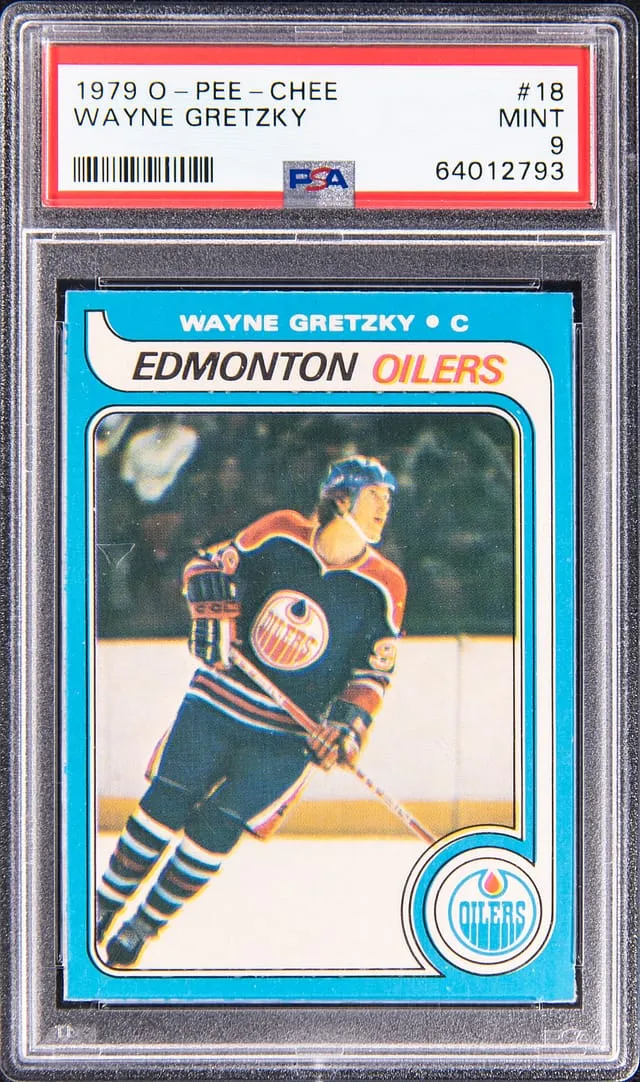
PSA 9 1979-80 OPC Wayne Gretzky Rookie Sells Big
Goldin sold a 1979-80 O-Pee-Chee #18 Wayne Gretzky rookie PSA 9 for $115,900. See how this six-figure result fits recent comps and hobby context.
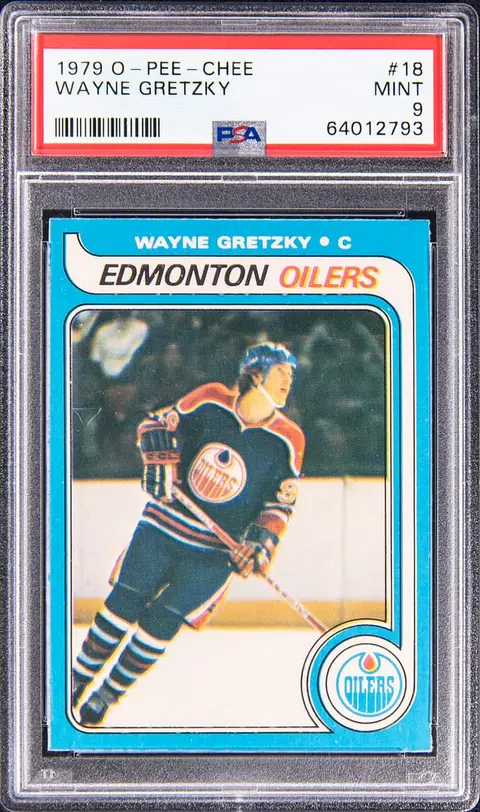
Sold Card
1979-80 O-Pee-Chee #18 Wayne Gretzky Rookie Card - PSA MINT 9
Sale Price
Platform
Goldin1979-80 O-Pee-Chee #18 Wayne Gretzky Rookie Card – PSA 9 Sells for $115,900
On March 8, 2026, Goldin closed a major vintage hockey sale: a 1979-80 O-Pee-Chee #18 Wayne Gretzky Rookie Card graded PSA MINT 9 realized $115,900. For many collectors, this card is the defining modern hockey rookie, and PSA 9 is one of the key grade tiers where serious set builders, player collectors, and long-term hobbyists tend to focus.
In this breakdown, we’ll look at what this card is, why it matters, how this result fits into recent sales, and what collectors can take away from it.
The card at a glance
- Player: Wayne Gretzky
- Team: Edmonton Oilers
- Year: 1979-80
- Set: O-Pee-Chee Hockey
- Card number: #18
- Status: True rookie card (flagship pack-issued RC)
- Grading company: PSA (Professional Sports Authenticator)
- Grade: PSA MINT 9
- Attributes: Standard base card, no autograph or memorabilia; key vintage flagship rookie
Gretzky’s 1979-80 O-Pee-Chee rookie is widely regarded as the cornerstone of modern hockey cardboard. It is the Canadian-issue counterpart to the 1979-80 Topps Gretzky, printed on rougher, more fragile stock with notoriously poor print quality and centering.
Because of that, high grades are scarce relative to raw copies and lower-grade examples. Gem Mint 10s are extremely rare; PSA 9s sit in that middle ground where the card is still legitimately difficult in high grade but not as unreachable as a PSA 10 for most collectors.
Why this card matters to collectors
Iconic player, true flagship rookie
Wayne Gretzky is not just a star – he is the statistical outlier of NHL history. Multiple all-time records, four Stanley Cups, nine Hart Trophies, and career point totals that still look untouchable.
This card is his true pack-pulled rookie, not a reprint, not an insert, not a later tribute. When collectors talk about “the” Gretzky rookie, they mean this 1979-80 O-Pee-Chee #18.
O-Pee-Chee vs. Topps
The 1979-80 O-Pee-Chee set is generally seen as the more desirable Gretzky rookie issue compared with its U.S. Topps counterpart. Reasons include:
- Print quality: O-Pee-Chee had rougher card stock, chipping-prone edges, and frequent centering issues.
- Regional importance: As the Canadian release, it connects directly to Gretzky’s NHL roots and hockey’s traditional core market.
- High-grade scarcity: The production challenges make PSA 9 and especially PSA 10 copies significantly tougher.
That combination is why the O-Pee-Chee version usually sells at a premium to the Topps version in comparable grades.
Vintage era, tough grading curve
By hobby standards, 1979-80 is considered vintage/early modern. Cards were bought to be handled, traded, and played with, not carefully sleeved on release. The result: many surviving Gretzky rookies show creases, rounded corners, and surface wear.
PSA 9 requires:
- Sharp corners
- Clean front and back
- Strong gloss
- Centering within relatively tight tolerances
Given what is known about O-Pee-Chee production quality, that is not easy to achieve.
Market context: how $115,900 fits in
The Goldin sale closed at $115,900 on March 8, 2026. Converted from the provided cents figure (11,590,000) to dollars, that’s a six-figure result firmly in the high-end vintage hockey tier.
For context, looking at public auction records over recent years:
- PSA 10 copies of this card have historically reached the high six figures and, in peak periods for the market, have pushed toward or above the seven-figure mark.
- PSA 9 copies have traded in a broad range depending on market conditions, often in the mid five-figure to low six-figure range.
In that framework, $115,900 sits in the stronger part of the historic PSA 9 range rather than as an outlier at either extreme. It reflects the card’s status as the clear number one flagship hockey rookie, while still leaving a substantial gap to the very small population of PSA 10s.
A note on comps and context
In hobby language, “comps” are comparable recent sales that help frame current prices. For vintage keys like the Gretzky OPC rookie, comps can vary because of:
- Overall market cycles (strong or soft periods for high-end vintage)
- Small differences in eye appeal (centering, print quality, color) within the same numeric grade
- Auction house audience and timing
The Goldin result is consistent with the long-standing pattern where:
- PSA 10 is a true outlier tier
- PSA 9 is the top realistically attainable grade for many advanced collectors
- Lower grades see wider participation, but with much larger populations
Population and perceived scarcity
A “pop report” (population report) is the grading company’s count of how many copies they have graded at each grade level.
For the 1979-80 O-Pee-Chee Gretzky rookie:
- The total graded population is large compared to most hockey cards, reflecting its status as a premier chase card.
- The number of PSA 9s is a small fraction of that total.
- PSA 10s are extremely scarce.
While pop numbers continue to move as more raw cards are submitted, the trend over time has reinforced the same basic picture: Gretzky’s rookie is not rare in absolute terms, but it is meaningfully scarce in high grade given the challenges of O-Pee-Chee production and late-1970s handling.
Why this result matters for different types of collectors
New or returning collectors
If you’re just coming back into the hobby or learning hockey cards, this sale illustrates a few concepts:
- Flagship rookie premium: A player’s main pack-issued rookie, especially of an all-time great, tends to be the long-term reference card for that player.
- Grade spread: The same card can sell across a very wide price range depending on condition and grading.
- Vintage resilience: Key vintage cards often behave differently than ultra-modern prospect or patch/auto cards. Their demand is grounded in long-established collector interest rather than short-term performance swings.
Active hobbyists and small sellers
For more involved collectors and small sellers, this result is another data point that:
- Confirms consistent demand for high-end vintage hockey, especially Gretzky
- Highlights the role of presentation: strong eye appeal within PSA 9 can matter in how bidders respond
- Underlines the importance of accurate grading when evaluating raw Gretzky rookies – subtle centering and print defects can move a card by multiple grade levels
Factors that can influence interest
A few broader drivers that tend to support sustained interest in this card:
- Gretzky’s enduring relevance: As new generations of fans are introduced to the “Great One,” his rookie remains the default target.
- Hobby education and content: More collectors learning about vintage hockey and O-Pee-Chee history generally translates to more attention on this card.
- Comparisons to other GOAT rookies: In conversations about Jordan, Mantle, and other iconic rookie cards, Gretzky’s OPC often appears as the hockey equivalent.
No single auction sets a permanent value level, but sales like this provide a clear reference point for the current environment.
Takeaways
- The 1979-80 O-Pee-Chee #18 Wayne Gretzky Rookie Card is the premier mainstream hockey rookie card.
- In PSA MINT 9, it occupies a critical middle ground between widely available lower grades and the extremely scarce PSA 10 tier.
- The $115,900 Goldin result from March 8, 2026, fits comfortably within the established six-figure range for strong PSA 9 copies.
- For collectors, this sale reinforces how cornerstone vintage cards can anchor a collection or a segment of the market without relying on short-term performance swings.
As always, any decision to buy, sell, or hold should be based on your own collecting goals, budget, and comfort with risk. Sales like this are best used as context rather than as a guarantee of future prices.