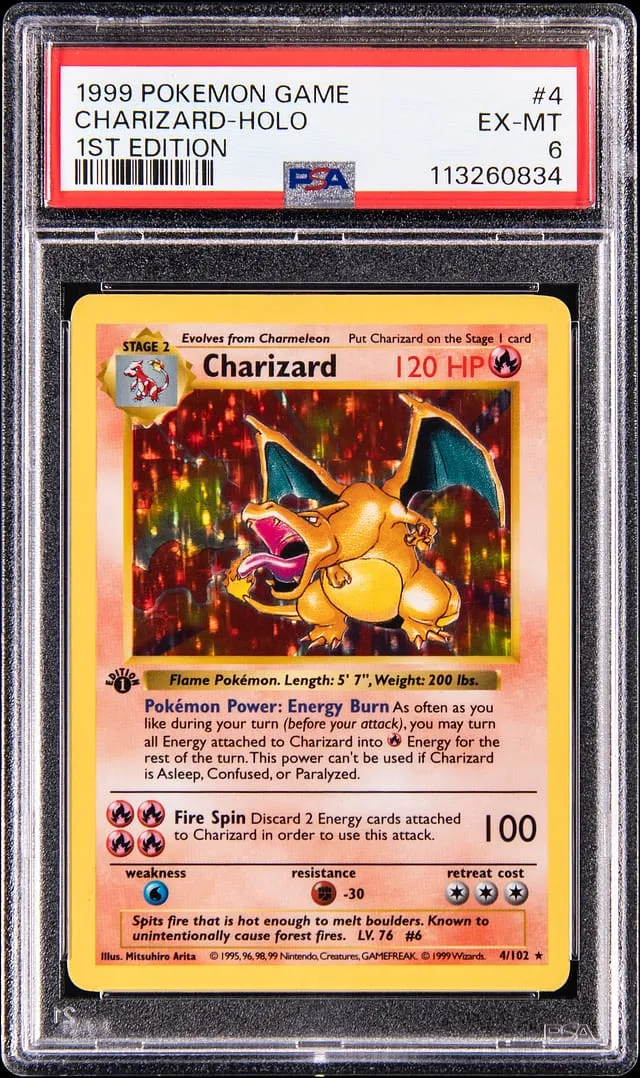
PSA 6 1st Edition Charizard Sells for $18,605
Figoca reviews Goldin’s May 18, 2026 sale of a 1999 Pokémon Base Set 1st Edition Holo Charizard PSA 6 and what it means for current market values.
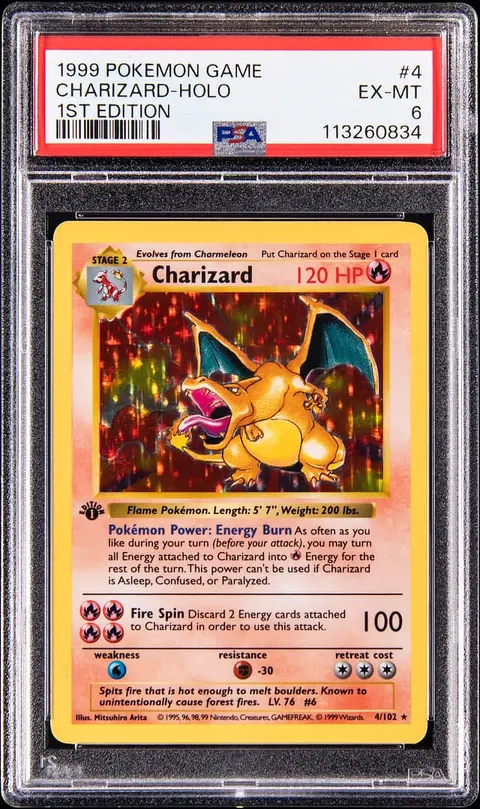
Sold Card
1999 Pokemon Base Set 1st Edition Holo #4 Charizard - PSA EX-MT 6
Sale Price
Platform
Goldin1999 Pokémon Base Set 1st Edition Holo Charizard PSA 6 Sells for $18,605
On May 18, 2026, a 1999 Pokémon Base Set 1st Edition Holo #4 Charizard graded PSA EX-MT 6 sold at Goldin for $18,605. For many collectors, this is one of the hobby’s true cornerstone cards, and its sales data help anchor the broader Pokémon market.
In this breakdown, we’ll look at what this card is, why it matters, and how this sale fits into recent price trends.
The card at a glance
- Character: Charizard
- Year: 1999
- Set: Pokémon Base Set 1st Edition (English)
- Card number: #4/102
- Finish: Holofoil (holographic)
- Key status: Iconic chase card from the first English Pokémon TCG set; widely treated as the flagship vintage Pokémon card
- Grading company: PSA (Professional Sports Authenticator)
- Grade: EX-MT 6 (Excellent–Mint)
- Attributes: No autograph, no serial number; value is driven by set, stamp, holo, and grade
This is not a “rookie card” in the sports sense, but in the Pokémon world it functions similarly: it’s the first widely distributed English Charizard holo, from the first print run of the first TCG set. The 1st Edition stamp, the holographic treatment, and Charizard’s popularity combine to make it a core grail for vintage Pokémon collectors.
Why this Charizard matters to collectors
A few reasons this specific card carries so much weight:
Historic set – 1999 Base Set 1st Edition is the beginning of the English Pokémon TCG. It’s the set that many collectors remember opening as kids. The 1st Edition print run is much smaller than Unlimited and retains a strong historical premium.
The hobby’s flagship card – Within that set, the holo Charizard is the best-known and most chased card. For non-collectors, it’s often the card they recognize. For many returning collectors, it’s the card that pulls them back in.
Vintage era – This card sits in the “vintage” category of Pokémon (late 1990s). Vintage cards tend to have:
- Lower original print runs than modern chase products
- More wear from being actually played and handled
- Higher demand for presentable mid-grade copies because many childhood copies are heavily damaged
Accessibility at mid-grade – While PSA 9 and PSA 10 copies have sold for six and even seven figures in peak periods, grades like PSA 6 offer entry into the same piece of history at a still-serious but comparatively more reachable price point.
Understanding the PSA 6 grade
PSA’s EX-MT 6 (Excellent–Mint) grade usually signals:
- Noticeable edge and corner wear
- Some surface and holo scratching
- Possibly a more pronounced print line or a small crease that doesn’t break the card badly
- Overall decent eye appeal, but clearly well below Near Mint–Mint (PSA 8) and Mint (PSA 9)
For a heavily chased 1999 holo like Charizard, the PSA population report (often shortened to “pop report,” which is simply the grading company’s census of how many copies they’ve graded in each grade) shows that mid-grades like 4–6 are fairly common. The scarcity premium really picks up at PSA 9 and PSA 10, where the population drops relative to demand.
That said, many collectors intentionally target 5s and 6s as a balance between affordability and eye appeal, especially when centering and color are strong for the grade.
Market context for PSA 6 1st Edition Charizard
When collectors talk about “comps”, they mean comparable recent sales—real transactions you can use as a reference point rather than asking prices.
Based on recent public auction and fixed-price data up through 2024–early 2025, PSA 6 1st Edition Holo Charizards have generally:
- Traded in a broad range, roughly in the mid-teens to low-twenties (thousands of dollars) depending on:
- Eye appeal (centering, print quality, holo scratching)
- How strong or weak the card is for the grade
- Auction format and timing
Within that context, the $18,605 sale at Goldin on May 18, 2026 falls comfortably in the middle of the expected band for a PSA 6:
- Not a clear outlier on the low end as a “steal”
- Not a clear record-setting high for the grade
- Instead, it reads as a healthy, market-consistent result in a maturing post-boom environment
How this compares to other grades
To frame the PSA 6 result, it helps to look up and down the grading ladder. While exact numbers move over time, past patterns have been roughly:
- PSA 4–5 – Noticeably lower, often into the high four-figures to low five-figures, depending on eye appeal
- PSA 6 – Solidly in the mid-tier; this $18,605 sale lines up with that zone
- PSA 7–8 – A step up for better eye appeal; typically a meaningful premium over 6s, with some copies clearing the $20,000+ mark in stronger stretches of the market
- PSA 9–10 – A very different world. PSA 9s and especially PSA 10s have historically achieved very large premiums, including headline-making six- and seven-figure results at various points of the Pokémon boom
The important takeaway is that PSA 6 occupies a collector-focused lane: still expensive, but centered on owning a key card in a presentable, authenticated condition rather than chasing record-breaking rarity.
What might be driving interest now
A few structural factors keep this card relevant regardless of short-term swings:
- Generational nostalgia – Many late-20s to early-40s collectors grew up with Base Set. As they reach higher earning years, demand for high-profile nostalgia pieces tends to persist.
- Matured post-boom pricing – After the 2020–2021 surge and subsequent cooling, prices for many vintage staples have settled into more stable ranges. Mid-grade 1st Edition Charizards have generally held better than more speculative modern cards.
- Established blue-chip status in the hobby – Without making investment claims, it’s fair to say that this card is widely treated as one of the hobby’s “blue-chip” pieces: recognizable, liquid (relatively easy to sell), and supported by a broad collector base.
No single piece of news explains this specific sale; rather, it fits into a longer-term pattern of steady demand for iconic vintage Pokémon.
Takeaways for collectors and small sellers
For collectors and small sellers looking at this Goldin sale from May 18, 2026, a few practical points stand out:
Mid-grade remains active – The $18,605 result reinforces that PSA 6 copies continue to see real bidding interest. Collectors still value owning a 1st Edition Base Charizard even if it isn’t a high-grade example.
Eye appeal matters inside the grade – Two PSA 6s can perform differently. Cards with better centering, fewer holo scratches, and stronger color often command stronger results than “average” examples, even at the same numeric grade.
Know your comps, not just asking prices – For anyone thinking about buying, selling, or trading a PSA 6 1st Edition Charizard, actual realized prices like this Goldin sale provide a more reliable reference than optimistic listing prices.
Think in ranges, not single numbers – Market conditions change. Instead of treating $18,605 as a fixed value, it’s more useful to see this as one data point within a reasonable band of recent sales.
As always, none of this is financial advice. It’s simply one more real-world sale to help you understand how this cornerstone Pokémon card is currently being valued.
If you’re holding or hunting for a 1999 Pokémon Base Set 1st Edition Holo Charizard, tracking sales like this across multiple auction houses and marketplaces is one of the best ways to stay grounded in the actual market—beyond the headlines and asking prices.