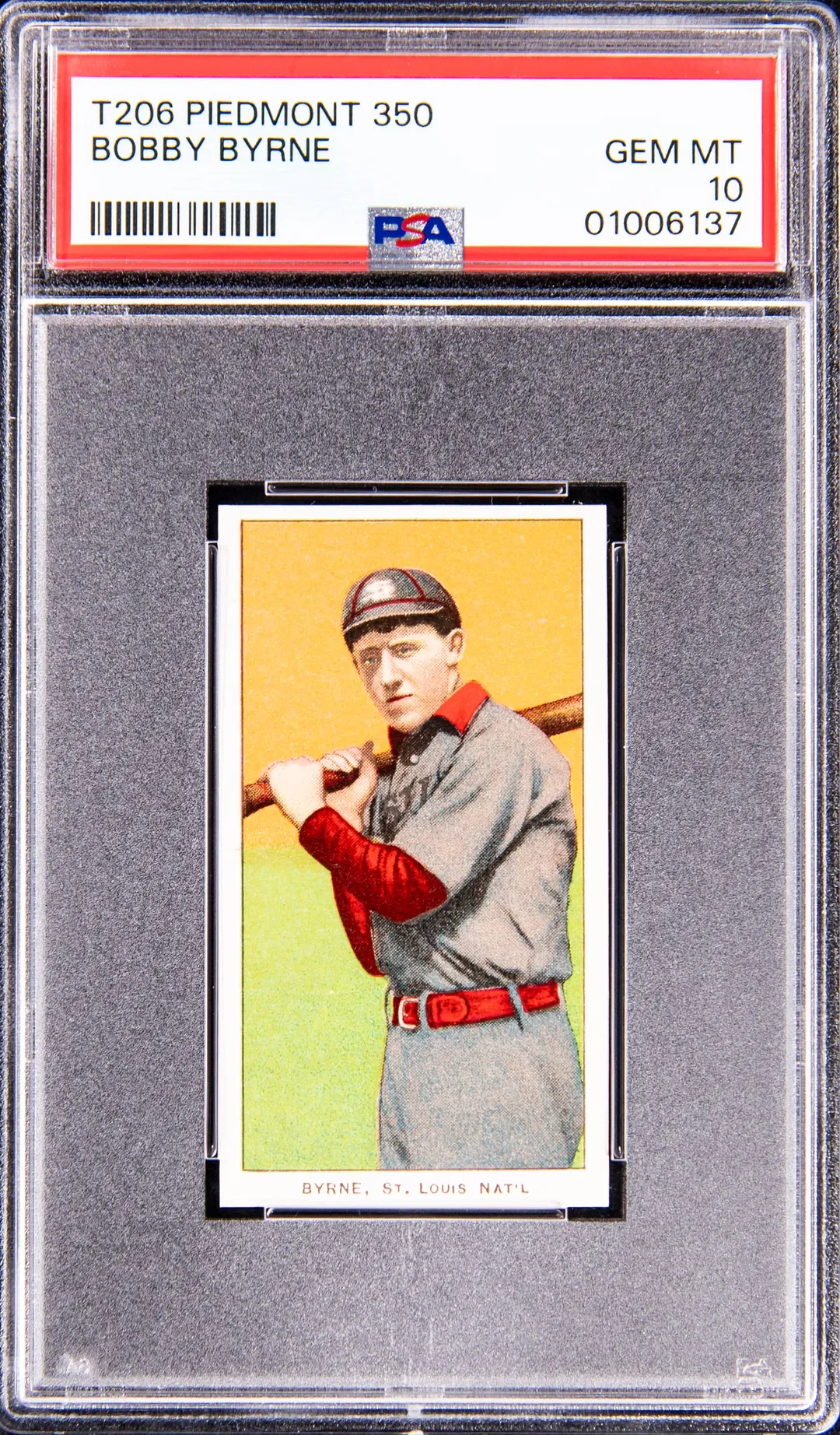
PSA 10 T206 Bobby Byrne Sells for $170,800
Goldin’s Feb 22, 2026 sale of a POP 1 PSA 10 T206 Bobby Byrne realized $170,800, highlighting true top-end scarcity in the iconic tobacco set.
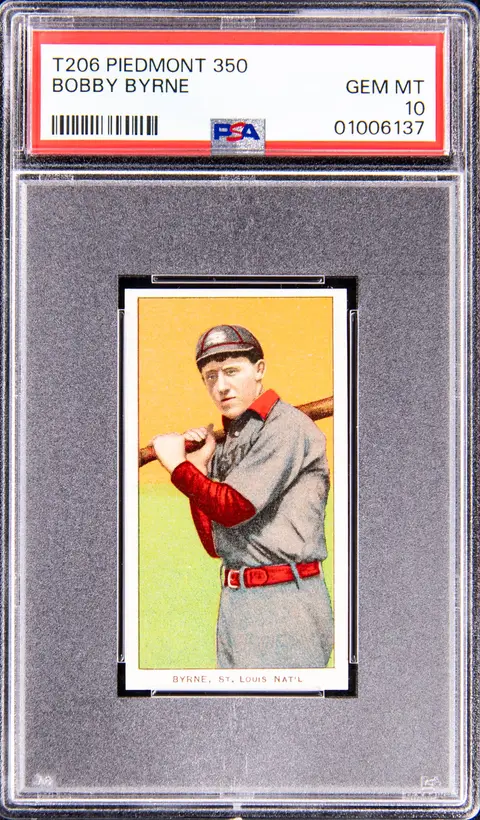
Sold Card
Extraordinary 1909-11 T206 White Border Bobby Byrne - Piedmont 350, Factory 25 - PSA GEM MINT 10 – POP 1 & One of Only 13 Known PSA 10 T206 Subjects!
Sale Price
Platform
GoldinExtraordinary 1909-11 T206 White Border Bobby Byrne - Piedmont 350, Factory 25 - PSA GEM MINT 10 – POP 1 & One of Only 13 Known PSA 10 T206 Subjects!
On February 22, 2026, Goldin sold a 1909–11 T206 White Border Bobby Byrne (Piedmont 350, Factory 25) graded PSA GEM MINT 10 for $170,800. For vintage collectors, this result is less about the dollar figure alone and more about what it signals for high-grade tobacco cards and the true top end of the T206 market.
In this breakdown, we’ll look at what this card is, why the grade matters so much, how it fits into the broader T206 landscape, and what this Goldin sale might mean for collectors building sets or chasing pop report outliers.
Card overview
Card: 1909–11 T206 White Border Bobby Byrne
Player: Bobby Byrne, third baseman (best known with the St. Louis Cardinals and Pittsburgh Pirates era)
Set: T206 White Border (1909–11)
Back: Piedmont 350, Factory 25
Grading company: PSA (Professional Sports Authenticator)
Grade: GEM MINT 10
Population note: PSA POP 1; one of only 13 PSA 10s across all T206 subjects
The T206 set is a cornerstone of pre-war baseball collecting. Issued in cigarette packs between 1909 and 1911, it covers stars, Hall of Famers, and commons alike. Within that universe, Bobby Byrne is considered a “type” or “common” player, but in T206, the label “common” refers mostly to the player’s star power—not to how easy a card is to find in top condition.
The specific back on this copy is Piedmont 350, Factory 25. Piedmont is one of the more standard T206 advertising backs, and the 350-series cards line up with a particular production run. While Piedmont 350 is generally more available than scarcer backs like Drum or Uzit, the real story here is not the back scarcity—it’s the condition.
Why a PSA 10 T206 is such an outlier
PSA 10, or GEM MINT, is PSA’s highest grade, signaling a card that is essentially flawless by their standards: sharp corners, strong centering, clean surfaces, and no visible printing or handling defects under normal viewing.
For ultra-modern releases, PSA 10s can be common. For tobacco-era issues from 1909–11, they are effectively near-mythical. Cards from this era were:
- Packaged loosely with tobacco products
- Subject to handling, staining, and trimming
- Printed with early 20th-century methods that introduced a lot of natural variance
Over the decades, surviving T206s often show corner wear, creases, centering issues, and back damage. That’s why most examples grade in the VG (Very Good) to EX (Excellent) range, and even PSA 5–7 copies can be considered very respectable.
Against that backdrop, this Bobby Byrne stands at PSA POP 1—the only known PSA 10 for this subject—and is reportedly one of just 13 PSA 10s for the entire T206 set. In other words, this is not just the best Byrne; it sits on a very short list of the best-preserved T206 cards, period.
When collectors talk about the “pop report” (short for population report), they mean the grading company’s census of how many copies exist at each grade. For T206 collectors, the pop report is a core tool used to understand how often a card turns up in certain grades and where true scarcity lies.
Market context and recent sales
While true PSA 10 T206 sales are rare, we can get some context by looking at three layers:
Sales of this exact card/grade (PSA 10 Bobby Byrne)
Public auction records for this exact card at PSA 10 are extremely limited, which is typical for a POP 1 vintage card. When a card like this surfaces, it does so infrequently and often in larger auctions such as Goldin, Heritage, or REA. That makes it difficult to establish a tight “comp” (comparable sale) history.Sales of the same card in lower grades
In recent years, T206 Bobby Byrne cards with Piedmont backs have traded across a wide range of grades:- Mid-grade (around PSA 4–5) typically sells in the low hundreds of dollars, depending on eye appeal, centering, and auction venue.
- Higher-grade copies (PSA 7–8) can push toward low four figures, again with some variation. PSA 9s, when they appear, tend to command a strong premium over 8s, reflecting their scarcity, and they already move the card into a more advanced collector segment.
Against that baseline, the jump from a high-grade PSA 8 or 9 into PSA 10 is not incremental—it’s a different market tier. The card transitions from being part of a general run of high-grade T206s into being a pop-report trophy piece.
Sales of other PSA 10 T206s
For other T206 subjects that have reached PSA 10, public results have shown:- Multiples far beyond the next grade down (PSA 9)
- Strong bidding from set registrants (collectors vying for top-ranked set builds) and advanced pre-war specialists
Individual results vary by subject—Hall of Fame names command more—but the underlying pattern is consistent: a PSA 10 T206 is treated as a once-in-a-generation opportunity rather than a repeatable transaction.
Where the $170,800 result fits
The Goldin sale on February 22, 2026 closed at $170,800. When you set this figure next to the rough hundreds-to-low-thousands range for most Byrne T206s in lower grades, the gap seems enormous. However, that spread reflects:
- Era scarcity at the top grade: Very few T206 cards even have a path to PSA 10.
- POP 1 status: For set builders competing on PSA’s registry, owning the only PSA 10 for a subject can lock in a significant registry advantage.
- Historical significance of the set itself: T206 is among the most studied and collected pre-war sets, so ultra-elite examples tend to attract sustained interest.
Instead of looking at this sale as a multiple of PSA 7–9 copies, it makes more sense to see it as:
- A data point in the very thin market for PSA 10 T206s; and
- A confirmation that the combination of POP 1 + key pre-war set can support six-figure results even for non-Hall of Fame subjects.
Because truly comparable sales are infrequent, calling this price “high,” “low,” or “typical” in a strict statistical sense is tricky. It is, however, clearly in line with how the market has treated other high-end, low-pop vintage tobacco cards.
Why collectors care about this card
Even though Bobby Byrne is not a headliner like Cobb, Wagner, or Mathewson, this card intersects with several collecting motives.
1. The T206 set’s historical weight
T206 is foundational to the hobby for a few reasons:
- It captures a large cross-section of early 20th-century baseball.
- It introduced the legendary Honus Wagner card, often pointed to as a symbol of the entire hobby.
- It offers a wide variety of advertising backs, poses, and print nuances.
Collectors often approach T206 in multiple ways: player runs, team runs, back runs, or full/near-full set pursuits. In every case, condition ladders—trying to move from mid-grade to high-grade—play a role in long-term collecting plans.
2. Registry competition and the appeal of POP 1
PSA’s Set Registry allows collectors to publicly track and compare their sets. Advanced T206 collectors compete for top-ranking positions, and a single POP 1 GEM MINT card can swing a registry score meaningfully.
Owning the lone PSA 10 of a subject gives the buyer both bragging rights and a practical scoring advantage. The Byrne fits perfectly into this dynamic: it is a common player in name, but a centerpiece asset in the context of the registry.
3. The survival story of early cards
For many collectors, high-grade pre-war cards are appealing because of the implied survival story. How did a small, thin piece of early 1900s cardboard escape the usual fate of creases, rounded corners, and staining for over a century?
A PSA 10 T206 encodes that question in its grade. It represents not just the player or the set, but the improbability of perfect preservation through multiple generations.
What this Goldin sale might mean going forward
Goldin’s February 22, 2026 sale of the PSA 10 Bobby Byrne for $170,800 will likely be referenced in a few ways in the coming years:
- Benchmark for ultra-high-grade “commons”: It provides another data point suggesting that even non-star T206 subjects can achieve six-figure results in the rarest possible condition.
- Reinforcement of top-grade premiums: The gap between PSA 9 and PSA 10 in pre-war issues is consistently large, and this sale supports that pattern.
- Confidence in the T206 high-end segment: Strong results for rare, top-graded T206 cards indicate continued collector demand at the upper end of the vintage market.
It’s important to remember that this does not automatically translate to similar prices for lower grades. Most collectors will continue to interact with T206 Byrne cards in the more accessible PSA 2–7 range. The PSA 10 sits in a different lane: museum-level condition, registry-focused demand, and very limited supply.
Takeaways for different types of collectors
Whether you are just learning about T206 or already hunting specific backs and poses, there are a few practical lessons from this sale:
- Condition drives separation in vintage. For tobacco-era cards, the jump from mid-grade to high-grade—and especially into PSA 9/10—changes the audience and price profile completely.
- Pop reports are a key tool. Checking population reports helps clarify where true scarcity lies and why some cards command outsized premiums compared to visually similar copies in slightly lower grades.
- High-end results don’t invalidate lower-end collecting. Six-figure auction headlines can feel distant, but they also reaffirm long-term interest in the set. That can support collector confidence across a wide range of budgets.
Closing thoughts
The 1909–11 T206 Bobby Byrne (Piedmont 350, Factory 25) PSA GEM MINT 10 that sold at Goldin on February 22, 2026 for $170,800 is less about the specific player’s fame and more about what it represents: the outer edge of condition rarity in one of the hobby’s most important sets.
For collectors who track T206 closely, this sale will sit alongside other notable PSA 10 results as a reference point for how the market values POP 1, ultra-elite examples. For newcomers, it’s a striking illustration that even so-called “commons” can become centerpiece cards when they survive in truly exceptional shape.
As always, these results should be read as price context, not a prediction. Markets change, players fade in and out of focus, and collector priorities evolve. But the core story remains: pre-war sets like T206 continue to reward careful attention to condition, provenance, and population data—and this Bobby Byrne is a clear, high-profile example of that dynamic in action.