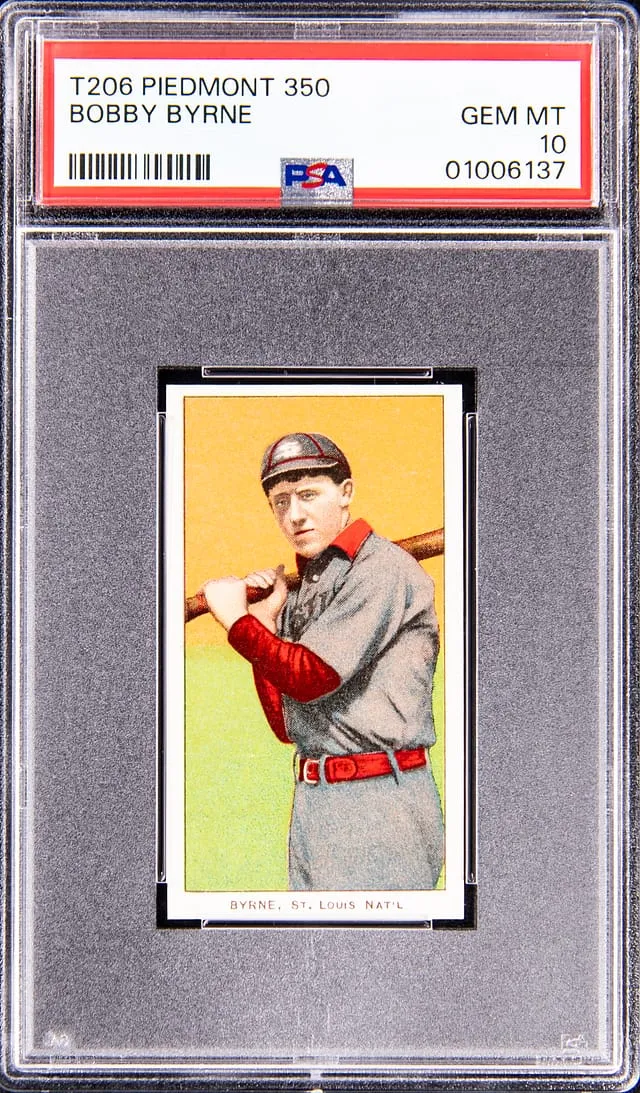
PSA 10 T206 Bobby Byrne POP 1 Sells for $170,800
Goldin sold a PSA 10 T206 Bobby Byrne (Piedmont 350, Factory 25) for $170,800. Explore the pop 1 rarity, T206 context, and vintage market signals.
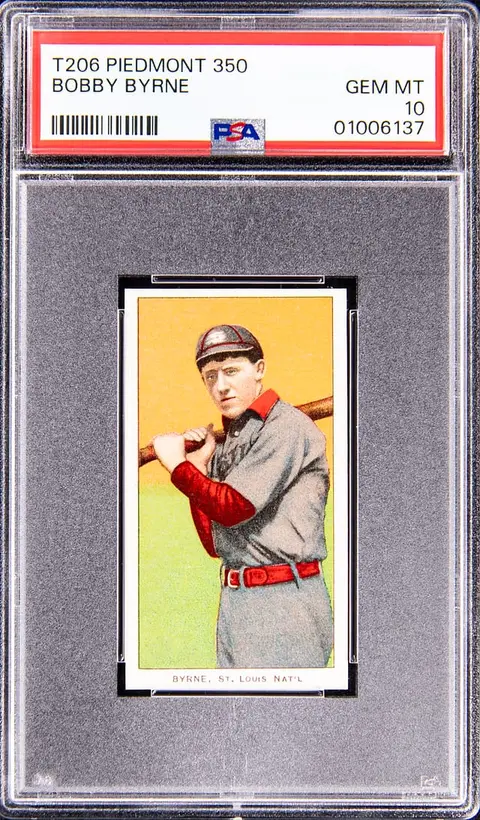
Sold Card
Extraordinary 1909-11 T206 White Border Bobby Byrne - Piedmont 350, Factory 25 - PSA GEM MINT 10 – POP 1 & One of Only 13 Known PSA 10 T206 Subjects!
Sale Price
Platform
GoldinExtraordinary 1909-11 T206 White Border Bobby Byrne - Piedmont 350, Factory 25 - PSA GEM MINT 10 – POP 1 & One of Only 13 Known PSA 10 T206 Subjects
A PSA 10 from the most collected prewar baseball set just changed hands, and it quietly says a lot about how deep vintage demand still runs.
On February 22, 2026, at Goldin, a 1909-11 T206 White Border Bobby Byrne (Piedmont 350, Factory 25) graded PSA GEM MINT 10 sold for $170,800. For context, this card is:
- Set: 1909-11 T206 White Border
- Player: Bobby Byrne, third baseman (most associated with the St. Louis Cardinals and Pittsburgh Pirates during the T206 era)
- Back: Piedmont 350, Factory 25
- Grading company: PSA (Professional Sports Authenticator)
- Grade: GEM MINT 10
- Population: POP 1 in PSA’s population report
- Historical note: One of only 13 total PSA 10s across the entire T206 checklist
There is no autograph, relic, or serial numbering here. The appeal is all about condition rarity inside a historically important prewar set.
Why this T206 Bobby Byrne matters
1. The T206 set: the hobby’s prewar cornerstone
The T206 White Border set (1909–1911) is widely considered the foundational tobacco-era baseball issue. It features:
- Over 500 different subjects (players and pose variations)
- Multiple back advertisements (Piedmont, Sweet Caporal, Old Mill, etc.)
- A mix of all-time icons (Cobb, Johnson, Mathewson, Young) and role players
Condition is usually the limiting factor. These cards were packaged with cigarettes, handled roughly, and printed over a century ago. Creases, rounded corners, paper loss, and off-centering are the norm.
2. Condition rarity vs player fame
Bobby Byrne is not a Hall of Famer. On a player-name basis, he’s a secondary subject in the checklist. But in ultra-high grade, the equation changes:
- T206 cards in PSA 10 are effectively museum-level condition outliers.
- Only 13 PSA 10s are known across the entire set, according to the pop report.
- This Byrne is POP 1, meaning no other example of this exact card has ever reached GEM MINT 10 at PSA.
In prewar, especially T206, collectors often pay primarily for condition plus set importance, with player stardom layered on top. When the grade is this extreme, even non-star players can become headline cards.
3. Piedmont 350, Factory 25 context
Piedmont backs are among the more common advertising backs in T206, especially compared to scarcer backs like Drum, Uzit, or Lenox. Within Piedmont, the "350" series refers to a specific print group covering roughly 350 subjects.
Factory 25 (Mount Pleasant, NC) is printed at the bottom of the back. While not a rare back code on its own, it helps collectors pinpoint exactly which configuration this POP 1 10 represents.
So what makes this card special is not a rare back. It is the unlikely survival of a common-back T206 in literally flawless condition.
Market context and recent sales
The Goldin sale closed at $170,800 (USD) on February 22, 2026.
Because PSA 10s from T206 are so rare, direct recent comps (short for comparables – recent similar sales) are limited:
- PSA 10 T206s rarely appear at auction. Many are locked away in advanced collections for years.
- When a T206 in PSA 10 does surface, it tends to sell at a strong premium to any lower grades, even PSA 9s, simply because the population is almost always 1 or extremely low.
By contrast, the same Byrne card in typical collector grades (for example, PSA 3–5) usually sells for a few hundred dollars, sometimes lower depending on eye appeal and back. Even PSA 7–8 examples generally sit orders of magnitude beneath this sale price.
This illustrates a core idea in prewar collecting:
The difference between “high grade” and “top-of-the-pop” is not linear. It’s exponential.
A PSA 7 or 8 is considered excellent for a T206. But a PSA 10 lives in its own category. It attracts not just set builders and Byrne collectors, but also:
- Registry competitors trying to build elite graded sets
- Condition-focused investors and long-term collectors
- Museums or institutional-type buyers who want a flagship example of what a T206 can look like
Within that context, $170,800 is consistent with how the hobby tends to price singular, population-1, century-old cards from iconic sets. There are no identical recent sales to label this result “cheap” or “expensive” with precision; instead, it fits the pattern of a serious, one-of-a-kind condition piece.
What this sale suggests about the T206 market
1. Condition at the very top still commands premiums
Even while modern cards can dominate social feeds, this sale quietly reinforces a long-running theme:
- Ultra-high-grade vintage – especially prewar – continues to command meaningful prices.
- Registry-driven collecting remains a strong undercurrent. When a unique 10 surfaces, there might be only a handful of realistic bidders, but they are often willing to stretch.
2. Set importance matters more than player name at the extremes
There’s a clear pattern in vintage markets:
- In mid-grade and low-grade, player star power carries most of the value.
- At the absolute top of the grading scale, the set’s historical significance can overshadow whether the player is a Hall of Famer or not.
This Byrne sale underscores how being part of the T206 master set and holding a POP 1 PSA 10 slot can drive demand even for a non-star.
3. Pop reports shape collector behavior
A population report (often called a "pop report") is simply the grading company’s tally of how many copies they have graded at each grade level.
In this case:
- PSA lists only one GEM MINT 10 for Byrne’s T206.
- Across all T206 subjects, there are just 13 total PSA 10s.
For registry and set builders, these numbers are crucial. They:
- Inform how realistic it is to chase a top-ranked set
- Help explain why some cards hardly ever appear for sale
- Show why, when they do appear, pricing can jump far above what lower grades suggest
Takeaways for different types of collectors
If you’re new to prewar and T206
- Use sales like this as orientation, not a target. You don’t need a PSA 10 to enjoy T206.
- T206 offers a wide range of entry points: eye-appeal-focused PSA 1–3s, mid-grade commons, and team/player PCs (personal collections).
- Understanding back types, poses, and print groups is a good way to deepen your knowledge before worrying about top-of-the-pop examples.
If you’re a returning hobbyist
- This sale underscores how much the grading and registry ecosystem has matured.
- Compared to years ago, pop data is easier to access, and advanced collectors track it closely.
- Condition outliers – especially POP 1s – have become their own micro-market inside broader vintage.
If you’re an active hobbyist or small seller
- You’re unlikely to handle a PSA 10 T206, but the same logic applies down the ladder:
- Study pop reports for PSA 8–9 vintage as well.
- Look for cards where the grade you’re targeting is unusually scarce relative to total graded population.
- When listing vintage, clearly describe:
- Set and year (e.g., “1909-11 T206”)
- Back type (e.g., “Piedmont 350, Factory 25”)
- Pop context if the grade is meaningfully low-pop
Final thoughts
Goldin’s February 22, 2026 sale of the 1909-11 T206 White Border Bobby Byrne – Piedmont 350, Factory 25 – PSA GEM MINT 10 (POP 1) at $170,800 is a reminder that:
- Prewar condition rarities still sit near the top of the hobby’s quiet hierarchy.
- T206’s historical importance continues to support strong results, even for non-star subjects.
- Population data, set history, and grading all intersect to create pockets of intense demand.
For most of us, this Byrne is a reference point more than a collecting goal. But understanding why it sold where it did can help you read the broader market and make more informed decisions in your own lane—whether that’s raw T206 commons, mid-grade Hall of Famers, or your own carefully chosen condition rarities.