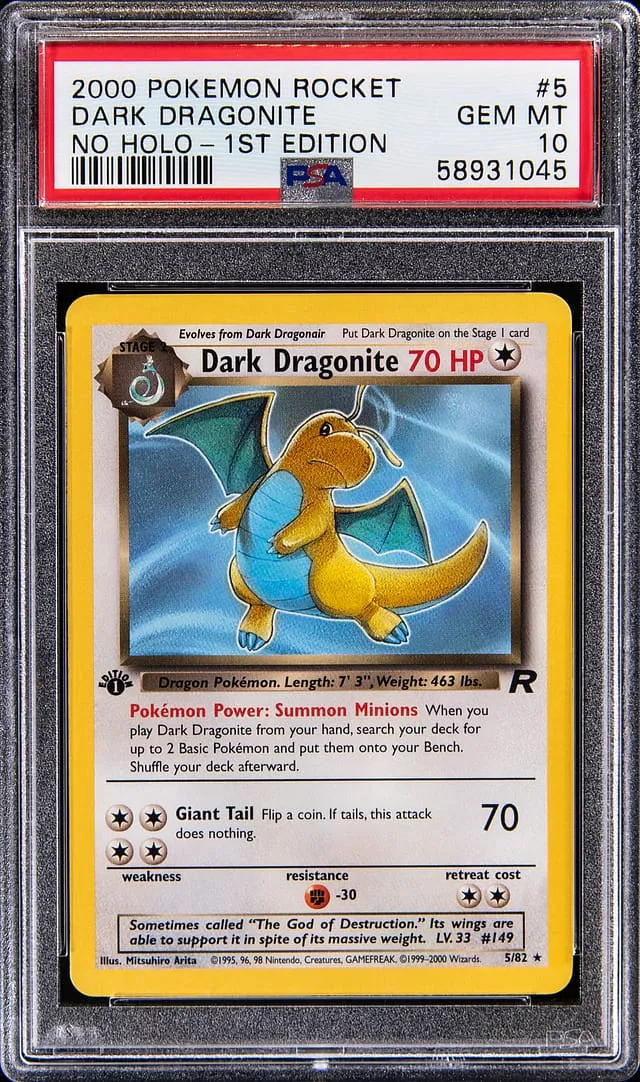
PSA 10 No Holo Dark Dragonite Sells for $73K
Goldin sold a 2000 Pokémon Rocket 1st Edition No Holo Error Dark Dragonite PSA 10 for $73,200. See how this key WOTC error fits into today’s market.
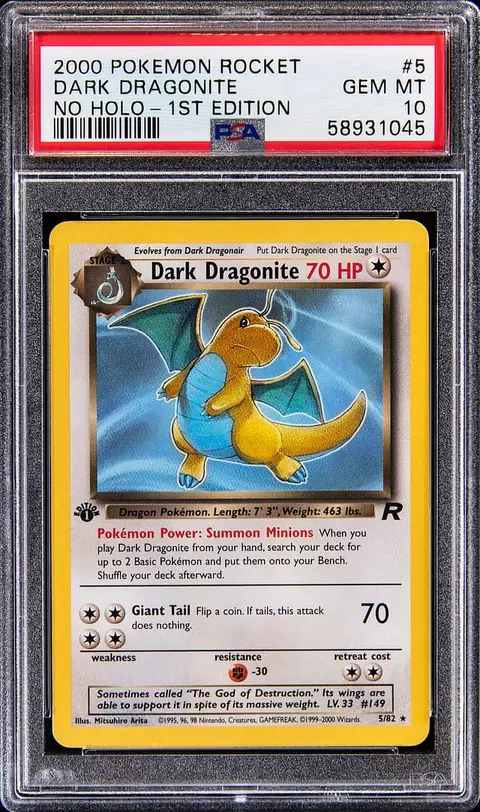
Sold Card
2000 Pokemon Rocket 1st Edition No Holo Error #5 Dark Dragonite - PSA GEM MT 10
Sale Price
Platform
Goldin2000 Pokémon Team Rocket 1st Edition “No Holo” Dark Dragonite PSA 10 Sells for $73,200
On March 30, 2026, Goldin auctioned a cornerstone error card from the WOTC (Wizards of the Coast) era: a 2000 Pokémon Rocket 1st Edition No Holo Error #5 Dark Dragonite graded PSA GEM MT 10. The final price landed at $73,200.
For collectors who follow early Pokémon rarities and error cards, this is a meaningful result that helps frame where one of the hobby’s most talked‑about misprints currently sits in the market.
Card overview: what exactly sold?
Let’s break down the basics of this card:
- Year & set: 2000 Pokémon Team Rocket (English)
- Card: Dark Dragonite
- Card number: #5
- Edition: 1st Edition
- Error type: “No Holo” Error – the card carries the holo card number (#5) but is printed on non‑holo cardstock
- Character: Dragonite (Dark Dragonite variant)
- Grading company: PSA (Professional Sports Authenticator)
- Grade: GEM MT 10 (PSA 10), PSA’s highest standard grade
- Attributes: Not a serial‑numbered card or auto; its appeal is driven by the error status, early‑era timing, and condition rarity
Dark Dragonite itself is not a rookie card in the traditional sports sense, but within the Pokémon TCG it is a key character card from the Team Rocket expansion, and this error version has long been treated as a specialty “chase” for advanced WOTC collectors.
What is the “No Holo Dark Dragonite” error?
In the 2000 Team Rocket set, Dark Dragonite appears in two forms:
- Holo Dark Dragonite – card #5 in the set
- Non‑Holo Dark Dragonite – card #22 in the set
The so‑called No Holo Error Dark Dragonite combines the two:
- It is printed without the holographic foil layer
- But it carries the holo card number #5 at the bottom
The commonly accepted explanation in the hobby is that a portion of non‑holo sheets were printed using the holo numbering, resulting in this misprint. While exact production numbers are unknown, the card is widely viewed as a true error rather than a deliberate variant, and it has been tracked and pursued for over two decades.
Market context and recent sales
This Goldin result at $73,200 is best understood by looking at:
- Sales of this exact error in different grades
- Sales of regular Dark Dragonite in high grade as a baseline
Error Dark Dragonite vs. regular versions
The standard 1st Edition Dark Dragonite (both holo #5 and non‑holo #22) appears regularly on major marketplaces in PSA 9 and PSA 10. Those prices, while strong for a WOTC holo, sit far below the No Holo Error. Collectors distinguish the error as a separate lane entirely:
- Regular Dark Dragonite 1st Edition PSA 10 (holo #5) tends to sell in the low‑to‑mid four‑figure range depending on timing and auction venue.
- The No Holo Error trades much more infrequently, and primarily through higher‑end auction houses or private deals.
Error Dark Dragonite PSA pop and scarcity
When collectors talk about a “pop report”, they mean the population report: the grading company’s count of how many copies of a specific card and grade exist in their database.
The No Holo Error Dark Dragonite has a much lower PSA population than the regular holo, especially at the top grade of PSA 10. That population scarcity in GEM MT is a major reason this card commands such a large premium over standard Dark Dragonite.
While exact population counts can change as new copies are graded, the basic shape of the landscape is consistent: PSA 10 copies are genuinely rare, and even PSA 9 examples are not commonly seen for auction.
How this $73,200 sale fits into the broader picture
Looking across recent years:
- The Pokémon high‑end error and rarity market saw an aggressive run‑up during the 2020–2021 boom, followed by a normalization period.
- Big‑ticket WOTC rarities—trophy cards, 1st Edition holos in PSA 10, and recognized errors—have generally held better than most modern chase cards, though prices can be volatile.
Within that context, this Goldin sale:
- Confirms that top‑grade No Holo Dark Dragonite remains in the mid‑five‑figure to low‑six‑figure conversation.
- Shows ongoing willingness from established collectors to pay a premium for PSA 10 examples through major auction houses.
Compared to earlier peaks in the Pokémon boom, this price level sits in a range that looks more consistent and data‑driven than purely speculative. It reflects the card’s long‑standing status and the thin supply of GEM MT copies rather than short‑term hype.
Why collectors care about this card
Several factors combine to make this card a target for advanced collectors:
1. WOTC era heritage
The Wizards of the Coast era (1999–2003) is broadly viewed as Pokémon’s golden age for nostalgia and long‑term collecting. Team Rocket, released in 2000, was the third English expansion after Base Set and Jungle/Fossil, and introduced the Dark Pokémon theme.
Dark Dragonite from Team Rocket has:
- Strong character appeal (Dragonite is a fan favorite from the original games and anime)
- Early‑era artwork and design that many collectors grew up with
When you combine an iconic character with a well‑known WOTC set, you already have a solid foundation of demand.
2. Recognized and longstanding error
Not all misprints are treated equally. Many printing quirks are one‑offs or poorly documented. In contrast, the No Holo Dark Dragonite has been:
- Known and discussed in the hobby for years
- Cataloged on major resources and checklists
- Tracked by serious Team Rocket and WOTC error collectors
That long‑term recognition matters. It separates this card from casual print anomalies and helps support a more stable collector base.
3. Condition scarcity at PSA 10
WOTC‑era cards were often played, shuffled, and stored without sleeves, especially around 1999–2001. For a card to reach PSA GEM MT 10, it generally needs:
- Clean corners and edges
- Centering within tight tolerances
- A surface free from print lines, scratches, or factory defects
For a scarce error card like this, the funnel narrows quickly—there may be a meaningful number of raw copies in binders and collections, but far fewer that meet PSA 10 standards. That scarcity underpins the price spread between GEM MT 10, lower grades, and raw copies.
4. Set‑building and niche collecting lanes
There are several overlapping collector groups this card appeals to:
- Team Rocket set builders who want every major variant and error
- Dragonite character collectors focused on high‑end versions of their favorite Pokémon
- Error card specialists who focus on production anomalies with good documentation
When multiple collector lanes converge on a low‑population card, bidding can be competitive, and individual auction outcomes can swing based on who shows up on a given night.
What this sale tells us about the current market
The Goldin result on March 30, 2026 doesn’t rewrite the Pokémon market, but it does offer a few useful signals:
- Top‑end WOTC errors are still well‑bid – Despite volatility in many segments of the hobby, long‑recognized WOTC rarities like this continue to command strong prices.
- Auction venue matters – Selling through a major auction house such as Goldin often exposes premium cards to a wider pool of serious bidders than a standard fixed‑price listing.
- Thin supply means prices can move on small sample sizes – Error cards with very low populations don’t trade often. Each auction becomes an important data point, but it’s still just one sample in a small data set.
For collectors using this sale as a reference point, it’s helpful to look at:
- Other recent sales of the No Holo Dark Dragonite across different grades
- Price trends for comparable WOTC errors and rare variants
- The relative premium this error carries over a standard 1st Edition Dark Dragonite in the same grade
Takeaways for collectors and small sellers
If you collect or sell early Pokémon, this sale underlines a few practical points:
- Documentation matters: Longstanding recognition, community documentation, and clear error status help separate key errors from minor misprints.
- Condition is king: For rare variants, the difference between PSA 9 and PSA 10 can be substantial, especially when population counts at the top grade are low.
- Use multiple comps where possible: In a thin market, don’t rely on a single sale. Look at a cluster of recent results and adjacent cards (same set, same character, or similar error types).
This Goldin sale from March 30, 2026 reinforces the position of the 2000 Pokémon Rocket 1st Edition No Holo Error #5 Dark Dragonite in PSA GEM MT 10 as one of the more notable early‑era Pokémon errors, sitting in a price range that reflects both its WOTC heritage and its true scarcity at the top grade.
As always, each collector’s approach will differ. Some will pursue the error as a centerpiece, others will be content with a standard holo Dark Dragonite. Either way, this auction gives everyone one more clear data point on how the market currently values one of Team Rocket’s most talked‑about cards.