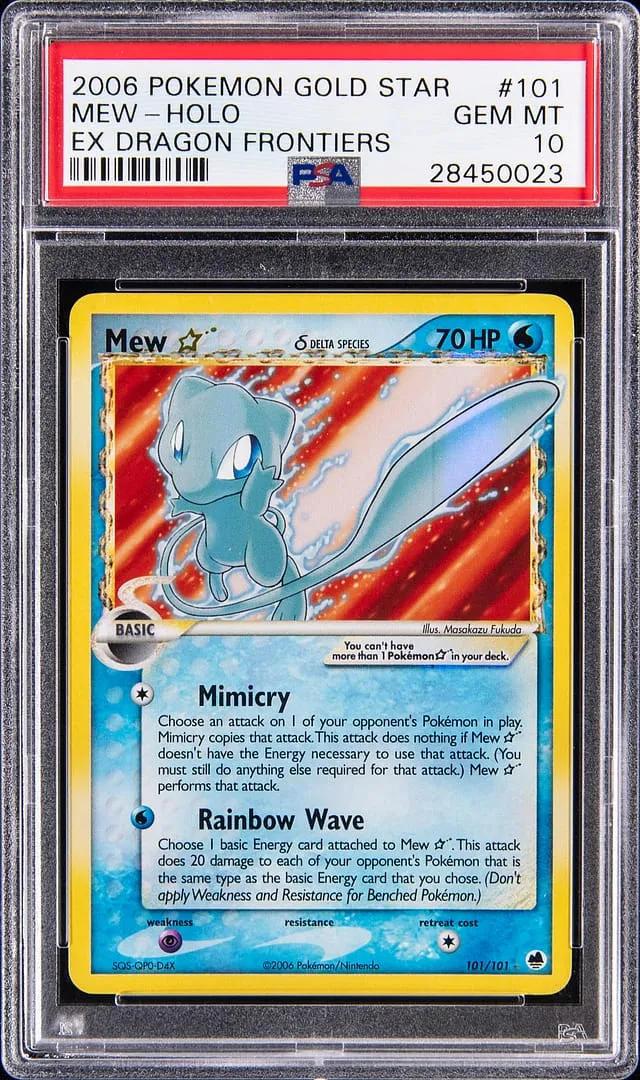
PSA 10 Gold Star Mew Sale: 2006 EX Dragon Frontiers
A PSA 10 Gold Star Mew from 2006 EX Dragon Frontiers sold for $866,200 at Goldin on April 20, 2026. Here’s what that means for Pokémon collectors.
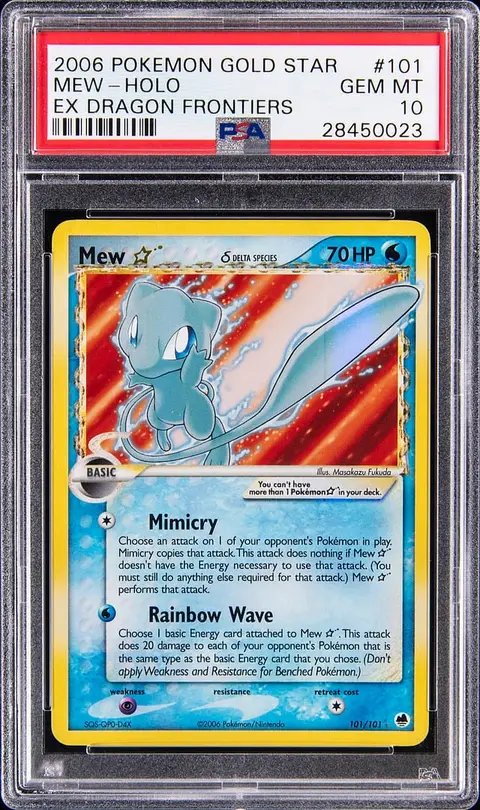
Sold Card
2006 Pokemon EX Dragon Frontiers Gold Star Holo #101 Mew - PSA GEM MT 10
Sale Price
Platform
GoldinA PSA 10 Gold Star Mew Steps Into the Spotlight: 2006 EX Dragon Frontiers Record Context
On April 20, 2026, a copy of 2006 Pokémon EX Dragon Frontiers Gold Star Holo #101 Mew graded PSA GEM MT 10 sold at Goldin for $866,200. For a modern-era Pokémon chase card, this is an eye‑catching result and an important data point for anyone tracking the high end of the non‑sport market.
Below, we’ll unpack what this card is, why collectors care, how this sale fits into recent price history, and what it might mean in the broader context of Gold Star cards.
Card overview: 2006 EX Dragon Frontiers Gold Star Mew #101
Let’s start by breaking down the basics of the card itself:
- Character: Mew (classic Mythical Pokémon, a long‑time hobby favorite)
- Year: 2006
- Set: EX Dragon Frontiers (Nintendo / Pokémon TCG, EX era)
- Card: Mew ☆ (Gold Star), Holo, #101/101
- Variant: Gold Star – the ultra‑rare tier in the EX era, featuring the gold star next to the Pokémon’s name
- Language: English
- Era: Mid‑2000s "EX" era Pokémon
- Grading company: PSA (Professional Sports Authenticator)
- Grade: GEM MT 10 (PSA’s highest standard grade for pack‑pulled cards)
- Special attributes:
- Gold Star rarity (significantly tougher pulls than typical holos)
- Final card in the set (#101/101)
- Non‑rookie but a key chase card for both Mew and Gold Star collectors
This is not a rookie card in the traditional sports sense, but it is widely viewed as a key issue for collectors who focus on:
- The Gold Star run across the EX era
- Mew as a character
- 2000s Nintendo‑era packs and booster boxes
Why EX Dragon Frontiers Gold Star Mew matters to collectors
To understand the significance of this sale, it helps to remember what Gold Star cards represented in the mid‑2000s.
Gold Star cards in the EX era
Gold Stars were introduced in the EX series as ultra‑tough chase cards. Pull rates were roughly on the order of one per several booster boxes rather than one per box, depending on the set and anecdotal data. This put them in a very different tier of scarcity compared with regular holos or even many EX cards of the time.
Key factors that matter to collectors:
- Extremely low pull rates compared to most modern chase cards.
- Distinctive design: the gold star symbol and shiny/alternate‑color artwork in many cases.
- Limited sealed product left: mid‑2000s boxes are expensive and heavily broken by now.
EX Dragon Frontiers as a set
EX Dragon Frontiers is a 2006 set known for:
- Delta Species mechanics (off‑type Pokémon with unusual typings).
- A compact but very desirable Gold Star checklist (including the big chase, Charizard ☆).
- Being one of the more heavily targeted sets by EX‑era collectors, which puts a spotlight on its Gold Stars.
Within that context, Mew Gold Star has become a key non‑Charizard chase:
- Mew has cross‑generation appeal: early‑game lore, nostalgia from the first movie and Game Boy era, and continued relevance.
- The artwork and final‑card‑in‑set positioning (#101/101) reinforce its status as a set milestone.
Population and grading context
In any high‑end discussion, collectors tend to check the “pop report” – short for population report, which is the grading company’s public data showing how many copies of a card exist in each grade.
While exact numbers change as more cards are graded, EX‑era Gold Stars in PSA 10 are generally:
- Scarce relative to both lower grades and to most modern ultra‑modern chase cards.
- Constrained by both condition sensitivity (print quality, edgewear, holo scratching) and the limited original print run.
For Mew Gold Star specifically, PSA 10 is firmly in the top tier of scarcity for the card. The combination of:
- an older, low‑pull‑rate chase card,
- strong character demand,
- and a thin PSA 10 population
makes each gem‑mint copy significant when it hits the market.
Recent sales and price context
In market discussions, collectors often refer to “comps” – comparable sales, usually recent auction or marketplace results that provide a rough sense of current pricing.
For this card in particular, the sales that matter most are:
- PSA 10 Mew Gold Star from EX Dragon Frontiers
- Other high‑grade Gold Stars from the same era (especially marquee characters)
Publicly reported sales over the last few years have shown:
- A wide spread between grades (PSA 8 vs 9 vs 10) due to population differences.
- A clear premium for PSA 10, with relatively few copies trading each year.
- Occasional standout results when a particularly strong copy appears at a major auction house.
Against that backdrop, the $866,200 result at Goldin on April 20, 2026, sits at the extreme high end of the known range for this card and firmly in “marquee” territory for EX‑era Pokémon. It reflects:
- How thin the market is at the very top of the pop.
- The premium that some collectors are willing to pay for a true grail‑tier Gold Star in PSA 10.
Because the market for a card like this is so thin – meaning very few buyers and very few sellers at this level – each sale can move the perceived range noticeably. One or two strong bids can make a large difference in the final number.
Factors that may be influencing demand
Rather than pin the result on any single cause, it’s more useful to look at the combination of drivers that often show up in sales like this:
Character demand Mew remains a top‑tier character with:
- Deep nostalgia from early video games and media.
- Continued presence in modern sets and promotional material.
- Cross‑appeal between older and newer collectors.
Era and scarcity The EX era occupies a middle ground:
- New enough that sealed product was widely available at the time.
- Old enough that much of that product has been opened, and condition‑sensitive high grades are scarce.
Gold Star focus Many dedicated EX and mid‑2000s collectors specifically build “Gold Star runs,” where they try to own every Gold Star in a consistent grade. That structural demand supports prices for key cards like Mew.
Auction venue and timing Goldin has become one of the go‑to auction houses for high‑end cards. When a trophy‑level piece appears in a major catalog with global exposure, the competition between advanced collectors can push results above quieter private‑sale levels.
As always, none of these elements guarantee future performance; they just help explain why a particular auction might end where it did.
How this sale fits into the broader Pokémon market
This Goldin result is noteworthy beyond just one card:
- It reinforces the idea that EX‑era Gold Stars have matured into a distinct "blue‑chip" segment of the Pokémon market, separate from both vintage WotC (Wizards of the Coast) and ultra‑modern special sets.
- It highlights how character selection matters. Non‑Charizard cards at this price level are still relatively rare, so a Mew Gold Star clearing this number is a data point for character diversification at the high end.
- It shows that PSA 10 scarcity still commands a significant premium when the population is low and demand is established.
For collectors returning to the hobby, this can be a useful reminder:
- The 2000s era is no longer “new.” Many of its top chase cards are now 20 years old, with real supply constraints.
- Condition and grading tier matter more than ever when the total pop in PSA 10 is small and the card is widely known.
What collectors and small sellers can take away
For collectors:
- If you are building a Gold Star run, this sale underscores how competitive the top grade can be for iconic characters.
- Lower grades can still offer the same artwork and set history at a fraction of the price; the gap between PSA 9 and PSA 10 in this era is often very large.
- Population reports and a look at past sales history are critical tools when deciding how to prioritize a card.
For small sellers and hobbyists:
- High‑end results like this can increase attention on related cards – for example, PSA 8–9 copies of the same card or other Gold Stars from EX Dragon Frontiers.
- At the same time, one strong auction does not automatically reset the entire market. It’s helpful to look at a range of comps over time, not just a single headline.
Final thoughts
The 2006 Pokémon EX Dragon Frontiers Gold Star Holo #101 Mew in PSA GEM MT 10 that sold for $866,200 at Goldin on April 20, 2026, is a clear milestone for EX‑era Pokémon. It reflects deep demand for Gold Stars, sustained interest in Mew as a character, and the scarcity of truly top‑end copies.
For anyone tracking the evolution of the Pokémon TCG market, this sale is less about short‑term speculation and more about how a small group of historically important cards continues to separate itself from the broader field.
As always, this information is best used as context rather than prediction: a snapshot of what one determined buyer and the market were willing to do for a gem‑mint Gold Star Mew on a particular night at Goldin.