Peyton Manning 1998 Contenders Rookie Auto PSA 9 Sale
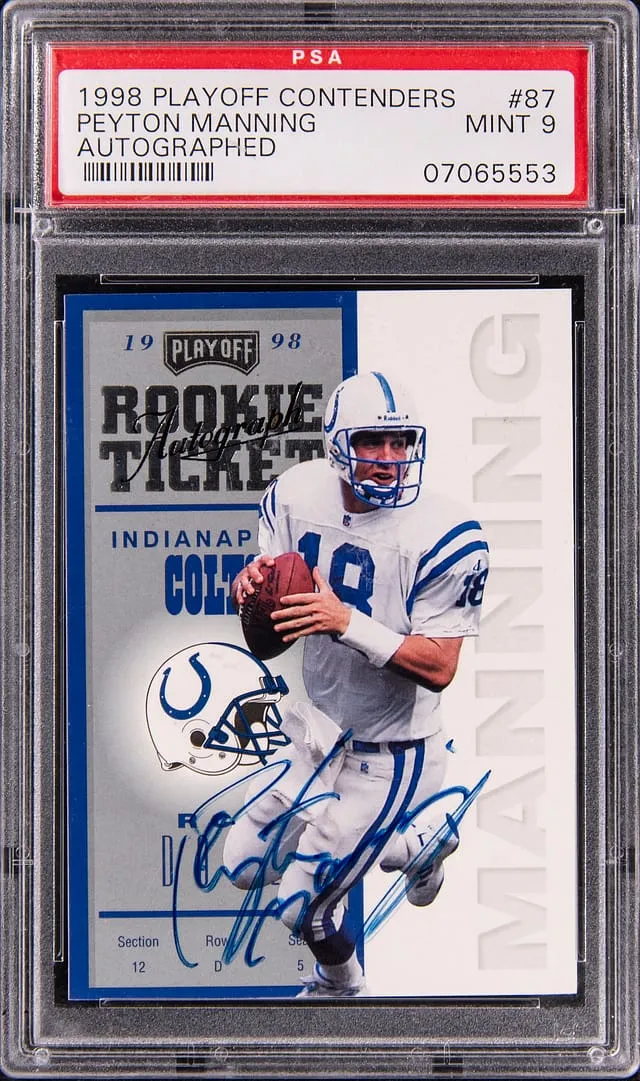
Goldin sold a 1998 Playoff Contenders Peyton Manning Rookie Ticket Auto PSA 9 (/200) for $26,907 on March 15, 2026. Here’s what it means for collectors.
Sold Card
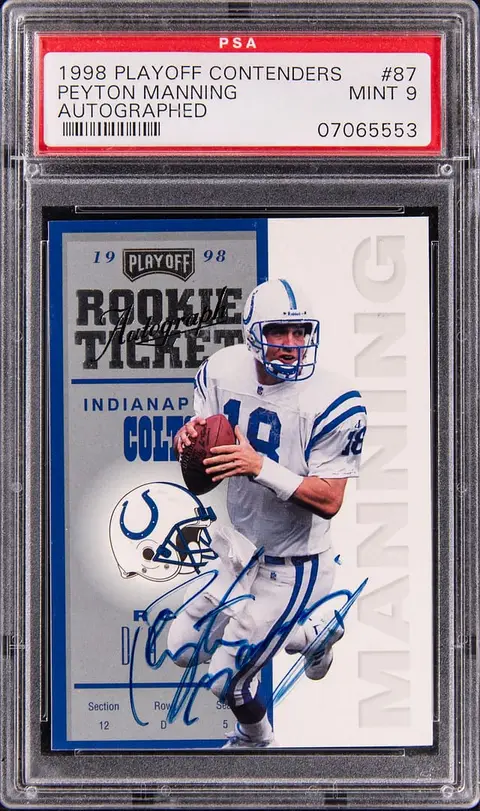
1998 Playoff Contenders Rookie Ticket Autograph #87 Peyton Manning Signed Rookie Card (/200) - PSA MINT 9
Sale Price
Platform
Goldin1998 Playoff Contenders Rookie Ticket Autograph #87 Peyton Manning Signed Rookie Card (/200) - PSA MINT 9 Sold for $26,907
On March 15, 2026, Goldin sold a 1998 Playoff Contenders Rookie Ticket Autograph #87 Peyton Manning rookie card, serial-numbered to 200 and graded PSA MINT 9, for $26,907. For many football collectors, this is one of the defining modern QB rookie cards, and this sale offers a useful data point for anyone tracking high-end Peyton Manning or 1990s football in general.
Card overview
Let’s break down exactly what this card is:
- Player: Peyton Manning (Indianapolis Colts)
- Year: 1998
- Set: Playoff Contenders
- Card: Rookie Ticket Autograph #87
- Serial numbering: Limited to 200 copies (/200)
- Type: True on-card rookie autograph (generally treated as a key, flagship-style rookie for Manning)
- Autograph: On-card (signed directly on the card, not on a sticker)
- Grading company: PSA (Professional Sports Authenticator)
- Grade: PSA MINT 9
For Peyton Manning collectors, the 1998 Contenders Rookie Ticket Auto is widely viewed as his key premium rookie. While he has other notable rookies from 1998 (Topps Chrome, SP Authentic, etc.), Contenders is often mentioned in the same breath as the iconic 2000 Contenders Tom Brady Rookie Ticket Auto for its place in the modern football hierarchy.
Why this card matters to collectors
A few reasons this specific card commands attention:
It’s the premium rookie autograph.
Among Manning’s rookies, the Contenders Rookie Ticket Auto is one of the most chased. It combines a recognized brand, an on-card signature, and a clearly defined print run.Low serial numbering (/200).
In hobby shorthand, “/200” means there are only 200 copies produced. For a Hall of Fame quarterback with a large collector base, that’s a genuinely limited supply.On-card autograph.
“On-card” means Manning signed directly on the card surface. Collectors often prefer this over “sticker autos,” where the signature is on a clear sticker applied to the card.PSA MINT 9 condition.
A PSA 9 is a high grade from PSA, one of the main third‑party grading companies. High-grade copies of late-1990s foil or condition-sensitive cards can be tough, and many long-term collectors specifically target PSA 9 or 10.Historical significance.
Peyton Manning is a first-ballot Hall of Famer, two-time Super Bowl champion, and one of the key quarterbacks of the late 1990s/2000s era. His true rookie auto from a respected set plays a similar role in football that the best flagship rookies do for all-time greats in other sports.
Context within 1990s and modern football cards
This card sits at an interesting intersection of eras:
- Era: Late 1990s, sometimes called early modern football. This period began to move away from true “junk wax” overproduction toward more limited, serial-numbered, and autograph-driven products.
- Set reputation: Playoff Contenders built a strong reputation for Rookie Ticket autographs, especially for quarterbacks. When collectors talk about “grail” Contenders cards, they often start with Brady (2000) and Manning (1998).
- Condition challenges: Cards from this era frequently have edge and corner chipping, particularly on darker or foil-heavy designs. That can make strong PSA 9 and especially PSA 10 copies noticeably scarcer than the raw print run would suggest.
Market context and price positioning
This Goldin sale closed at $26,907 on March 15, 2026.
When hobbyists talk about “comps,” they mean comparable recent sales of the same card or very similar ones—often in the same grade or a grade up/down. For a card like this, relevant comps usually include:
- The same 1998 Contenders Rookie Ticket Auto #87 Peyton Manning in different PSA grades (8, 9, 10)
- BGS-graded copies (for example BGS 9, 9.5 with various subgrades)
- Occasionally, parallel versions or related high-end Manning rookies used as a rough benchmark
Across major public marketplaces and auction houses, high-end Manning rookie autos tend to show:
- Clear premium for strong grades. PSA 9 and equivalent BGS 9/9.5 commands a noticeable step up over mid-grade copies.
- Even larger gap to gem-mint. For many key football rookies, the jump from a PSA 9 to a PSA 10 (if any exist) can be substantial, since true gem copies of late-1990s autographs are not common.
Within that general pattern, a PSA 9 at $26,907 fits into the established idea that:
- The Contenders Rookie Ticket Auto is Manning’s central high-end rookie.
- Collectors continue to assign real value to low-serial, on-card, Hall of Famer rookie autos from the 1990s.
Without relying on any single outlier sale, the price level here is consistent with the long-term perception of the card as a blue-chip Manning piece rather than a short-term speculative play.
PSA grading and population perspective
The “pop report” (population report) is the grading company’s public record of how many copies of a given card they’ve graded at each grade (e.g., how many PSA 8, PSA 9, PSA 10). While exact day‑to‑day numbers can change as more cards are submitted, the pattern for this card generally shows:
- A modest total population compared to mass‑produced base rookies
- A concentration of grades in the 8–9 range
- Very few true gem-mint examples
That combination—limited print run plus a population skewed toward strong but not perfect grades—is typical of sensitive late-1990s autograph cards and supports a premium for well-centered, well-presenting PSA 9 copies.
Why this sale matters right now
A few broader factors give context to this March 15, 2026 Goldin result:
- Stable Hall of Fame profile. Manning’s playing career is complete, and his Hall of Fame status is secure. That tends to reduce the kind of performance volatility that can affect active players’ cards.
- Renewed attention to established QBs. In periods when the hobby cools slightly on speculative modern rookies, interest often rotates back to proven legends like Manning, Brady, and other multi-time MVPs.
- Contenders brand continuity. New Rookie Ticket autographs are still produced today. That keeps the brand name in front of newer collectors and, in turn, draws some of them back to key historical Rookie Tickets like this one.
Rather than signaling a dramatic new direction on its own, this sale fits into a longer pattern: consistent demand for cornerstone Hall of Fame rookie autos in limited supply and high grade.
Takeaways for different types of collectors
For newcomers and returning collectors:
This card is a clear example of how the hobby values:
- Hall of Fame résumés
- True rookie autographs
- Low print runs
- Trusted third‑party grading
If you’re just learning the market, studying sales like this helps you understand why some cards from the same year and player are worth far more than others.
For active hobbyists and small sellers:
A PSA 9 Contenders Rookie Ticket Auto at $26,907 reinforces a few working assumptions:
- High‑end, on‑card rookie autos of all‑time great QBs tend to hold collector interest across market cycles.
- Condition, brand, and serial numbering all matter—buyers differentiate sharply between base rookies and premium issues like this.
- Auction-house visibility (in this case, Goldin on March 15, 2026) can help surface top-tier buyers for the more iconic pieces.
As always, individual purchase or selling decisions come down to personal goals, risk tolerance, and collecting focus, but this sale offers a clean, well-documented reference point for Peyton Manning’s top-tier rookie market.
Final thoughts
The 1998 Playoff Contenders Rookie Ticket Autograph #87 Peyton Manning (/200) in PSA MINT 9 sits near the top of modern football collecting. The March 15, 2026 sale at Goldin for $26,907 doesn’t create a new narrative so much as it confirms an existing one: limited, on-card rookie autographs of Hall of Fame quarterbacks remain central to how many collectors define the modern football card landscape.
For anyone building a Peyton Manning run or studying how key rookie issues are valued, this is a sale worth bookmarking in your personal price history notes.