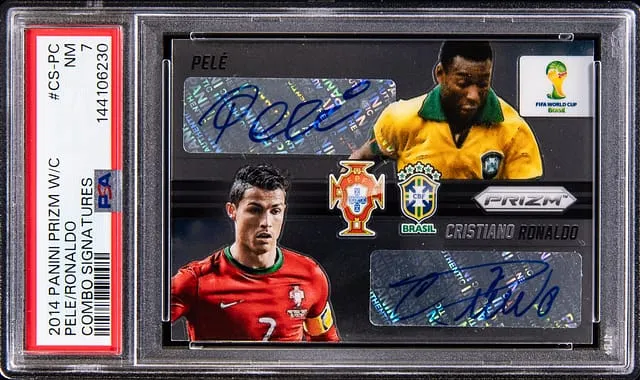
Pelé/Ronaldo 2014 Prizm Dual Auto Sells for $19.5K
Deep dive on the 2014 Panini Prizm World Cup Pelé/Cristiano Ronaldo dual auto /10 that sold for $19,521 at Goldin on May 10, 2026.
Sold Card
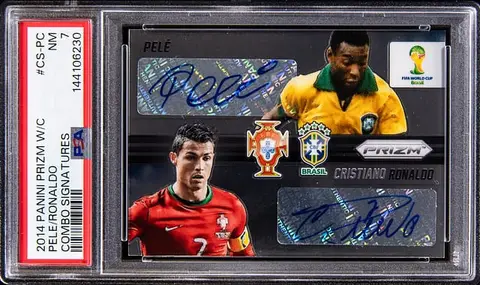
2014 Panini Prizm World Cup Combo Signatures #CS-PC Pele/Cristiano Ronaldo Dual-Signed Card (#07/10) - Ronaldo's Jersey Number - PSA NM 7 - Pop 2
Sale Price
Platform
Goldin2014 Prizm Pele/Ronaldo Dual Auto Sells for $19,521 at Goldin
On May 10, 2026, Goldin closed a notable modern football (soccer) auction: a 2014 Panini Prizm World Cup Combo Signatures #CS‑PC dual‑signed card featuring Pelé and Cristiano Ronaldo, serial numbered 07/10, graded PSA NM 7. The card realized $19,521.
For collectors who track high‑end football cards, this sale is a useful data point in understanding how dual‑autograph legends are being valued in today’s market.
The card at a glance
- Set: 2014 Panini Prizm World Cup
- Subset: Combo Signatures
- Card number: #CS‑PC
- Players: Pelé (Brazil) / Cristiano Ronaldo (Portugal)
- Autographs: Dual on‑card autos (both signed on the card itself)
- Serial numbering: Hand‑numbered 07/10
- Special note: 07 matches Cristiano Ronaldo’s iconic jersey number
- Grading company: PSA
- Grade: PSA 7 (NM – Near Mint)
- Population: Pop 2 in PSA 7 at the time of sale
This is not a rookie card for either player, but it is considered a key issue because it pairs two of the most important names in global football on a single, low‑print, on‑card autograph from a landmark World Cup release.
Why 2014 Prizm World Cup matters
2014 Panini Prizm World Cup is widely viewed as:
- The flagship chromium World Cup set of the modern era.
- A foundational product for ultra‑modern football collecting, similar to what Topps Chrome and Prizm did earlier for basketball.
- A set that introduced many collectors in North America to high‑end World Cup cards and parallels.
Within this release, Combo Signatures cards are among the most chased inserts because they feature two elite players signing on the same card, usually in very low print runs.
Pairing Pelé and Cristiano Ronaldo gives this card cross‑era appeal:
- Pelé – The defining global football icon of the 20th century, three‑time World Cup winner.
- Cristiano Ronaldo – One of the most productive forwards in history, multiple Ballon d’Ors, Champions League titles, and global fan base.
That combination, on a chromium World Cup card numbered to just 10 copies, is what drives collector attention.
Attributes that make this copy stand out
Several details of this particular example are worth noting:
Serial number 07/10
Card numbering doesn’t always move markets, but in football, jersey‑numbered copies often get extra attention. Cristiano Ronaldo’s association with the number 7 is deeply ingrained in his brand (CR7). Jersey‑numbered cards can be treated as the “headline” or “marquee” copy within a short print run.Dual on‑card autographs
The autographs are signed directly on the card (as opposed to signed stickers that are later applied). For many collectors, on‑card autos feel more “premium” and personal, especially on dual‑signed cards.Low serial number (only 10 copies)
A /10 print run in a globally collected sport like football means that even long‑term completionist collectors may never see this card surface in any grade.PSA 7 (Near Mint) with Pop 2
A population report, or “pop report,” shows how many copies of a card have been graded at each grade level by a grading company. This example is Pop 2 in PSA 7. For ultra‑low print cards, pop reports are usually thin across all grades, which can make exact grade‑to‑grade comparisons tricky.
Market context: what does $19,521 mean?
This Goldin result at $19,521 sits within a maturing segment of the football card market: ultra‑modern, low‑serial, dual‑autograph legends.
Because only 10 copies of this card exist, public sales are naturally limited. Recent comps (short for “comparables,” meaning similar recent sales used for context) for this exact card and parallel can be sparse or lumpy over time.
When looking at this sale, collectors tend to consider:
- Relative rarity – 10 copies globally, split across multiple grading companies and raw (ungraded) examples.
- Grade tolerance – For thick or autograph cards from 2014, surface and corner issues are common. Collectors focused on rare autos sometimes accept PSA 7–8 grades more easily than they would on mass‑printed base cards.
- Player combination – Dual autos with two legends typically command a premium over comparable single‑player autos, but they also attract a more specific buyer pool.
While exact historical records for this specific card in this specific grade may be limited, the price level places it alongside other important 2014 Prizm World Cup inserts and high‑end Pelé or Ronaldo issues, particularly where:
- Print runs are /10 or lower;
- Autographs are on‑card;
- The design features World Cup iconography rather than club kits.
In that broader lane, $19,521 is consistent with a card that sits near the top end of modern legend‑focused World Cup content without approaching the very highest tiers typically reserved for true rookies or 1/1 (one‑of‑one) cards.
How this compares to related cards
When comps for the exact card are scarce, collectors typically reference:
- Other 2014 Prizm World Cup autographs of Pelé and Ronaldo separately, especially low‑serial parallels.
- Dual autos of Pelé combined with other top names from different sets and years.
- High‑grade, low‑print World Cup‑focused Ronaldo autographs from the 2010s.
In many of those categories, prices have stabilized from the sharp peaks of earlier boom periods and are now shaped more by:
- Specific player combinations,
- Serial numbering,
- On‑card vs sticker autos,
- And whether a card captures World Cup imagery.
Within that framework, this Goldin sale reinforces that:
- Dual‑legend autos anchored in 2014 Prizm World Cup still command significant attention.
- Jersey‑numbered copies can act as a tiebreaker when collectors prioritize one specific serial number.
Collector significance
A card like this tends to appeal to several collecting approaches:
Pelé specialists
For Pelé‑focused collectors, dual autos that pair him with all‑time greats are often treated as “showcase” pieces. 2014 Prizm World Cup is also late‑career for Pelé, so the card reads more like a tribute than an early career issue.Cristiano Ronaldo / CR7 collectors
The 07/10 serial number aligns directly with Ronaldo’s CR7 identity, which can be enough to make this specific copy more appealing than other serials in the same run.World Cup and national team collectors
The card brings together Brazil and Portugal under the World Cup banner. For collectors who organize around international football rather than club football, this is one of the more recognizable dual autos of the era.Set builders and high‑end Prizm collectors
Some hobbyists chase big cards purely because they represent key moments in card‑making history. 2014 Prizm World Cup occupies that role for modern soccer in a way that is comparable to first‑generation chrome sets in other sports.
Factors that may be influencing demand
A few broader trends provide context for this sale:
- Global interest in football cards has become more consistent, with less reliance on short‑term hype around specific tournaments.
- Pelé’s legacy remains firmly established in the hobby; his signature is viewed as historically important, particularly on cards that connect to the World Cup.
- Cristiano Ronaldo’s late‑career milestones, continued international play, and massive global following help keep sustained demand for his premium cards, even as his club situation evolves.
None of these factors guarantee future prices; they simply help explain why a dual‑signed, low‑print World Cup card featuring both players continues to find strong bidders at major auctions.
Takeaways for collectors
If you’re tracking this segment of the market, this Goldin sale on May 10, 2026 suggests a few practical observations:
- Ultra‑low print World Cup legend autos remain a focused, but deep, niche. There may not be constant turnover in comps, but when they surface at major houses, they usually find informed buyers.
- Card details matter. On‑card autos, the 07/10 serial number, and the 2014 Prizm World Cup brand all contribute to this specific result.
- Grade is only one part of the equation. For rare dual autos, collectors often prioritize autograph quality, imagery, and numbering as much as the numerical grade.
For anyone building a long‑term football collection, this sale is another reminder that 2014 Prizm World Cup continues to serve as a reference point for how modern, premium World Cup cards are valued.
As always, these observations are about understanding the current market landscape and hobby context, not predicting what comes next. For figoca users and researchers, cataloging sales like this helps build a clearer picture of how iconic football cards evolve over time.