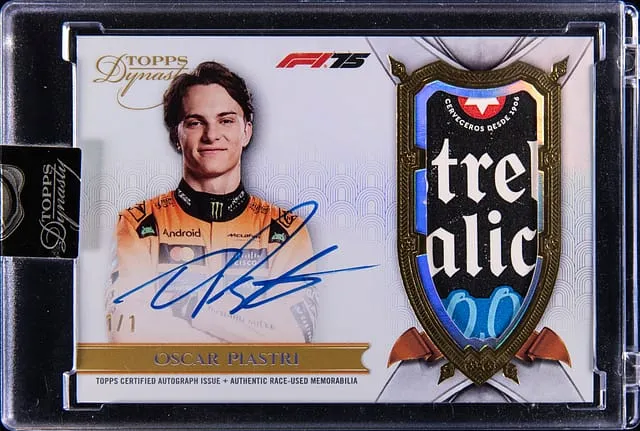
Oscar Piastri 2025 Topps Dynasty F1 1/1 Gold Sale
A data-focused look at the $19,780 Goldin sale of the 2025 Topps Dynasty F1 Oscar Piastri Autographed Patch Gold 1/1.
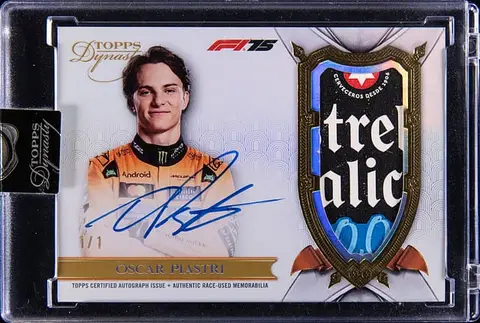
Sold Card
2025 Topps Dynasty F1 Autographed Patch Gold #DAP-OPIVII Oscar Piastri Signed, Race-Used Patch Card (#1/1) - Topps Encased
Sale Price
Platform
GoldinThe ultra-premium side of modern F1 cardboard just logged another notable result: a 2025 Topps Dynasty F1 Autographed Patch Gold #DAP-OPIVII Oscar Piastri, featuring an on-card autograph and race-used patch, numbered 1/1 and sealed in the original Topps case, sold at Goldin on March 20, 2026 for $19,780.
This card is officially titled:
- Year / Product: 2025 Topps Dynasty Formula 1
- Card: Autographed Patch Gold #DAP-OPIVII
- Player: Oscar Piastri (McLaren)
- Features: On-card signature, multi-color race-used patch, serial-numbered 1/1, Topps factory-encased
- Grading: None noted; this is raw but sealed in the original Topps holder
Dynasty is Topps’ top-tier F1 line, with every card being a premium hit: thick stock, autograph, and usually a piece of race-used material. Gold parallels and 1/1s sit at the high end of that pyramid. For many collectors, a Dynasty 1/1 autograph patch is closer to a centerpiece than an add-on to a PC.
Where this card sits in the Piastri hierarchy
Oscar Piastri’s key early cards appear in the 2022–2023 F1 products, particularly in Topps Chrome F1 and flagship Topps sets where his first widely recognized “rookie” and early issues live. By 2025, we’re past his first-appearance phase and into what many collectors see as core “prime career” high-end cards.
Within that ecosystem:
- Topps Dynasty is the premium lane. Think of it as the brand where collectors chase cornerstone pieces: patch autos, team logo swatches, and 1/1s.
- Gold parallel 1/1: In a typical Dynasty run, each driver will have a handful of different image/patch layouts, often with parallel tiers (for example /10, /5, and 1/1). The Gold 1/1 is one of those true single-copy cards.
- On-card autograph: Piastri signed directly on the card surface rather than on a sticker, which matters to many high-end collectors.
- Race-used patch: The patch is sourced from event-worn material, which pushes this into the “memorabilia plus ink” category rather than just an autograph insert.
It’s not a rookie card in the strict sense, but it is a top-end, one-of-one, hard-signed patch auto from Topps’ flagship high-end F1 set. For a lot of modern F1 player collectors, a Dynasty 1/1 patch auto sits right alongside their best Chrome parallels.
What we can say about the market context
Public, verifiable sales data for this exact card is limited: by definition, a 1/1 only has a single copy, and it doesn’t trade often. That said, we can look at closely related cards and general patterns.
Comparable card types
When collectors talk about “comps” (short for comparables), they mean recent sales of the same or closely related cards. For this Piastri, the relevant comps include:
- Other Oscar Piastri Dynasty 1/1 patch autos from previous years or different image variations
- Lower-numbered parallels from Dynasty, such as /5 or /10 patch autos
- High-end Piastri on-card autograph patch cards from other premium sets
Across major marketplaces and auction houses, a pattern has emerged for modern F1 stars:
- Dynasty 1/1 patch autos of established or high-upside drivers often land in the low five-figure range, with big swings based on driver performance, patch quality, and timing.
- Dynasty /5 and /10 Piastri patch autos have generally sold materially lower than true 1/1s, as you’d expect, but still command a meaningful premium versus regular on-card autographs.
Against that backdrop, the $19,780 realized at Goldin on March 20, 2026 is comfortably in line with what high-end F1 collectors have been willing to pay for centerpiece Piastri cards with similar scarcity and aesthetic appeal.
Because each 1/1 is unique and patch quality can vary a lot, no two sales are perfectly apples-to-apples. The presence of a visually strong race-used patch and on-card auto usually pushes demand up; less striking swatches can pull it down.
Why collectors care about this card
A few key factors are driving interest in this particular Oscar Piastri card:
1. Modern F1, ultra-premium lane
Topps Dynasty sits in the ultra modern era of cards: low-serial, high-end, and dominated by patches and signatures rather than base rookies. In F1 specifically, it has become one of the primary destinations for collectors looking for cornerstone pieces of their favorite drivers.
For Piastri, whose early career hype has translated into consistent on-track relevance, Dynasty offers:
- True one-of-one chase cards
- Event-worn materials tied to F1 weekends
- Autographs that are usually on-card and bold
This combination makes Dynasty a common choice when a collector wants one big Piastri piece instead of a stack of mid-range rookies.
2. The 1/1 factor
Regardless of sport or player, “1/1” (one of one) is the top of the print-run ladder. Not all 1/1s are equal, but when you combine:
- Dynasty branding
- A race-used patch
- An on-card signature
…you’re checking most of the boxes high-end collectors look for in a true single-copy card.
3. Player narrative and timing
Oscar Piastri’s profile in the hobby is driven by a few themes:
- Strong junior résumé and early F1 performances
- A seat at a historically significant team like McLaren
- Comparisons to other young talents in the grid
F1 card prices have proven sensitive to both season timing and recent results. Big podiums, contract news, or strong stretches of form can temporarily push demand higher, especially during or just after the F1 season.
By March 2026, the F1 card market has matured from its initial 2020–2021 boom, but there remains a clear appetite for true highlights of current stars rather than broad speculation across the whole checklist.
How this sale fits broader F1 card trends
The $19,780 result at Goldin on March 20, 2026 lines up with a few ongoing themes in the hobby:
Concentration at the top: Rather than everything rising, we’re seeing money concentrate into a smaller number of drivers and a smaller number of sets. Dynasty, Chrome, and a few key parallels continue to do the heavy lifting.
Preference for on-card, event-used pieces: Collectors increasingly differentiate between on-card autos with race-used memorabilia and sticker autos or generic relics. This card hits the more preferred profile.
Selective but real demand for Piastri: While not at the same level as the very top tier of F1 icons, Piastri’s high-end cards continue to find willing buyers when they combine scarcity, patch quality, and strong presentation.
As always, a single sale doesn’t define a market by itself. It does, however, provide an additional data point for where serious collectors currently value a top-tier Piastri Dynasty 1/1.
Takeaways for collectors and small sellers
Whether you’re building a Piastri PC, exploring F1 for the first time, or considering consigning a high-end card, here are some practical notes drawn from this sale:
- Context matters more than any single comp. When you look at price history, consider year, parallel, patch quality, and whether the autograph is on-card.
- Dynasty remains a key F1 reference point. Results like this reinforce Dynasty’s role as a benchmark for high-end F1 pricing.
- 1/1s are thinly traded. Expect a wide range of opinions on value. With only one copy, negotiations often come down to how badly a particular collector wants that exact card.
- Timing and venue can influence outcomes. High-visibility auction houses like Goldin tend to attract more eyeballs for ultra-premium cards, which can help establish or confirm market ranges.
None of this should be read as a prediction; it’s simply another reference point in a still-evolving modern F1 market. For Piastri collectors in particular, the 2025 Topps Dynasty F1 Autographed Patch Gold #DAP-OPIVII sale at $19,780 is a useful marker of how the hobby is currently valuing a top-end, on-card, race-used 1/1.
As more 2025 Dynasty singles surface and additional Piastri high-end cards sell, the price picture will become clearer. For now, this Goldin result stands as one of the more informative data points for where high-end Piastri patch autos sit in early 2026.