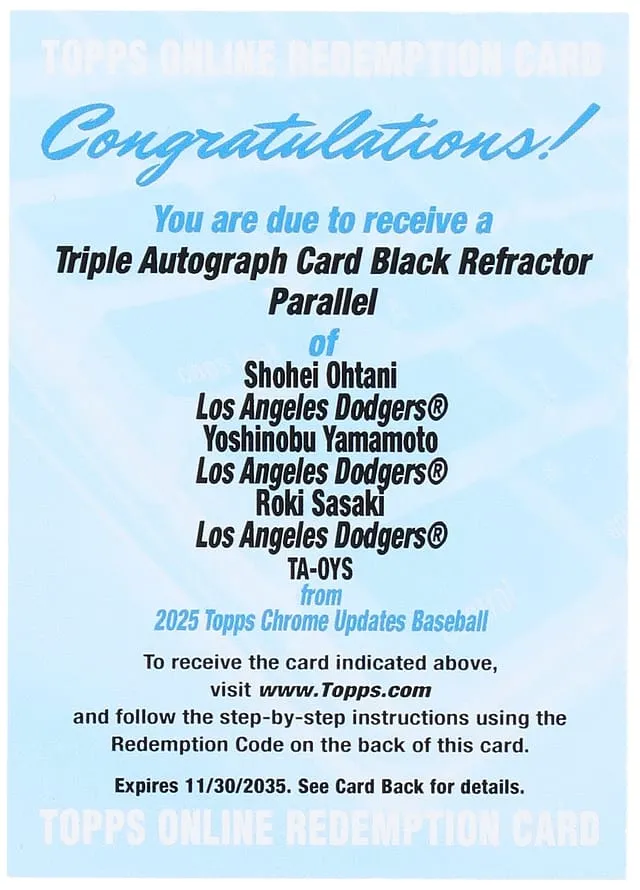
Ohtani/Yamamoto/Sasaki Triple Auto /10 Sells for $16K
Goldin sold a 2025 Topps Chrome Update Ohtani/Yamamoto/Sasaki Triple Autographs Black Refractor /10 redemption for $16,287. Here’s the market context.
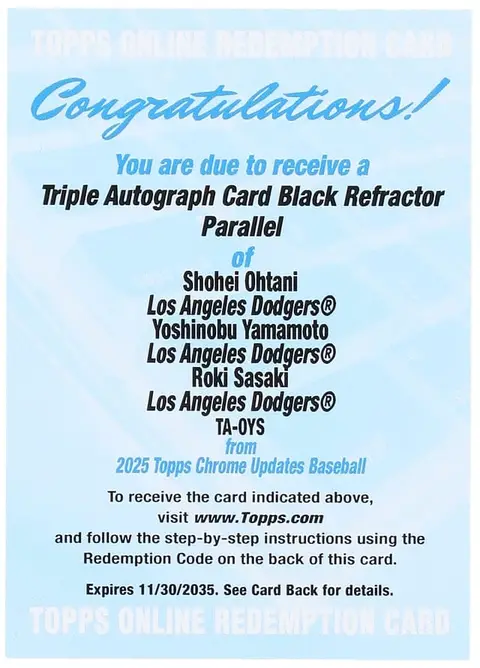
Sold Card
2025 Topps Chrome Update Triple Autographs Black Refractor #TA-OYS Shohei Ohtani/Yoshinobu Yamamoto/Roki Sasaki Multi-Signed Card (#/10) Unused Redemption Card
Sale Price
Platform
GoldinA black refractor triple autograph featuring Shohei Ohtani, Yoshinobu Yamamoto, and Roki Sasaki is not the kind of card that quietly slips through an auction.
On March 27, 2026, Goldin closed the sale of a 2025 Topps Chrome Update Triple Autographs Black Refractor #TA-OYS Shohei Ohtani/Yoshinobu Yamamoto/Roki Sasaki Multi-Signed Card (#/10) – Unused Redemption for $16,287.
For modern baseball collectors, this card checks just about every “ultra-modern grail” box:
- Three of the most followed pitchers on the planet
- A scarce black refractor parallel, numbered to just 10 copies
- Multi-signed card configuration
- From a major chromium release (Topps Chrome Update)
Below, we’ll break down what this card is, why it matters, and how this Goldin sale fits into the current market context.
What exactly is this card?
Card details
- Year: 2025
- Product: Topps Chrome Update
- Insert / subset: Triple Autographs
- Parallel: Black Refractor
- Card number: #TA-OYS
- Players: Shohei Ohtani, Yoshinobu Yamamoto, Roki Sasaki
- Serial numbering: #/10 (only 10 copies produced)
- Type: Multi-signed autograph card
- Status: Unused redemption card (the redemption itself, not a graded slab)
As listed, this example is an unused redemption, meaning the winning bidder acquired the redemption card that would be submitted to Topps to receive the actual triple autograph card. In the modern hobby, high-end autographs are frequently distributed this way, especially for multi-signed cards where coordinating signatures can take time.
There is no grading company or numeric grade in the sale description, which is typical for a redemption. Once redeemed and fulfilled, collectors can then choose to grade the physical card.
This is not a rookie card in the traditional sense, but it functions as a key issue for collectors who chase:
- High-end Shohei Ohtani autographs
- Early MLB-licensed Topps autos of Yoshinobu Yamamoto
- One of the first major Topps Chrome triple autos pairing Ohtani with Roki Sasaki
Why collectors care about this card
1. The player trio: Ohtani, Yamamoto, Sasaki
Shohei Ohtani
- The face of modern baseball, now in his prime.
- Two-way superstar, multiple MVP awards, massive global following.
- Ohtani’s on-card autos and low-serial parallels in flagship and chromium products are among the most chased modern baseball cards.
Yoshinobu Yamamoto
- Elite NPB ace transitioning to MLB with significant expectations.
- Early MLB-licensed autographs are closely watched by both prospectors and long-term collectors.
Roki Sasaki
- One of the most electric arms in Japan, known for elite velocity and strikeout stuff.
- Still in NPB, but widely viewed as a potential future MLB headline pitcher.
Putting all three on a single, low-numbered chrome triple autograph gives this card a strong Japan–MLB crossover appeal, combining established superstardom (Ohtani) with two of the most intriguing arms in Japan.
2. Set and era: ultra-modern flagship chromium
2025 Topps Chrome Update sits firmly in the ultra-modern era of cards: highly produced base checklists, but with specific, very scarce premium inserts and parallels.
Within this ecosystem:
- The Triple Autographs insert is a high-end chase subset.
- The Black Refractor parallel numbered to /10 is a premium low-serial version.
Collectors often use terms like “case hit” for the rarest cards in a sealed case of product. While Topps does not necessarily label this exact card as a case hit in official materials, triple autos at this scarcity level function similarly in the practical chase hierarchy: they appear rarely and anchor the top of the product’s hit structure.
3. Multi-signed, low-serial configuration
A few things make multi-signed cards like this stand out:
- Scarcity: Only ten copies of the black refractor /10 exist by design.
- Configuration risk: All three players share the same physical card. Condition sensitivity can matter even more once graded.
- Long-term story: If even one of Yamamoto or Sasaki reaches their full potential in MLB, the narrative around this card gets stronger. If both excel, it becomes a key international pitching piece.
For that reason, this isn’t just another Ohtani auto; it’s a specific snapshot of three overlapping career arcs, captured in one chromium card.
Market context: how does the $16,287 sale fit in?
When collectors talk about “comps”, they mean recent comparable sales used to frame a current price. For this redemption, truly direct comps are limited:
- It is a 2025 release, so population in the wild is still developing.
- This result is for an unused redemption, not a graded, in-hand copy of the card.
- Multi-signed Ohtani triple autos are comparatively rare, and each trio configuration is different.
Based on available public data up through early 2026:
- Other Ohtani high-end autos /10 from recent Topps Chrome style products frequently reach into the five-figure range, with premiums for on-card signatures and compelling co-signers.
- Multi-player Ohtani autos with notable co-signers often command more than similar single-player Ohtani autos at comparable serial numbering, especially when the secondary players have real star or prospect status.
- Yamamoto’s first MLB-licensed autos created early spikes in 2024–2025 products, especially in low-numbered refractors.
- Sasaki’s limited officially licensed autographs and parallels often see sharp bidding because supply is low relative to interest.
Within that overall pattern, $16,287 for this Goldin sale sits in a range that:
- Reflects Ohtani’s established high-end auto market.
- Assigns clear added value for pairing him with Yamamoto and Sasaki.
- Factors in some uncertainty: the buyer still needs to redeem and eventually, if they choose, grade the card.
Because this is a very specific triple auto configuration from a very recent set, there is not yet a long track record of identical prior sales to call any single auction result a “record” in a meaningful way. Instead, this sale is best seen as an early benchmark for:
- High-end Ohtani/Yamamoto/Sasaki triple autos
- 2025 Topps Chrome Update’s top chase cards
Unused redemption vs. in-hand, graded card
Collectors sometimes ask how an unused redemption compares to a graded, in-hand card.
A few practical points:
Fulfillment timeline and risk
The buyer will need to submit the redemption to Topps and wait for fulfillment. Turnaround times can vary. Until the card is in hand, condition and even exact signature placement remain unknown.Condition and grading
Once fulfilled, a mint or gem-mint grade (from companies like PSA, BGS, or SGC) can materially affect market value. At this stage, however, the Goldin sale reflects the redemption itself, plus the perceived odds that the eventual card will be high grade.Collector preference
Some collectors prefer in-hand, slabbed copies (less uncertainty). Others are comfortable buying a redemption if they believe the underlying card is important enough to justify the wait.
In that context, the $16,287 sale is a price signal for the concept and scarcity of this triple autograph as much as for any specific physical card condition.
Why this matters for the broader market
This Goldin result offers a few insights for collectors watching modern baseball cards:
International stars drive multi-player demand
Combining Ohtani with Yamamoto and Sasaki shows how much weight international storylines carry. It’s not just about U.S. MLB stars anymore; cross-league narratives are central to the modern hobby.Ultra-modern chromium still rewards true scarcity
Even in an era of large print runs, clearly defined low-serial parallels like black refractors /10 continue to separate themselves from the pack.Triple autos can be more than a novelty
Historically, some multi-signed cards have been treated as curiosities. When the player selection is this focused and relevant, they become core grails for specific collector segments.Redemptions remain part of the high-end ecosystem
This sale underscores that serious buyers will still chase redemptions when the underlying card is compelling enough, even with added wait and uncertainty.
Takeaways for collectors and small sellers
For collectors:
- If you collect Ohtani or high-end Japanese MLB/NPB stars, this card is a reference point for how the market values premium, low-serial multi-autos.
- For Yamamoto and Sasaki collectors, it highlights how their early and limited pairings with Ohtani may sit near the top of their card hierarchies.
For small sellers:
- This type of sale shows the ceiling for well-marketed, truly scarce, multi-signed cards in flagship chromium products.
- When evaluating your own inventory, it’s useful to separate:
- Mass-produced base and common refractors, from
- Low-serial, high-concept cards (triple autos, key color parallels, and international combinations).
As more copies of the 2025 Topps Chrome Update Triple Autographs Black Refractor #TA-OYS surface—both redeemed and graded—the market will gain additional data points. For now, the March 27, 2026 Goldin sale at $16,287 stands as an early marker for how collectors value this particular blend of star power, scarcity, and international appeal.
If you’re tracking modern high-end baseball, this is one of those sales worth bookmarking and revisiting as Yamamoto and Sasaki’s careers continue to unfold.