Ohtani/Yamamoto/Sasaki Triple Auto #/10 Sells for $12K
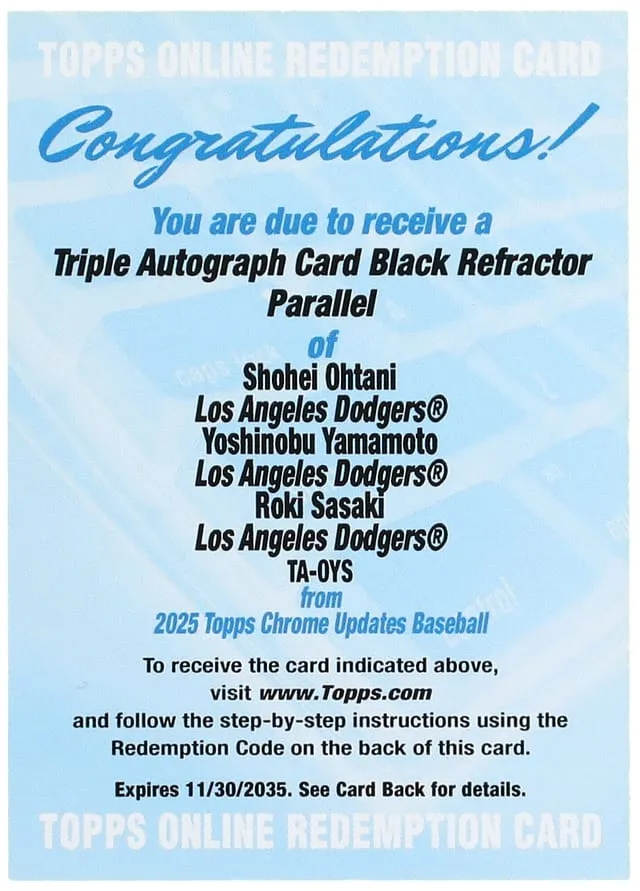
Goldin sold a 2025 Topps Chrome Update Ohtani/Yamamoto/Sasaki Triple Autographs Black Refractor #/10 unused redemption for $12,200 on May 10, 2026.
Sold Card
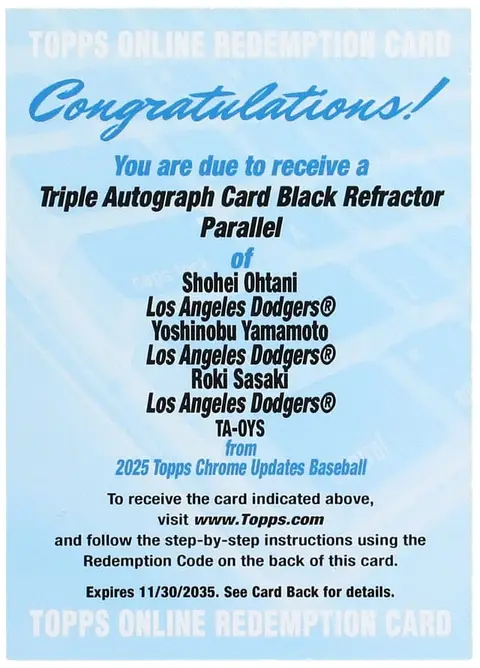
2025 Topps Chrome Update Triple Autographs Black Refractor #TA-OYS Shohei Ohtani/Yoshinobu Yamamoto/Roki Sasaki Multi-Signed Rookie Card (#/10) - Unused Redemption Card
Sale Price
Platform
Goldin2025 Topps Chrome Update Triple Autographs Black Refractor #TA-OYS Shohei Ohtani/Yoshinobu Yamamoto/Roki Sasaki Multi-Signed Rookie Card (#/10) - Unused Redemption Card Sells for $12,200
On May 10, 2026, Goldin closed the auction on one of the more intriguing modern baseball pieces to hit the market this year: a 2025 Topps Chrome Update Triple Autographs Black Refractor #TA-OYS featuring Shohei Ohtani, Yoshinobu Yamamoto, and Roki Sasaki.
The card realized $12,200 and was described as an unused redemption card, serial-numbered to just 10 copies.
Because this is a newly released, ultra-modern issue and a niche configuration (multi-signed, low-serial, and redemption-based), deep public sales history is still thin. That makes this Goldin result a useful early reference point for collectors tracking the emerging market for high-end Japanese star autograph combinations.
Card overview
Here’s how the card breaks down in hobby terms:
- Year: 2025
- Product: Topps Chrome Update
- Card: Triple Autographs Black Refractor
- Card number: #TA-OYS
- Players: Shohei Ohtani, Yoshinobu Yamamoto, Roki Sasaki
- Serial numbering: Limited to 10 copies (#/10)
- Autograph type: Triple autograph (multi-signed)
- Configuration: Unused redemption card
- Category: Ultra-modern, multi-player key issue
Topps Chrome Update is an extension of the core Topps Chrome line that typically focuses on rookies, traded players, and late-season additions. While the flagship (paper) Topps rookie is still the traditional “first choice” for many collectors, Chrome and Chrome Update have become central parts of the modern rookie and autograph ecosystem.
This particular card is notable not just for its scarcity (#/10), but for the combination of players:
- Shohei Ohtani – already established as one of the defining talents of his era.
- Yoshinobu Yamamoto – a highly touted Japanese ace making the jump to MLB.
- Roki Sasaki – an NPB phenom whose future MLB arrival is widely anticipated.
The card in this sale is described as an unused redemption, meaning the physical card with the signatures has not yet been issued; instead, the buyer holds the redemption piece that can be submitted to Topps (subject to Topps’ current redemption policies and timelines).
No third-party grading company (such as PSA, BGS, or SGC) grade is specified for this sale. In the high-end ultra-modern market, graded and slabbed copies frequently command a premium over raw (ungraded) or redemption pieces, but for very low-serial cards, scarcity and player combination can sometimes outweigh the absence of a grade.
What makes this card important to collectors?
1. Three marquee names on one card
Triple autograph cards are naturally niche—some collectors prefer single-player autos—but when the checklist is this strong, they become focal pieces for player collectors and modern high-end builds.
- Ohtani is already a global headliner with a massive collector base in both the US and Japan. His presence on any multi-auto dramatically increases demand.
- Yamamoto has entered MLB with significant expectations, and early performance often drives interest in his first MLB-licensed autographs.
- Sasaki is still in NPB, but his pitching feats and international buzz have made his early licensed signatures and potential MLB rookies a long-term point of interest.
Having all three together on a single, numbered-to-10 Black Refractor is the kind of configuration that appeals to:
- Ohtani supercollectors trying to cover key multi-signature pieces
- Collectors focused on Japanese stars in MLB and NPB
- Modern high-end set builders who chase rare Chrome and Chrome Update autos
2. Ultra-modern, low-serial Chrome parallel
In modern and ultra-modern cards (roughly mid-2010s to present), scarcity is often defined by serial numbering and specific parallels.
- “Black Refractor” signals a more limited print run than base or standard refractors.
- #/10 is a true low-serial tier; once population reports (often called “pop reports,” which track how many copies have been graded at each grade level) start to fill in, it’s likely only a small fraction of the 10 will ever surface in slabs from PSA/BGS/SGC.
This isn’t a flagship base rookie in the traditional sense, but for auto-focused collectors, a triple autograph Chrome parallel like this is closer to a “showpiece” than a typical insert.
3. The redemption factor
A redemption card is a placeholder issued by the manufacturer that entitles the holder to receive the actual card once it is produced and signed. Collectors generally consider:
- Risks: expiration windows, potential replacement if a specific card cannot be fulfilled, and the time delay before receiving the final piece.
- Upside: if fulfilled as intended, the resulting card is usually pack-fresh and eligible for top grades.
In this case, Goldin specifically notes “Unused Redemption Card,” which means the buyer must still complete the redemption process with Topps. Some collectors view unused redemptions cautiously; others see them as an opportunity to control the card’s journey from pack redemption through to grading.
Market context and price comparison
This sale
- Auction house: Goldin
- Sale date (UTC): 2026-05-10
- Realized price: $12,200
- Status: Unused redemption, not graded
Because this is a newly issued, numbered-to-10 triple autograph from a recent Chrome Update release, public sales data is limited. Early transactions like this often serve as benchmarks while the market feels out long-term pricing.
Comps and related sales
For a card this specific—2025 Topps Chrome Update Triple Autographs Black Refractor #TA-OYS Ohtani/Yamamoto/Sasaki #/10—recent public comps are sparse. When a card has only 10 copies, it may be months or years before multiple examples go through major auction houses or large marketplaces.
In situations like this, collectors often look at proxy comps:
- Other Ohtani multi-autograph Chrome or high-end triple autos, especially low-serial parallels.
- Early Yamamoto and Sasaki autograph issues in Topps Chrome and other licensed sets.
- Similar triple autograph cards pairing one established MLB star with two emerging or international standouts, especially in the #/5–#/25 range.
Across those categories, recent ultra-modern, low-serial, on-card triple autos featuring an A-tier headliner (like Ohtani) and strong secondary names have commonly landed in the mid four figures to low five figures, depending on:
- Serial number (e.g., #/5 vs #/25)
- Condition and grading
- Set and brand prestige
- Whether the card is the first or among the earliest licensed autographs with that specific player combination
Within that context, $12,200 for an unused redemption of a #/10 triple autograph with Ohtani, Yamamoto, and Sasaki is consistent with what you’d expect for a premier, low-serial, modern Chrome multi-signature featuring one established global star and two highly followed Japanese pitchers.
It’s not an outlier on the level of record-setting Ohtani 1/1s or logo patch autos, but it does sit firmly in the upper tier of modern multi-auto pricing.
How collectors might think about this sale
This Goldin result offers a few takeaways for hobbyists and small sellers trying to understand where ultra-modern, multi-signature Chrome cards fit in today’s market.
1. Ohtani still anchors multi-signature demand
Multi-autograph cards can sometimes lag behind single-player autos, but when Ohtani is involved, the dynamic changes. His global collector base and ongoing accomplishments keep demand for his premium pieces strong.
Seeing a triple auto reach five figures in unused redemption form underlines how much weight his name still carries, even when sharing space with two other signatures.
2. Interest in Japanese pitching stars is pushing niche configurations
Pairing Ohtani with Yamamoto and Sasaki taps into a specific but growing segment of the hobby:
- MLB fans following Yamamoto’s transition to the U.S. game
- Prospect-style interest in Sasaki’s potential MLB future
- Collectors who build themed collections around Japanese talent
This card essentially packages three separate collector bases into one low-serial piece.
3. Ultra-modern scarcity is still largely about structure
In the ultra-modern era, rarity isn’t just about the serial number; it’s also about how the card is built:
- Triple on-card autos (if this is fulfilled as on-card) are harder and more expensive for manufacturers to produce and coordinate than stickers.
- A #/10 Black Refractor within a popular Chrome release taps into established collector expectations about what “rare” looks like.
Even without a slab and with the added layer of being a redemption, these structural attributes clearly mattered enough to support a $12,200 result.
4. Early results set tone, not destiny
For cards like this with thin sales history, early auction results help form the initial price range, but they do not lock in long-term value.
Future outcomes will depend on factors such as:
- On-field performance of Yamamoto and Sasaki
- Ohtani’s continued production and health
- How many of the 10 copies are eventually redeemed, graded, and brought to market
- Broader shifts in demand for ultra-modern, low-serial Chrome autographs
Collectors and sellers might use this $12,200 figure as a reference point rather than a fixed benchmark.
Takeaways for different types of collectors
For new or returning collectors
If you’re just getting back into the hobby, a card like this illustrates several modern realities:
- Short prints and parallels (like a #/10 Black Refractor) drive a lot of the action in ultra-modern products.
- Autographs and patch autos often sit at the top of the price spectrum, especially when they feature global stars.
- Redemptions are a normal part of the modern landscape; learning how they work and what risks they carry is important as you move into higher-end territory.
You don’t need to chase five-figure pieces, but understanding why a card like this sells where it does can inform how you approach more affordable Chrome autos and parallels.
For active hobbyists and small sellers
If you’re buying, selling, or breaking modern Topps Chrome products, this sale is a reminder that:
- Multi-signature cards can be viable anchors for a break or a high-end showcase, especially with the right mix of players.
- Player combinations matter. A triple auto with one megastar and two strongly followed names can command a different tier of attention than a random trio from the same checklist.
- Documentation helps. For rare cards with light comp history, being able to reference established auction results from houses like Goldin can make pricing conversations easier when you go to sell or trade.
Final thoughts
The 2025 Topps Chrome Update Triple Autographs Black Refractor #TA-OYS Ohtani/Yamamoto/Sasaki #/10 unused redemption selling for $12,200 at Goldin on May 10, 2026 offers a clear snapshot of where high-end, ultra-modern multi-autograph Chrome pieces currently sit.
It’s not a record-breaker, but it’s a strong, data-rich comp in a segment of the market where data is often thin. For collectors tracking Ohtani, following the rise of Yamamoto and Sasaki, or focusing on modern Japanese star cards, this sale is a meaningful reference point—and a reminder of how powerful the right player combination can be when paired with low-serial Chrome design.