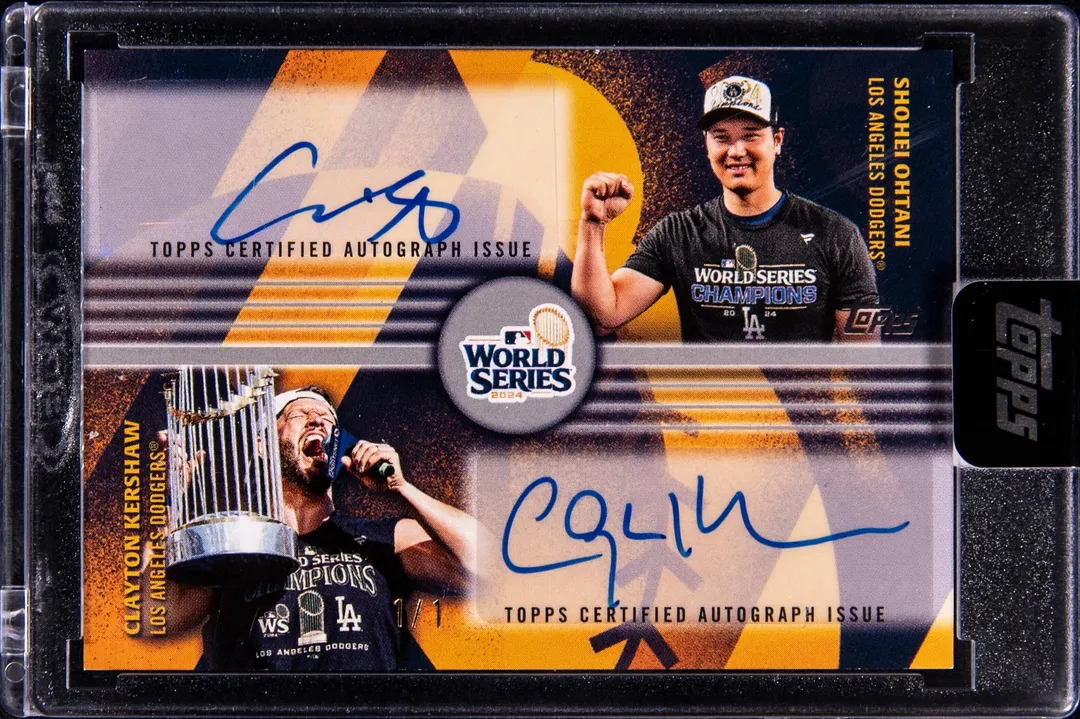
Ohtani & Kershaw 1/1 World Champion Dual Auto Sale
Breakdown of the 2025 Topps World Champion Dual Autographs Platinum 1/1 Shohei Ohtani/Clayton Kershaw sale at Goldin for $13,420.
Sold Card
2025 Topps Series 2 World Champion Dual Autographs Platinum #WCDA-SC Shohei Ohtani/Clayton Kershaw Dual-Signed Card (#1/1) - Topps Encased - Including Used Redemption Card
Sale Price
Platform
Goldin2025 Topps Series 2 World Champion Dual Autographs Platinum #WCDA-SC Shohei Ohtani/Clayton Kershaw Dual-Signed Card (#1/1) - Market Notes from figoca
On February 8, 2026, Goldin completed the sale of a modern hobby outlier: a 2025 Topps Series 2 World Champion Dual Autographs Platinum #WCDA-SC Shohei Ohtani/Clayton Kershaw dual-signed card, serial-numbered 1/1 and sold with the original used redemption card, for $13,420.
For collectors trying to understand what this card is, why it matters, and how this sale fits into the broader market, this breakdown walks through the key points in plain language.
What exactly is this card?
Let’s start by identifying the card clearly:
- Year & product: 2025 Topps Series 2 Baseball
- Insert subset: World Champion Dual Autographs
- Parallel: Platinum (typically the true 1/1 tier in modern Topps inserts)
- Card number: #WCDA-SC
- Players: Shohei Ohtani and Clayton Kershaw
- Teams pictured: Both in their World Series–winning context (the World Champion branding is the focus, even more than a single team line)
- Serial numbering: 1-of-1 (the only copy of this Platinum version)
- Autographs: Dual autographs (two signatures on one card)
- Configuration: Topps encased, indicating it was sealed by Topps at the factory in a tamper-evident holder
- Redemption status: Includes the used redemption card from the original pull
- Rookie or key issue? Not a rookie card for either player. This is a high-end, modern dual-auto insert rather than a flagship rookie.
No third‑party grading company (like PSA, BGS, or SGC) is mentioned in the sale details, so the key attributes here are:
- It is a pack-issued, Topps-encased card.
- It is the Platinum 1/1 version of this dual auto.
- It includes a Topps-issued, dual on-card or sticker auto (Topps series dual autos are often stickers, but the sale notes don’t clarify the medium).
Why this dual matters to collectors
On its own, a flashy 1/1 doesn’t automatically make a card important. What pushes this card into a different lane is the pairing and the theme.
Two modern World Series icons on one card
- Shohei Ohtani is modern baseball’s defining two-way star, now a multiple-time MVP and a central figure in every modern high-end release.
- Clayton Kershaw is the dominant starting pitcher of his era, a future Hall of Famer, and already a core PC (personal collection) name in the hobby.
Putting them together on a World Champion–branded dual autograph from a flagship Topps release checks several boxes:
- Star power on both signatures – no “weak” side of the dual.
- Narrative appeal – the World Champion title ties the card to postseason and legacy rather than just regular-season stats.
- Cross‑collector reach – Ohtani collectors, Kershaw collectors, Dodgers/postseason collectors, and 1/1 modern chasers can all reasonably target this card.
Modern, ultra‑modern, and why that matters
This card falls into the ultra-modern category (roughly mid‑2010s onward), where:
- Serial‑numbered inserts, parallels, and 1/1s are central to collecting.
- Autographs are common, but high‑tier duals featuring two first‑ballot Hall of Fame–level names remain genuinely scarce.
- Condition is usually strong out of the pack, but 1/1s often stay ungraded because the buyer is satisfied with factory encapsulation or prefers to keep the Topps seal intact.
The World Champion Dual Autographs subset is a classic example of modern Topps design: it layers narrative (World Series context) on top of parallel tiers, with Platinum as the perceived top rung.
The sale: $13,420 at Goldin on February 8, 2026
The realized price for this copy at Goldin was $13,420.
Because this is a 1/1, there are no direct “same-card” comparables in the way that there would be for a serial‑numbered /25 or /50 card. Instead, collectors typically look at comps (short for comparables: recent sales of similar items) in nearby categories:
- Other Ohtani/Kershaw dual autos from Topps and Bowman
- Other Ohtani dual autos with Hall of Fame–track pitchers
- Similar flagship-style Topps 1/1 platinum dual autos featuring two stars
Within that framework, a five‑figure sale for a dual World Champion 1/1 doesn’t read as an outlier. It slots into the broader pattern we’ve seen for:
- High‑end Ohtani autos from top-tier brands
- Kershaw premium ink tied to World Series themes or top sets
Exact up‑to‑the‑day comps for this precise card are limited by definition (there is only one copy), but the realized price is consistent with what advanced modern collectors have been willing to pay for Ohtani‑anchored 1/1s paired with other elite names.
Market context: how does this fit into recent trends?
Without speculating, we can outline a few grounded dynamics that help explain interest in a card like this:
Ohtani’s ongoing awards and milestones
As long as Ohtani is adding MVP‑level seasons, elite counting stats, and new milestones, his market has a steady reason to exist. Dual autos that feature him start from a higher baseline than most players.Kershaw’s Hall of Fame runway
Kershaw’s career résumé is essentially complete for Hall of Fame purposes. That gives his key autos a “known floor” in terms of collecting narrative: he is widely accepted as a generational pitcher.Shift toward narrative‑driven inserts
Modern collectors increasingly focus on cards that tell a story—World Series, records, awards—rather than only chasing base rookies. This World Champion dual auto fits that trend.Preference for scarce, clearly defined chase cards
With so many parallels in modern products, clearly defined top‑tier chases like “Platinum 1/1” remain easier for collectors to understand and follow over time.
The Goldin sale doesn’t reset the high‑end Ohtani market, but it does reinforce that dual autos linking current superstars to long‑term greats continue to command premium attention.
The role of the used redemption card
A small but notable detail in this sale is the inclusion of the used Topps redemption card alongside the encased dual auto.
For newer collectors: a redemption card is a placeholder you pull from a pack when the actual card wasn’t ready at packout. You redeem it with the manufacturer to receive the real card later.
In this case:
- The buyer gets the encased 1/1 dual auto, and
- The original used redemption card that started the process.
Some collectors like having the redemption as part of the card’s story—especially with a 1/1—and treat it almost like an additional provenance piece. It doesn’t automatically add monetary value, but it can:
- Make the overall package more complete and appealing to certain buyers.
- Help document that the card came straight from the manufacturer’s fulfillment, not through additional handling.
How collectors might think about a card like this
Again, this is not financial advice, and there are no guarantees in the hobby. But from a collector‑first perspective, this kind of card tends to appeal in a few ways:
- PC cornerstone: For someone who collects Ohtani, Kershaw, or World Series–themed cards, this is the type of item that can sit at the top of a display.
- Long‑term narrative piece: Dual autos that connect generations or eras often age reasonably well in terms of interest, even when prices fluctuate.
- Set or theme build: Advanced collectors building out World Champion or postseason‑themed inserts may view this as a keystone.
Because it’s a 1/1, traditional “tracking the market” over time is tricky—you’re really following similar duals and adjacent Ohtani 1/1s to get context rather than expecting this exact card to have a constant, visible market.
Takeaways for newer and returning collectors
For collectors just getting back into the hobby, here are a few practical points you can pull from this sale:
Not all autographs are equal.
A dual auto of two elite names, tied to a specific achievement (World Champion), usually sits in a very different tier than a random auto from a mid‑tier player.1/1 doesn’t automatically mean unreachable.
Some 1/1s sell for modest amounts; others, like this, command five figures. Player selection, brand, and story all matter.Encased vs. graded.
Factory-encased cards can do very well at auction even without third‑party grading, especially when they’re 1/1s from reputable brands.Comps are a tool, not an answer.
For unique items, you use neighboring sales—similar duals, similar players, similar tiers—to understand where a realized price fits.
Summary
The 2025 Topps Series 2 World Champion Dual Autographs Platinum #WCDA-SC Shohei Ohtani/Clayton Kershaw dual-signed 1/1, sold by Goldin on February 8, 2026 for $13,420, is a clean example of how modern, story-driven, ultra‑scarce inserts behave in today’s market.
It combines:
- Two elite, hobby‑relevant names
- A clear flagship‑Topps identity
- A Platinum 1/1 designation
- Factory encapsulation and the original used redemption card
For active hobbyists, it’s another data point showing that high‑end duals built around Ohtani and established greats remain a central, and closely watched, lane in the modern baseball card market.